Databus Logo
Blog Login →
💰 Society Accounting Module · India 🇮🇳

Double-entry accounting
built for housing societies

Per-unit ledgers, sinking-fund segregation, GST/TDS, asset depreciation, bank reconciliation and Tally XML export. Treasurer and auditor on the same screen — no Excel handover.

One-click balance sheet Auto sinking fund GST & TDS built in Tally-compatible export
Sound familiar?

The accounting failures your spreadsheets keep producing

Each one is a mechanism gap. Each one has a specific fix.

"Our treasurer tracks maintenance payments in three Excel files. Nobody agrees on who has paid."
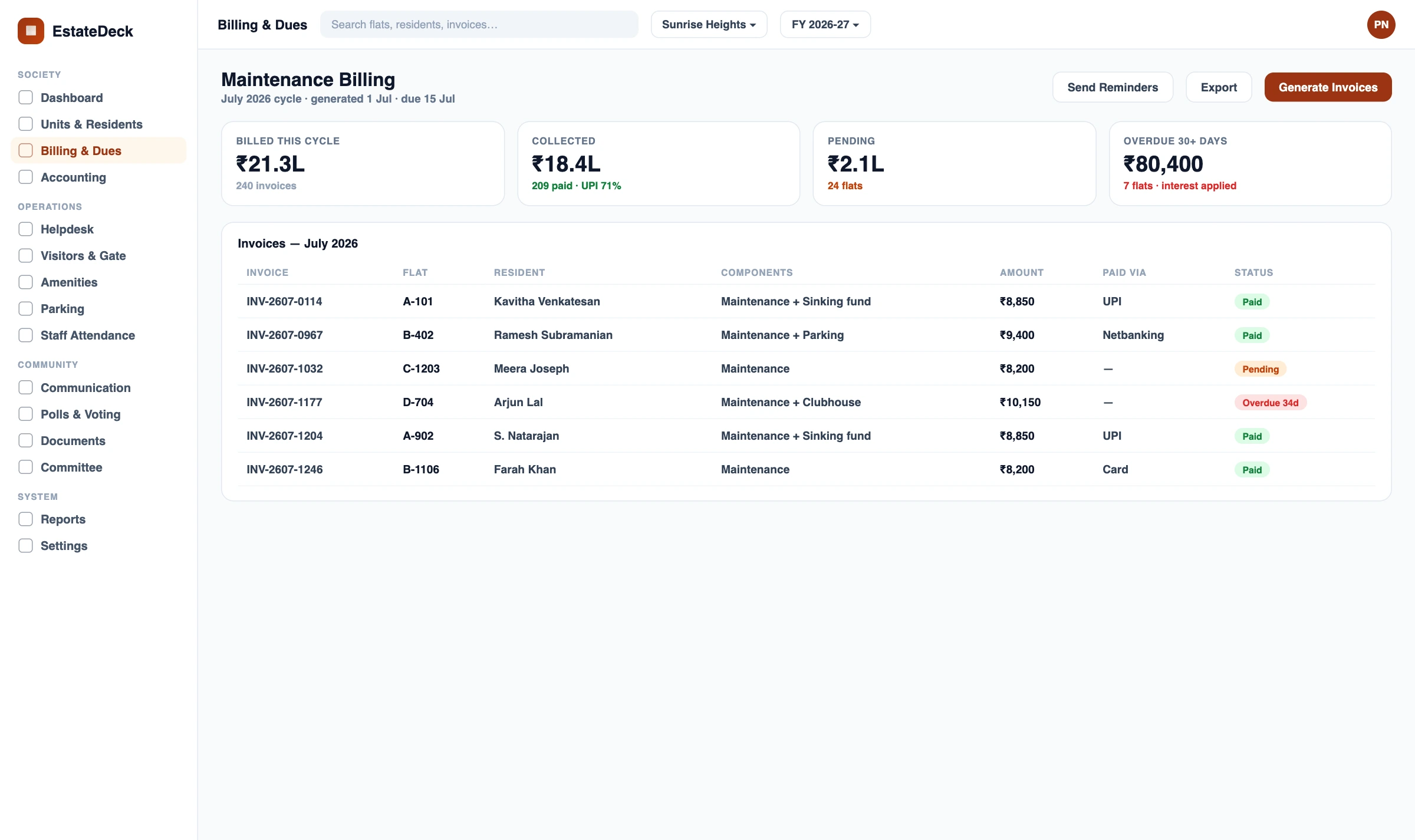
Per-unit ledgers updated the moment a UPI payment lands. Single source of truth.
"Audit time means two weeks of scrambling to compile a balance sheet from old files."
Balance sheet, P&L and trial balance generated in one click. Accurate to today.
"We've collected sinking fund for years. Nobody knows the running balance or which account it's in."
Auto-allocated to a separate ledger mapped to its own bank account. Always knowable.
"We paid the security agency without deducting TDS. Now the CA wants a revised return."
TDS deducted automatically on vendor payments per Income Tax Act § 194-IB.
"The lift cost ₹8 lakh. No one tracked depreciation. It's missing from the balance sheet."
Fixed asset register with SLM/WDV — depreciation journal posts at year-end automatically.
"Bank statement shows a UPI payment we can't trace in our accounts. Reconciliation is endless."
Bank statement upload auto-matches transactions by UTR, amount and date.

🏗️ Fixed Assets & Depreciation

📋

Digital Asset Register

Every high-value society asset — generator, lift, gym, CCTV, furniture — logged in one auditable register from purchase to disposal.

  • Lifecycle data: purchase date, cost, vendor, warranty per asset.
  • Auto-depreciation: SLM or WDV configurable; journal posts at year-end.
  • Balance sheet impact: net book value updated every period.
  • AMC linkage: each asset tied to its contract with 30-day expiry alerts.
📦

Consumables & Inventory Control

Daily consumables — diesel, bulbs, cleaning supplies, stationery — logged in and out so nothing leaves the store without a record.

  • Stock register: inward and outward movement per item.
  • Low-stock alerts: diesel-critical notifications before power-cut season.
  • Vendor mapping: reorder from preferred vendors in one click.
  • Expense integration: each purchase auto-posts to the expense ledger.

🏛️ Sinking Fund & Statutory Compliance

🏦

Sinking Fund Auto-Allocation

State Co-operative Society Acts require sinking funds to stay separate from maintenance operations. EstateDeck enforces this — no treasurer intervention.

  • Auto-allocation: configured % of maintenance routes to Sinking Fund ledger at source.
  • Dedicated bank: ledger mapped to its own bank account — no accidental mixing.
  • FD tracking: corpus FDs, interest accrued, maturity dates — all visible.
  • Withdrawal workflow: committee approval required before any sinking-fund debit.
🧾

GST & TDS Compliance

Indian housing societies have specific GST and TDS obligations. The mechanism handles both — your CA gets clean data, not Excel to untangle.

  • Auto TDS: deducted on vendor payments under Income Tax Act § 194-IB and § 194C.
  • GSTR-ready reports: GSTR-1 and GSTR-3B compatible exports.
  • Challan generation: TDS and GST challans created from EstateDeck directly.
  • ₹7,500 threshold alert: system flags when per-unit maintenance crosses GST applicability.

📊 Reports & Audit Mechanism

📈

One-Click Financial Statements

The four reports every auditor asks for — generated from live data, not assembled the night before the AGM.

  • Balance sheet: assets, liabilities, funds mapped correctly.
  • Income & expenditure: P&L updates in real time per transaction.
  • Trial balance: ledger mismatches caught before external audit.
  • Receipts & payments: standard RWA format ready for AGM packet.
🔄

Bank Reconciliation & Auditor Portal

Match the bank statement to the books automatically — then hand the auditor their own login so they verify without calling the treasurer.

  • Statement upload: PDF or Excel bank statement, auto-parsed.
  • UTR auto-match: transactions paired by amount, date, reference. Unmatched flagged.
  • Auditor portal: read-only login for the CA — all reports, zero edit access.
  • Petty cash vouchers: bill photo attached as audit-proof.
Mechanism comparison

EstateDeck Society Accounting vs. Tally

Tally is general accounting. EstateDeck is RWA-specific. The mechanism differences matter.

Mechanism EstateDeck Tally (general)
Operator skill required Honorary Treasurer — no accounting background Trained accountant
Per-unit maintenance ledgers Auto-created & auto-updated per flat Manual creation & manual updates
Sinking fund logic Built-in auto-allocation rules Manual journal entries every cycle
Asset depreciation SLM/WDV + AMC alerts integrated Basic ledger only — no AMC linkage
GST/TDS compliance Auto-deduction + GSTR-ready exports Manual calculation
Bank reconciliation Auto-match by UTR Fully manual
External auditor access Read-only portal login Share full access or email files
From billing to audit

The four-step accounting flow

Residents pay online

UPI, cards, net banking. Payment posts to the per-unit ledger and the maintenance income ledger instantly.

Expenses recorded

Vendor bills entered with auto TDS. Petty cash with bill photo. Sinking fund auto-allocated.

Bank reconciled

Upload statement. UTR-matched automatically. Unmatched items flagged for review.

Audit closed

Auditor logs in. Balance sheet, P&L, trial balance ready. Sign-off without Excel handover.

Who actually uses it?

Built for every accounting role in the committee

Treasurer

Honorary Treasurers

Record expenses, track dues, close the books each month in under an hour — without accounting knowledge or an external bookkeeper.

Secretary / Chairman

Managing Committee

See real-time financial dashboards — income vs expenditure, dues, sinking fund balance — before every committee meeting.

Chartered Accountant

External Auditors

Log into the read-only auditor portal. Verify vouchers, ledgers and statements. No Excel requests, no office visits.

Large Societies

Multi-Tower Townships

Per-tower maintenance rates, shared amenity costs, multiple bank accounts — one accounting system handles them all.

New RWAs

Newly Formed Societies

Start with a clean structured system from day one — opening balances imported, RWA chart of accounts pre-configured.

Property Managers

Professional Management Firms

Manage accounting for several societies from one login. Separate books per society, unified reporting for clients.

★★★★★

"I took over as Honorary Treasurer two years ago with zero accounting background. The previous treasurer left behind three Excel files that didn't agree on anything. Migrating to EstateDeck Accounting was the first time the sinking fund balance, the bank balance and the books actually matched. Our AGM audit took two days this year instead of three weeks."

Devyani Banerjee
Honorary Treasurer · Garden Heights Co-op Housing Society · New Town, Kolkata
Honest scope

This page is the mechanism, not the workflow

For each adjacent intent, here is where to go instead.

Sibling solution

Want the buyer workflow?

For "close the books in an hour" / "pass the AGM audit stress-free" outcome content, go to /solutions/accounting-finance-management/.

Sibling feature

Just want to collect rent on UPI?

Maintenance Billing handles the collection layer. Society Accounting handles the books layer. Both connect. Go to /features/billing/.

Sibling feature

Tracking vendor AMC contracts?

Vendor & AMC Management handles the contract lifecycle. Society Accounting records the payments. Go to /features/vendor-management/.

Competitor disambig

Replacing Tally entirely?

EstateDeck Accounting runs day-to-day society books. If your auditor still wants Tally output, EstateDeck exports Tally XML — so the society runs on EstateDeck and the CA consumes Tally.

Not what we do

Looking for Zoho Books or QuickBooks?

Those are general business accounting tools. EstateDeck is RWA-specific — sinking fund, per-unit ledgers, ₹7,500 GST threshold logic baked in. Different product category.

Different software

Schools, colleges or coaching?

EstateDeck is property-only. For K-12 schools see SchoolDeck; colleges CampusAlly.

Have questions?

Society accounting software — common questions

What is society accounting software?

Society accounting software is a double-entry bookkeeping system built specifically for housing societies and RWAs. Unlike general tools like Tally, it handles per-unit maintenance ledgers, sinking fund segregation, corpus fund management, and housing-society-specific compliance reports natively — without manual configuration. EstateDeck Society Accounting is one such platform, built for Indian RWAs and aligned with the GST Act 2017 ₹7,500 RWA threshold and state Co-operative Society Acts.

Can EstateDeck completely replace Tally for our society?

Yes. EstateDeck handles day-to-day society accounting with a simpler interface aimed at honorary treasurers rather than trained accountants. If your statutory auditor still prefers Tally, you can export all vouchers and ledgers as Tally-compatible XML files for their use — so the society runs on EstateDeck while the auditor consumes Tally output.

How does sinking fund management work in EstateDeck?

EstateDeck automatically allocates a configured percentage of each maintenance collection to a separate Sinking Fund ledger, mapped to a dedicated bank account. The system also tracks corpus fund Fixed Deposits, interest accrued, and maturity dates, keeping long-term reserves legally ring-fenced from daily operations — required under state Co-operative Society Acts.

Does EstateDeck handle GST and TDS for housing societies?

Yes. TDS is automatically deducted when recording vendor payments under Income Tax Act § 194-IB and Section 194C rules. The system generates GSTR-1 and GSTR-3B compatible reports and alerts you when per-unit maintenance crosses the ₹7,500 / month threshold that triggers GST applicability. Challans for statutory payments can be generated directly from EstateDeck.

Can I give my external auditor a separate login?

Yes. EstateDeck provides a read-only auditor login. Your chartered accountant can view all ledgers, vouchers, and financial reports without being able to edit any data. This eliminates the audit-season ritual of emailing Excel files back and forth between the treasurer and the CA.

Is our society's financial data secure?

Yes. Financial data is backed up daily to encrypted cloud servers. Role-based access ensures only the Treasurer, Secretary, and Auditor can view sensitive financial records, aligned with the DPDP Act 2023 for personal data. You can also export a full copy of your ledgers at any time for your own offline backup.

How does asset depreciation work for the generator and lift?

Register each asset in EstateDeck with its purchase cost, date, and depreciation method (Straight Line Method or Written Down Value). The system calculates annual depreciation automatically and posts the journal entry at year-end — reflecting the accurate net book value in your balance sheet without manual intervention.

Can we migrate existing data and opening balances?

Yes. EstateDeck's onboarding team helps import past member records, outstanding dues, opening balances, and asset register data via Excel templates. Most migrations are completed within the 7–10 day setup window at no extra cost.

What's the difference between Society Accounting and Maintenance Billing?

Maintenance Billing is the collection layer — generating invoices and accepting UPI / card payments from residents. Society Accounting is the books layer — recording every payment and expense, running sinking-fund allocation, depreciation, GST/TDS, bank reconciliation, and producing balance sheets. They are connected — payments flow from Billing to Accounting automatically — but they are separate modules with separate deep pages.

Does EstateDeck handle state-specific RWA regulations?

Yes. EstateDeck's accounting module is configurable for state-specific frameworks including the Maharashtra Co-operative Societies Act 1960, Karnataka Co-operative Societies Act 1959, Tamil Nadu Apartment Ownership Act 1994, Telangana Apartment Ownership Act 1987, and West Bengal Apartment Ownership Act 1972. Sinking-fund percentages, election rules and audit format requirements vary by state — the system supports the format your registrar expects.

Run the books like the
auditor wants them run.

Double-entry, RWA-specific, GST-aware. No spreadsheets, no scrambling at AGM.

Live in 7 days Opening balances migrated Auditor login included No accountant needed
Book a Free Demo