The day-to-day operations layer for Indian landlords running 1 to 500 residential units. UPI 2.0 rent collection with Auto-Pay mandates · native tenant portal app · DLT-registered WhatsApp reminders · 60+30-day lease-renewal alerts · maintenance ticket gateway · move-in/out checklists. The 1st-of-the-month rent collection that used to take a week now finishes before lunch.
What this page covers: day-to-day residential ops for one property. For e-stamped lease lifecycle, full maintenance workflow, per-property P&L and Tally export, or portfolio rollup across 10+ buildings, follow the linked solutions.
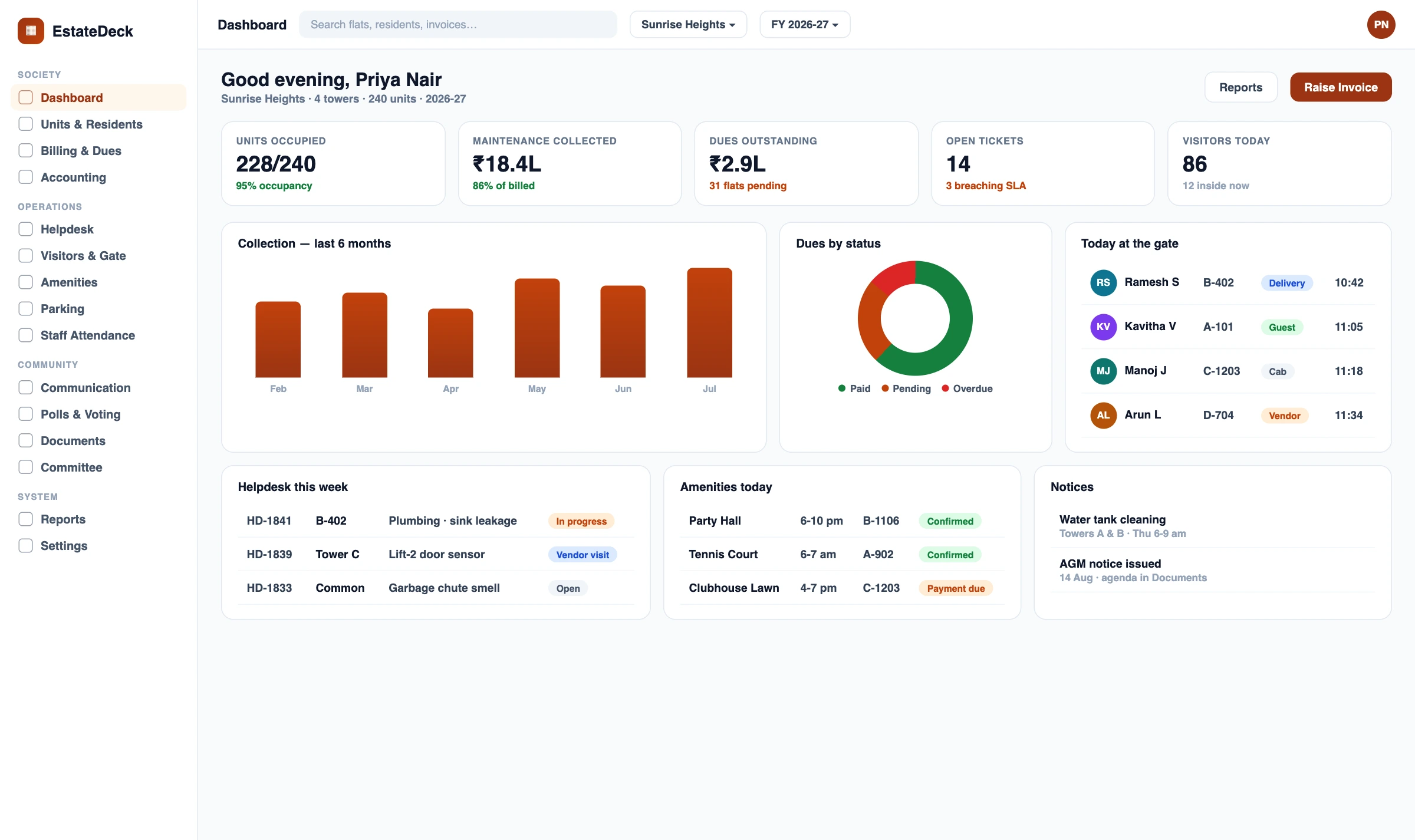
Residential property management software is the day-to-day operations layer for Indian landlords and small property managers running 1 to 500 residential units. The core workflow is UPI rent collection — auto-generated rent demand on the 1st of every month, residents pay via UPI 2.0 intent handover to PhonePe / Google Pay / Paytm / BHIM, the per-property ledger updates in real time, and GST-compliant receipts auto-issue within 3 seconds. The software also covers the resident-facing tenant portal (rent, maintenance tickets, visitor pre-approval, amenity booking), lease renewal alerts, and move-in/out operational checklists. Deeper workflows like the e-stamped lease lifecycle and per-property P&L are handled by separate EstateDeck modules — this page is the coordinator that sits at the centre.
This page is the day-to-day operations stage. The other four stages have their own dedicated EstateDeck pages. Picking the right one is what stops you from running everything through one bloated tool.
Post the vacant flat to MagicBricks, 99acres, Housing, NoBroker + microsite.
Listings Showcase →e-Stamped lease, deposit ledger, renewal cadence, escalation clauses.
Lease Management →UPI rent · tenant portal · renewal alerts · maintenance gateway · move-in/out.
You are here →Resident ticket → vendor assignment → completion photo → sign-off + cost.
Maintenance →Per-property P&L, §24 House Property, §194-IB TDS, Tally XML export.
Accounting →A real Friday morning at a Visakhapatnam residential building, told in the order it actually unfolded.
Every small Indian landlord loses the first week of every month to the same four leaks. None of them are tenant problems — they're tool problems.
UPI here, Google Pay there, cheque from Mr. Sharma, NEFT confirmation from Mrs. Pillai, cash from the senior couple. By the 5th of the month no one is sure who has paid and who hasn't. The reconciliation takes longer than the collection itself.
Sending bulk rent reminders from a personal WhatsApp is a TCCCPR 2018 violation waiting to happen — escalating fines from May 2025+. Most landlords don't know this until they hit a wall. A DLT-registered utility template is the only compliant path; doing it yourself is a paperwork rabbit hole.
"Sir, my lease ends next week" is the most expensive sentence a landlord hears. By then the tenant has either left or has all the leverage. A renewal alert 60 days out — when there's still time to negotiate, raise, or refresh — is the operational difference between control and chaos.
Generic property software is built for the UPI-native millennial tenant. The 70-year-old retired schoolteacher who has paid by cheque for 18 years gets locked out, or worse, made to feel like an inconvenience. A platform built for India treats cash, cheque, NEFT and UPI as equal first-class payment methods.
UPI rails, TRAI messaging rules, tenancy law, and tax visibility — every operational surface honours the regulatory framework Indian landlords actually have to work inside.
Rent collection rides the UPI 2.0 framework administered by NPCI. UPI Auto-Pay recurring mandates per NPCI's e-mandate framework. PhonePe, Google Pay, Paytm, BHIM, and bank UPI apps all supported via standard intent handover.
The platform respects the Model Tenancy Act 2021 framework (notice periods, security deposit caps, rent revision norms) and accommodates state Rent Control Acts where they apply — Maharashtra Rent Control 1999, TN Buildings Lease and Rent Control, AP Buildings Lease and Rent Control, etc.
WhatsApp Business utility-template reminders are sent under your landlord-DLT Entity ID (TM-XXXXXXXXXX) and Principal Entity registration. Transactional category only. May 2025+ template-category enforcement compliant.
Databus is a registered Meta WhatsApp Business Solution Provider. India per-conversation pricing aligned to Meta's 1 July 2025 India price list. Utility-template approval pre-cleared for residential rent-reminder use cases.
For personal landlords receiving residential rent above ₹50,000 per month from a single tenant, §194-IB requires 5% TDS deduction by the tenant. EstateDeck surfaces the §194-IB note on the receipt and reconciles against Form 26AS — TDS computation itself lives at Property Accounting.
Tenant data — phone, email, ID documents, payment history — is held under DPDP §6 consent. Withdrawal under §13 honoured within 24 hours. Co-owner read access (NRI sons, joint owners) carries its own §6 consent capture for tenant data masked appropriately.
References: UPI 2.0 framework + UPI Auto-Pay e-mandate framework administered by NPCI · Model Tenancy Act 2021 · state Rent Control Acts (Maharashtra Rent Control Act 1999 · Tamil Nadu Buildings Lease and Rent Control Act 1960 · Andhra Pradesh Buildings (Lease, Rent and Eviction) Control Act 1960 · others) · Transfer of Property Act 1882 §105 to §108 · TCCCPR 2018 · WhatsApp Business Solution Provider framework, India price list 1 July 2025 · Income Tax Act 1961 §194-IB · DPDP Act 2023 §6, §11, §13 · Indian Evidence Act §65B (and 2024 BSA equivalent provisions).
Forty-two flats, three vacant, and for years the first week of every month was rent week. My accountant Veera would chase, I would chase, the tenants who paid on time would feel insulted being asked twice. Now the system asks — politely, once, exactly when needed — and I drink chai. By lunch on the 1st I see how the month is going. The senior-citizen tenants who still pay by cheque don't feel singled out; the ledger treats them the same as the UPI Auto-Pay mandate folks. That respect matters more than the software does.
Four buyer profiles, all running 1 to 500 residential units in India.
Above 10 properties across cities you also need the portfolio rollup at Multi-Property Portfolio Management — this residential operations layer remains the daily surface for each individual property within that portfolio.
Five operations make a residential rental month. EstateDeck owns the daily surface of all five and coordinates the deeper workflow where it lives elsewhere.
Rent demand auto-generates against each let unit on the 1st of every month. The resident's EstateDeck app surfaces the rent-due card. When the resident taps Pay Rent, the app uses UPI 2.0 intent handover to launch the resident's chosen UPI app — PhonePe, Google Pay India, Paytm, BHIM, or their bank app. The amount and the landlord's UPI VPA are pre-filled. The resident authorises with their UPI PIN.
The UPI callback returns to EstateDeck with the transaction reference. The per-property ledger updates within 3 seconds. The receivable aging bucket reduces. A GST-compliant receipt PDF auto-issues to the resident's app and email, with the §194-IB TDS note visible where applicable. The landlord sees the payment on their dashboard within the same 3-second window. Three seconds, end to end.
UPI Auto-Pay (recurring mandate) — A resident can set up a one-time NPCI-compliant mandate from inside the app. From the next billing cycle, monthly rent auto-debits on the due date without manual authorisation. The resident can pause or cancel the mandate from their UPI app at any time.
The tenant portal is not a separate app. It is the same EstateDeck app the landlord uses, with the home screen and permissions auto-detected from the resident's role. One installation, four home screens (resident, landlord, broker, vendor) — removing the install-friction that kills resident adoption in most RWA software.
A resident sees: pay rent · rent ledger · raise maintenance ticket · request visitor pre-approval · book amenity slot · read building notices · download lease and rent receipts. The mobile-app form-factor details (offline mode, biometric unlock, low-RAM Android compatibility) live at the mobile-app device-platform page.
Lease expiry alerts fire at exactly the right operational distance — 60 days out (the strategic conversation moment) and 30 days out (the closing moment). The actual renewal workflow — generating the renewal terms, e-stamping the new agreement under IT Act §3A + Aadhaar eSign via NeSL/Protean, refreshing the deposit ledger, applying escalation clauses — runs at Tenant & Lease Management.
The handoff is one tap from the alert. This page surfaces the alert at the operational moment; the lease module owns the legal workflow.
UPI is the dominant rent rail in 2026 India, but not the only one. The platform treats cash, cheque, NEFT, and IMPS as first-class payment methods alongside UPI:
The 70-year-old retired schoolteacher who has paid by cheque for 18 years is not an edge case in this product. She gets the same receipt, the same ledger entry, the same audit trail as the UPI Auto-Pay resident in the next flat.
This page is the day-to-day operations layer for one residential property — the surface landlords and residents touch every day. Four sibling solutions own the deeper workflows; one owns the scale-up layer. Each handoff is intentional.
→ Tenant & Lease Management — the e-stamped lease lifecycle. Aadhaar eSign via NeSL/Protean, escalation clauses, deposit ledger, renewal cadence. The alert fires here; the workflow runs there.
→ Maintenance & Facility Operations — the end-to-end ticket-to-vendor-to-sign-off loop with monthly per-unit cost reports. Residents raise tickets here; the workflow runs there.
→ Property Accounting & Finance — per-property P&L, §24 House Property treatment, §194-IB TDS computation, Tally XML export, owner monthly statements. Rent collected here flows into the ledger there.
→ Property Listings & Showcase — vacancy filling via MagicBricks / 99acres / Housing / NoBroker syndication. When a flat falls vacant here, the listing posts there.
→ Multi-Property Portfolio — cross-property rollup for 10–500 unit operators across cities. This residential layer remains the daily surface inside that rollup.
| Monthly task | Spreadsheets + WhatsApp chase | EstateDeck Residential |
|---|---|---|
| 1st-of-month rent collection | First week of every month chasing | 35 of 39 in by lunch on the 1st |
| UPI Auto-Pay support | Manual UPI links every month | NPCI-compliant recurring mandate |
| Reminder compliance | Personal WhatsApp = TCCCPR risk | DLT-registered utility template |
| Senior-citizen cheque tenants | Treated as exceptions | First-class · same audit trail |
| Renewal lead time | Noticed at 7-day mark | Alert at 60 + 30 days |
| Tenant portal | WhatsApp + phone calls | Native Android + iOS app |
| Receipt issue | Manual + late + sometimes never | Auto · GST-compliant · 3 sec |
| NRI co-owner visibility | Monthly WhatsApp summaries | Read-only · live · DPDP §6 |
| Reconciliation | 3–7 days into the next month | Real-time per UPI confirm |
| Audit trail per payment | None | §65B-admissible per receipt |
Ten direct answers. Each maps 1:1 to the FAQPage schema for AI search.
See a real 1st-of-the-month rent collection morning end-to-end — UPI Auto-Pay, manual UPI, DLT WhatsApp reminders, cheque payers — in a 20-minute walkthrough on your own building data.
EstateDeck by Databus · Chennai · Built for Indian landlords and small property managers · 1 to 500 unit portfolios


