Three taps on your phone — pick a category, snap a photo, send. EstateDeck auto-routes the ticket to your society's plumber, electrician or housekeeping. The SLA timer starts. If the ticket sits, the escalation matrix wakes up. No phone calls. No chasing.
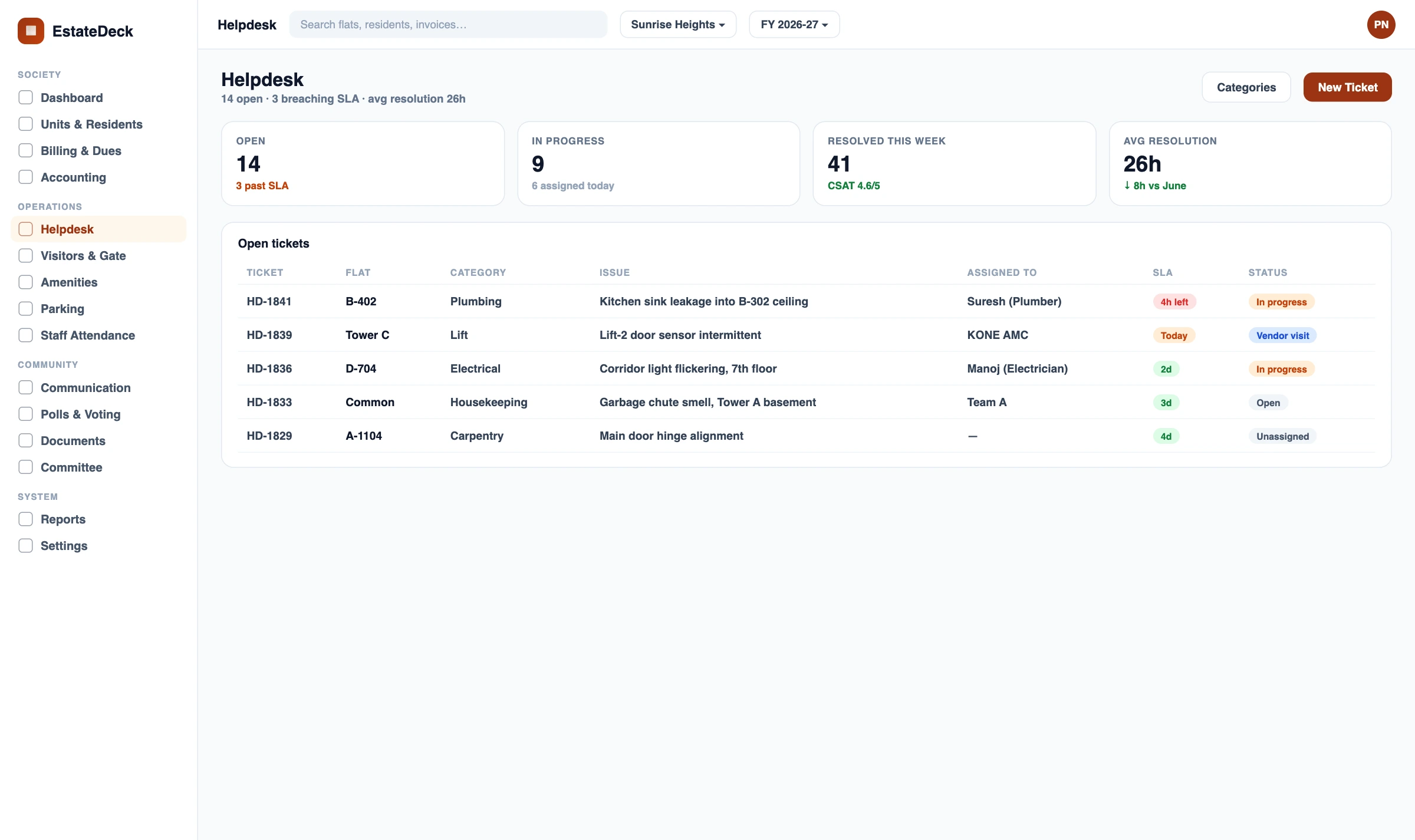
A society maintenance helpdesk app is a digital ticketing system that lets residents raise complaints — plumbing, electrical, carpentry, housekeeping, security or common-area issues — from their phone, attach a photo or voice note, and track resolution. EstateDeck auto-routes the ticket to the right in-house staff or empanelled vendor by category, starts an SLA timer, runs a multi-level escalation matrix if the ticket sits, requires staff to post a before-and-after photo on resolve, and asks the resident to rate the work. The ticket trail is admissible under IT Act 2000 Section 65B if a deficiency-of-service complaint ever escalates under the Consumer Protection Act 2019.
Mehul Patel is the Hon. Joint Secretary for Maintenance at Riverside Greens Co-operative Housing Society in Naranpura, Ahmedabad — 380 flats, four towers, 14 in-house facility staff (2 electricians, 3 plumbers, 4 housekeeping, 3 security guards, 2 carpenters), plus three empanelled external vendors. The society is registered under the Gujarat Co-operative Societies Act 1961, with owner-flat governance under the Gujarat Ownership Flats Act 1973.
For three Tuesdays running, the lift in Tower B started juddering between the 8th and 10th floors. Mehul got the same complaint on WhatsApp each week from a different resident. He had no way to know it was the same problem — the messages just looked like three irritated owners. He told each one he'd "look into it". He forgot the first two.
EstateDeck launched at Riverside Greens in early April. In the first four weeks, residents filed 187 tickets across all categories — and 12 of them were "lift juddering Tower B". The system's recurring-issue detection flagged them as the same root issue. Mehul opened a single consolidated work order, attached the 12 ticket trails as evidence, and called the lift AMC vendor (scheduled via Vendor Management) with something better than "a resident said". A motor bearing on the Tower B lift was replaced under the AMC; the juddering stopped.
By month-end, 175 of 187 tickets had been resolved within SLA. The remaining 12 had escalated through the matrix — Mehul saw them, asked his Estate Manager why, and got specific answers. He hadn't been on a single WhatsApp call about maintenance in three weeks.
Three failure modes that every Hon. Joint Secretary for Maintenance has lived through. None of them get fixed by hiring another assistant.
The Estate Manager's phone rings 40 times a day. He says "I'll send someone" to each call. He forgets half of them by lunch.
Lift B has been juddering on Tuesdays for three weeks. Three different residents complained. The Estate Manager logged none of them. You'd have to be a detective to spot the pattern.
The Estate Manager forwarded it to the Supervisor. The Supervisor forwarded it to the Plumber. The Plumber didn't see it. Three days pass. The resident calls again, angrier.
Most steps happen automatically. The resident raises the ticket, the staff resolves it, and the system handles routing, timing and escalation in between.
Tap Raise Ticket. Pick category. Add photo or voice note. Optionally request a preferred time.
System routes to the right staff or vendor by category. Workload-balanced across multiple staff in same category.
Configurable per category. Emergencies in minutes, standard in hours, cosmetic in days.
Assigned staff walks to the flat, fixes the issue, uploads before/after photo, marks Resolved.
1–5 star rating required to close. One-tap reopen if the issue persists within 7 days.
SLA breached? Supervisor at L1 → Estate Manager L2 → Hon. Jt Secretary L3 → Hon. Secretary L4.
Sample ticket — in progress
"Kitchen sink tap has been dripping continuously since last night. Water collecting under the sink. Photo attached."
📷 1 photo · 🎙️ 0 voice notes · 🏷️ Common-area cost? No — In-flat
A photo and three taps. No phone call, no chasing the Estate Manager, no remembering whether you already complained last week.
"Leaking tap in kitchen." Picked from a category, snap of the leak attached, sent in three taps from the resident app.
For lift-stuck, water-main-burst, common-area gas-leak situations — the priority flag puts the ticket at the front of the queue and triggers an immediate alert to the Estate Manager.
Residents can suggest a window when they'll be home. "Please send the electrician between 10 AM and noon tomorrow." The staff app shows the requested window.
The Estate Manager doesn't dispatch anyone. The system does — by category, by workload, by SLA. The escalation matrix wakes up only if the timer is breached.
Plumbing tickets go to the Plumber's app. Electrical to the Electrician. Security to the Chief Security Officer. No manual dispatch needed.
The clock starts the moment the ticket is created. Different categories have different default SLAs, set by your committee to match real staffing.
If the SLA timer breaches a threshold, the ticket escalates automatically. Each level adds a new pair of eyes — and a documented order to act.
A ticket isn't done when staff says it's done — it's done when the resident agrees. And the system learns from every closed ticket so the next one doesn't have to happen.
Staff get the ticket on their phone. They walk to the flat, fix the issue, and post a matching before-and-after photo. The ticket moves to Resolved.
The resident must rate the work 1–5 stars to close the ticket. If the issue comes back within 7 days, one tap reopens it — the original photo history travels with it.
The system surfaces when the same issue keeps coming back — the same flat, the same staff, the same asset. The Tuesday-juddering Tower B lift gets flagged automatically.
Side-by-side on the parts that residents, committees and Registrars actually ask about.
| What matters | EstateDeck Helpdesk | Calling the Estate Manager |
|---|---|---|
| Ticket number | ✓ Permanent TKT-2026-XXXX | ✗ None — "I'll look into it" |
| Category routing | ✓ Automatic by category + workload | ⚠ Manual; depends on who picked up |
| SLA timer | ✓ Configurable per category | ✗ No defined "overdue" |
| Escalation if stuck | ✓ 4 levels — automatic | ✗ Resident has to call again, louder |
| Photo proof | ✓ Before + after on every resolve | ✗ "Done" — take their word for it |
| Reopen if not fixed | ✓ One tap; original history attached | ⚠ Phone again; start from zero |
| Recurring pattern detection | ✓ Same-asset / same-flat / same-staff flags | ✗ Detective work, if anyone bothers |
| Audit trail | ✓ §65B-admissible electronic record | ✗ WhatsApp screenshots, if that |
| Consumer Protection Act 2019 evidence | ✓ Deficiency-of-service trail ready | ✗ Hearsay vs hearsay |
Most maintenance tickets close in days. The ones that don't can end up in a Consumer Disputes Redressal Commission or a Co-operative Court — and the question becomes: what records do you have? EstateDeck builds for that day.
The society-resident relationship can be tested under Consumer Protection Act 2019 deficiency-of-service provisions, particularly for repeated unresolved tickets. The EstateDeck ticket trail is the canonical evidence — every raise, every escalation, every rating timestamped.
Common-area assets — lifts, fire safety equipment, electrical systems — are subject to maintenance norms under the National Building Code 2016 (BIS). The ticket history shows whether NBC-required maintenance happened on schedule and to standard.
Lift Acts apply per state (Maharashtra Lifts Act 1939 + Maharashtra Lifts Rules 2018; similar regimes in other states). Lift tickets — particularly recurring ones — should map cleanly to the statutory inspection log maintained by the AMC vendor.
Every action on a ticket — raise, route, status change, escalation, photo upload, rating, reopen — is captured as a §65B-admissible electronic record. When a maintenance dispute reaches mediation, the trail holds up.
Resident name, flat number, contact phone — collected at ticket raise — are personal data. Consent is captured under DPDP §6 at onboarding and applies to ticket flow. Phase I notified 13 November 2025.
State co-operative society acts (Maharashtra MCS 1960, Karnataka KSCS 1959, Gujarat Co-op 1961, West Bengal Co-op 2006, Delhi DCS 2003) and apartment ownership acts impose a duty on the committee to maintain common areas. The ticket trail evidences performance.
The 40 daily calls drop to 4. Everyone else is ticketing instead of phoning — and the tickets are arriving with photos.
The configured timer runs whether anyone is watching or not. The Hon. Joint Secretary sees breaches the moment they happen.
The Tuesday-juddering lift gets caught after 3 tickets, not 30. The AMC vendor gets a defined work order, not a hunch.
"I called six times, no one came" → check the ticket history. Conversation over. Resident's complaint stands or doesn't, on the record.
Highest-rated staff get monthly recognition. Lowest-rated patterns surface for retraining. RWA gets a performance signal, not gossip.
Last year's tickets, escalations, ratings — exportable for the Registrar or the next committee handover. No reconstruction effort.
40 phone calls a day. Half forgotten by evening. Move to ticketing — Estate Manager handles 4 phone calls a day, and the other 36 issues flow through the auto-routing without him.
Recurring-issue detection flags 12 tickets in 30 days mentioning Tower B. AMC vendor gets a consolidated work order with all 12 photo trails — root cause identified, motor bearing replaced.
Pull the ticket history. Every escalation, every photo, every resident rating timestamped. The Consumer Protection Act 2019 evidence is already assembled — no last-minute reconstruction.
One-year ticket history exportable. Open tickets carry forward with full context — new Hon. Secretary doesn't inherit a black box, just an open list with priorities.
Configure SLA per category. Facility emergency in minutes, standard in hours, cosmetic in days. The escalation matrix wakes up at the right time for each kind of ticket.
The ticket is tagged In-Flat (chargeable, not RWA-paid). Resident sees the rate before the work begins. The invoice generation flow lives in Billing — this page just tags the ticket.
A society maintenance helpdesk app is a digital ticketing system that lets residents raise complaints — plumbing, electrical, carpentry, housekeeping, security or common-area issues — from their phone, attach a photo or voice note, and track resolution. EstateDeck auto-routes the ticket to the right staff or empanelled vendor by category, starts an SLA timer, runs a multi-level escalation matrix if it sits, requires staff to post a before/after photo on resolve, and asks the resident to rate the work. The trail is IT Act 2000 §65B-admissible.
Yes. A photo of the leaking pipe, the cracked tile or the lift display panel saves staff a guessing trip — they bring the right tools. A voice note works well for older residents who prefer not to type. Both attach directly to the ticket and become part of the audit trail. On resolve, staff posts a matching before-and-after photo so the resident can see the work done before closing.
The SLA timer starts the moment the ticket is created. Each category has a configurable default — facility emergencies in minutes (lift stuck, water main burst, common-area gas leak), standard requests in hours, cosmetic in days. The Hon. Joint Secretary or Estate Manager configures the times to match the society's staffing reality. If the timer expires, the ticket escalates.
EstateDeck's escalation matrix is configurable but typically runs four levels. L1: not picked up in 4 hours → Supervisor notified. L2: not resolved in 24 hours → Estate Manager notified. L3: pending 3 days → Hon. Joint Secretary for Maintenance notified. L4: a final notice to the Hon. Secretary. Every escalation is timestamped.
Helpdesk is for maintenance tickets — facility issues both emergency and routine — that flow through a ticket workflow with auto-routing, SLA timing and resolution photos. SOS Alerts is for personal emergencies that need an immediate one-tap escalation to security, the RWA, and optionally an ambulance — a medical event, an intruder, a fire in your flat, an elderly resident who has fallen. Use Helpdesk for the broken lift. Use SOS for the person trapped in the broken lift.
The resident must rate the resolution 1–5 stars to close the ticket. If the issue persists — the tap leak comes back, the bulb flickers again — the resident reopens the ticket with one tap within 7 days. The same staff is typically reassigned with the original photo history attached so they can see what was tried before. A reopen counts against the original SLA and can trigger a fresh escalation cycle.
Not on this page. EstateDeck does track them — but in two specific places. The vendor directory, empanelment, AMC visit calendar, vendor payments and job assignment under an AMC live in Vendor Management. The AMC contract document itself — the PDF, its expiry date, the renewal alert — lives in Document Repository. This page is about the ticket workflow before, during and after an AMC visit; the AMC itself sits with the vendor and document modules.
By default — but the rule is set by your RWA. EstateDeck tags each ticket as Common Area (RWA-paid: corridor lights, lift, lobby plumbing, garden) or In-Flat (chargeable to resident: fan inside your flat, switchboard inside, kitchen tap). Chargeable rates per category are configurable per society. The actual maintenance bill or extra-work invoice is generated by Billing — this page just tags the ticket.
The Guard at the gate or the Estate Manager in the office can log a ticket on the resident's behalf via the Admin Console. The ticket carries the resident's flat number, contact phone and a short note. The resident gets an SMS confirmation with the ticket number even if they don't have the app open. Elderly residents who prefer to call the estate office continue to do so — the ticket gets created on their behalf.
Yes. Every action on a ticket — raise, route, status change, photos, resolve, rating, reopen, escalation — is recorded as a timestamped electronic record. The trail is maintained to be admissible under IT Act 2000 §65B. If a deficiency-of-service complaint reaches a District Consumer Disputes Redressal Commission under the Consumer Protection Act 2019, or if the society audit raises a maintenance question, the ticket log is the canonical record.
Tickets are where issues surface — but vendors, AMC contracts, invoices and notice broadcasts each live on their own module so the boundaries stay clear.
20-minute demo on your society's real ticket flow. No commitment. Setup typically lands within 7 days, including the SLA and escalation matrix configured for your staffing.


