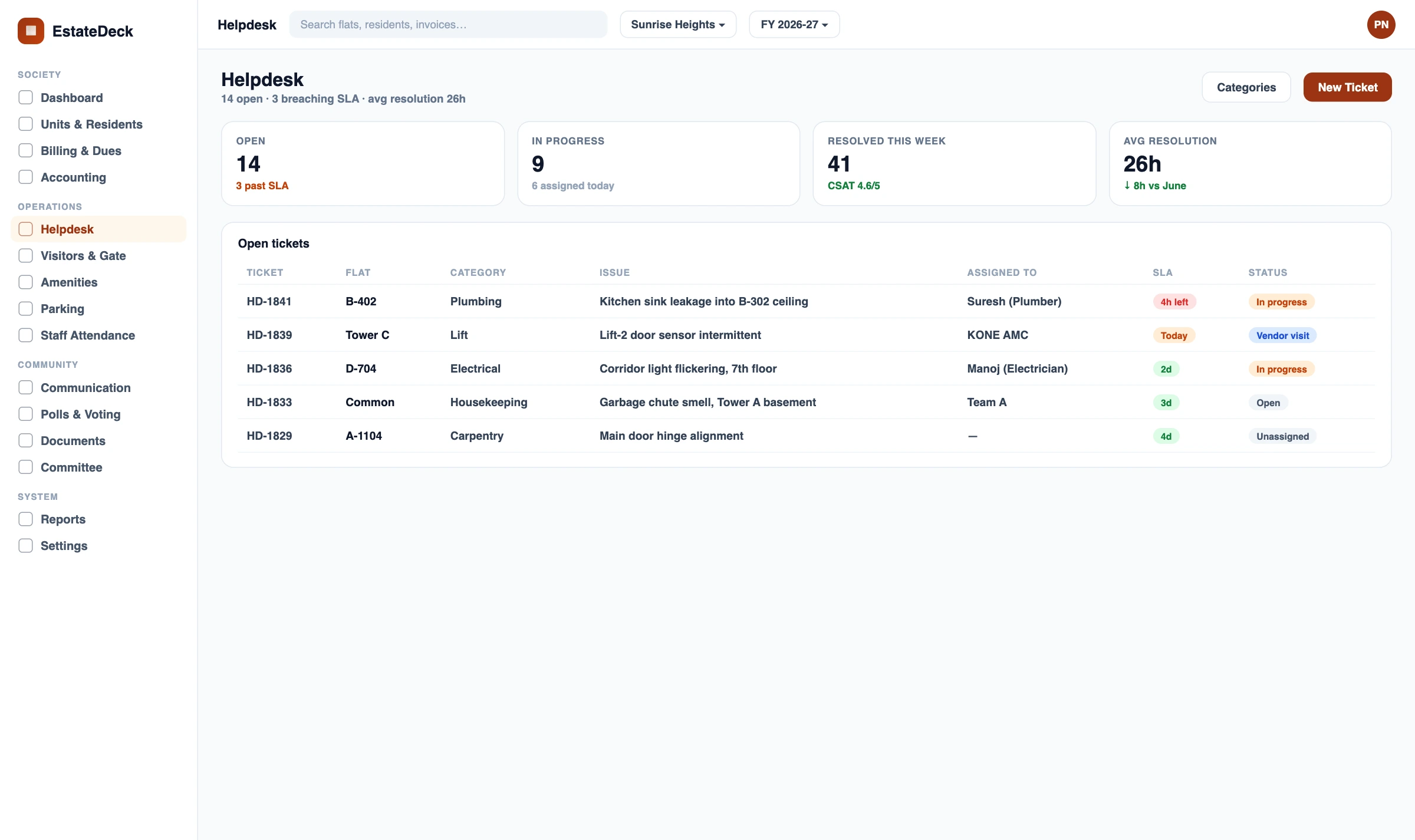
EstateDeck is property maintenance workflow software for Indian housing societies, RWAs, builders and multi-property landlords — the resident raises a ticket via app, the right vendor is auto-assigned, photo proof is uploaded at completion, and the resident signs off before payment. The 47-member maintenance WhatsApp group can retire.
The buyer's mental model. Each step is one feature mechanism; this page coordinates the four.
Tap, photo, voice note — done in 20 seconds. No more calling the Secretary at 11 PM.
Routed by category to a verified vendor — GSTIN, MSME Udyam, PSARA checked. SLA timer starts.
Before + after photos with geotag and timestamp. IT Act §65B-admissible record.
Resident approves in app. Payment routed through maker-checker. §194C TDS-aware.
The walkthrough that defines this product. Real timestamps, real vendor data.
Mrs. Iyer taps Plumbing → photo of the dripping tap → voice note "kitchen sink, dripping since morning, slow drip." Category auto-detected. Ticket #2407 created. SLA: 4 hours (Plumbing-Standard).
System checks the verified plumber directory — Sunil Plumbing Works (GSTIN active, MSME Udyam registered, last job rating 4.6/5, 14-min average response). Push notification + WhatsApp Business utility template fires. Backup vendor on standby if no acceptance in 30 min.
Sunil taps Accept. ETA 11:30 AM. Mrs. Iyer gets WhatsApp: "Plumber assigned. ETA 11:30. Track here."
Guard tablet logs Sunil's entry; photo captured. Vendor's GSTIN + face match against directory. Mrs. Iyer notified. Sunil heads up to B-1402.
Sunil uploads three photos: before (dripping), during (washer replacement), after (dry tap, 30-sec video). Geotag confirms B-1402. Timestamp 12:42:18. Quote: ₹420 (washer + service). Below the ₹3,000 auto-approve threshold.
Mrs. Iyer checks the tap, taps Sign Off, rates 5/5. Payment auto-released to Sunil's UPI VPA the same day. Ticket #2407 closed. Photo log archived for the AGM if needed.
SLA windows, mandatory licences, KYC checks — all defined at category level.
| Category | Default SLA | Mandatory KYC |
|---|---|---|
| Plumber | 4 hours (Standard) | GSTIN MSME |
| Electrician | 3 hours (Standard) · 30 min (Emergency) | GSTIN MSME |
| Lift / Elevator (AMC) | 1 hour (Breakdown) | GSTIN Contract Vendor |
| DG Set | 2 hours (Breakdown) | GSTIN AMC Vendor |
| Fire Safety | Quarterly (Audit) · 30 min (Alarm) | GSTIN CFO licensed |
| Security Agency | Continuous staffing | PSARA GSTIN |
| Housekeeping | Daily schedule | GSTIN MSME |
| Gardener / Landscaping | Weekly schedule | PAN |
| Painter | Quote-based (project) | GSTIN MSME |
| Air Conditioning (AC) | 6 hours (Standard) | GSTIN MSME |
| Pest Control | Quarterly schedule | GSTIN CIBRC reg. |
| Civil Work | Quote-based (project) | GSTIN MSME |
And why that breaks at scale, at audit, and at every committee handover.
Mrs. Iyer's leaking-tap message gets buried under 80 birthday wishes and 14 wedding invitations. The Secretary sees it Wednesday morning. By then the bathroom ceiling has dampness too.
No photo proof. No timestamp. The bill says "lift repair ₹4,200." Was the lift actually serviced? Or did the vendor charge for a 2-minute look-and-leave? Geotagged before-and-after photos answer that.
A leaking tap is 4 hours. A stuck lift is 1 hour. A fire alarm trip is 30 minutes. Without SLA timers, every ticket gets the same lazy "will look into it" response.
The Secretary pays ₹38,000 to a vendor on a personal UPI handle — discovered at the next audit. Maker-checker thresholds with Treasurer sign-off above ₹10,000 prevent this entirely.
Generic ticketing tools handle complaints. Property maintenance needs more.
Resident files a complaint in 20 seconds — category, photo, voice note. No phone calls, no WhatsApp groups, no chasing.
The system routes each ticket to the right vendor — from the verified directory. KYC, GSTIN, MSME Udyam pre-checked at onboarding.
Different repairs need different urgency. A stuck lift cannot wait 4 hours. A clogged drain can. SLAs reflect that.
Every completed job closes with before + after photos, geotagged to the unit, timestamped. IT Act §65B-admissible.
No single individual approves payment. Thresholds split the work between Secretary, Treasurer and President.
At month-end, the Treasurer sees maintenance cost rolled up by flat, by tower, by category. Patterns surface — which tower's plumbing is failing, which lift needs replacement, not repair.
The ticket volume, vendor categories and approval thresholds shift with each. EstateDeck adjusts on its own.
80–500 flats. Resident-driven tickets via app. AMC-linked categories (lift, DG, fire). Treasurer-Secretary maker-checker. Monthly AGM-ready reports.
0–24 months post-handover. Track snag-list completion, defect rectification, contractor accountability. Builder-paid until handover to RWA.
20–200 rental units. Tenant raises tickets per unit. Landlord approves spend per property. P&L impact visible in real time.
Office buildings, IT parks, malls. Tenant ticketing across floors. AMC vendor pools, escalation rules, tenant-paid vs landlord-paid split.
The honest table. Generic ticketing handles helpdesks — not properties.
| What you actually need | WhatsApp group + paper register | Generic ticketing tool | EstateDeck |
|---|---|---|---|
| Ticket with photo + voice note | ~ Lost in chat | ✓ | ✓ Property-aware |
| Vendor auto-assign by category | ✗ Manual call | ✗ | ✓ 12+ categories |
| SLA timers per category | ✗ | ~ Generic SLA | ✓ Lift 1hr, Fire 30min |
| Vendor KYC (GSTIN + MSME + PSARA) | ✗ | ✗ | ✓ Live checks |
| Photo proof + geotag at completion | ✗ | ~ File upload | ✓ §65B audit |
| Resident sign-off before payment | ✗ | ✗ | ✓ Native |
| Maker-checker payment thresholds (₹) | ✗ | ✗ | ✓ Configurable |
| §194C TDS on contractor payments | ✗ | ✗ | ✓ Flagged + auto |
| Monthly per-unit cost reports | ✗ | ✗ | ✓ AGM-ready |
| Vendor mobile app for technicians | ✗ | ~ Generic | ✓ Built for low-tech vendors |
Six frameworks every property maintenance platform in India has to honour. We do the work; you sign the file.
1% for individuals/HUF, 2% for companies. Threshold ₹30,000 per single payment or ₹1,00,000 aggregate per year. Flagged before crossed.
Buyers must pay MSME-registered vendors within 45 days (or 15 days if no written agreement). Income Tax §43B(h) disallows the buyer's deduction past 45 days.
Live GSTIN verification against the GSTN portal at vendor onboarding. Threshold awareness for unregistered vendor cap (₹40L / ₹20L special states).
Private Security Agencies Regulation Act 2005 — only PSARA-licensed agencies can be assigned security category jobs. State licence captured at onboarding.
Every completion photo + geotag + timestamp forms a §65B-admissible electronic record. Holds up in court for vendor billing disputes.
Resident complaint data, vendor personal data captured under §6 consent; purpose limitation enforced per §8(7). Phase I notified Nov 2025; full May 2027.
Down from 2 days in a WhatsApp group. Auto-assignment + SLA timers eliminate the "did anyone see this" delay.
Every payment carries a sign-off + photo proof + maker-checker trail. Auditors stop questioning, residents stop suspecting.
Patterns surface in the monthly cost report. Lift 4 is consuming 60% of building lift maintenance? Time to replace, not repair.
If your question isn't here, the demo will answer it.
Property maintenance workflow software runs the full repair loop for buildings and societies — a resident raises a complaint via app with a photo, the system auto-assigns the right vendor (plumber, electrician, lift technician, DG operator), the vendor uploads a completion photo with timestamp and geotag, and the resident signs off in the app before payment is released.
It replaces WhatsApp groups, paper registers and the Hon. Secretary chasing the same plumber for the third time this week.
EstateDeck routes tickets by complaint category. A leaking tap goes to verified plumbers. A lift breakdown goes to the AMC-contracted vendor first; if they don't respond in 2 hours, the system escalates to a backup vendor. Security agency calls go to PSARA-licensed agencies only.
The granular vendor directory mechanism — KYC, GSTIN validation, MSME Udyam check, AMC visit calendar — lives in our Vendor Management feature page.
A geotagged, timestamped photo at job completion solves three problems at once:
1. It proves the vendor actually came (not just billed for visiting). 2. It documents the work for the resident's sign-off. 3. It forms an IT Act 2000 §65B-admissible electronic record if a dispute arises — useful for the next audit, the next AGM, or the next time a vendor under-quotes and then walks off mid-job.
Yes. Every vendor is onboarded with a live GSTIN check against the GSTN portal, MSME Udyam registration check (for §43B(h) compliance), and PAN verification.
Security agencies require PSARA licence under the Private Security Agencies Regulation Act 2005. Vendors with expired registration get blocked from new job assignments automatically.
EstateDeck uses a maker-checker model with configurable ₹ thresholds — typical setup:
Under ₹3,000: auto-approve. ₹3,000–10,000: Secretary sign-off. ₹10,000–50,000: Treasurer + Secretary. Above ₹50,000: full committee resolution.
The actual ledger entry and §194C TDS computation post to our Accounting module — this page covers the approval workflow, not the bookkeeping.
Income Tax Act Section 194C requires TDS on contractor payments:
1% if the contractor is an individual or HUF. 2% if the contractor is a company. Threshold: ₹30,000 per single payment or ₹1,00,000 in aggregate per financial year.
EstateDeck flags the threshold before it's crossed. The actual TDS computation, Form 16A generation and bookkeeping happen in our Accounting module.
Yes — but the workflow is split for a reason.
The AMC visit calendar (quarterly lift checks, monthly DG service, annual fire safety inspection) lives in our Vendor Management feature page.
The AMC contract document itself, with validity expiry alerts at 30 and 7 days, lives in our Compliance Documents solution. This page coordinates the maintenance loop that those two pages power.
Yes. The resident sees the full journey: ticket raised → vendor assigned (with name and ETA) → vendor arrived (with photo) → work in progress → completion photo → sign-off requested.
Updates fire as WhatsApp Business utility messages via Meta BSP. Residents no longer have to call the Secretary to ask if the plumber is coming.
At month-end, EstateDeck rolls up every maintenance ticket by flat — Flat A-704 had ₹4,200 in plumbing, ₹1,800 in electrical, ₹820 in painting. The Treasurer sees per-unit and per-category totals.
Patterns emerge: Tower B has 3× the plumbing tickets of Tower A, suggesting an underlying pipe issue. This is the reporting layer that the helpdesk and vendor modules feed.
Yes. Vendors accept jobs, view location, upload before-and-after photos with geotag, raise quotes for approval, and submit invoices — all from a simple Android app.
Most vendors are not tech-savvy; the app is built for two-finger typing and audio notes with multilingual UI.
Yes. Every resident's complaint data, vendor's personal information and the photo proofs are stored under the Digital Personal Data Protection Act 2023 — notice and consent at onboarding (§6), purpose limitation enforced (§8(7)), retention configurable per society bye-laws.
Phase I notified 13 Nov 2025; full compliance by 13 May 2027. We're already aligned to the final framework.
Distinct workflows, all feeding the same maintenance picture.
See ticket-to-sign-off run on your own building. 20-minute demo. No card required.


