Hobby academies run on rhythms exam coaching never sees: rolling admissions any week of the year, monthly fees with make-up classes, gradings, recitals and costume money, and parents of six-year-olds who expect a message, not a mark sheet. TutorDesk runs that shape of institute.
Exam-coaching tools assume a cohort marching toward one test date. An academy teaching Carnatic vocals or Bharatanatyam admits in any month, teaches mixed levels in one room, and measures progress in gradings and stage readiness rather than ranks. Forcing that life into test-series software leaves half the screens meaningless; running it on WhatsApp and a register leaves the academy owner doing accounts at midnight before every recital. The fit an academy needs is batches with rolling entry, fees that repeat monthly without retyping, and communication built for parents of young children.
Hobby-class communication is not mark sheets; it is reassurance and logistics. The class happened, your child attended, the recital is on the 14th, costumes need to reach us by Friday, fees for March are due. Academies drown when all of that runs through one teacher's personal WhatsApp: numbers get missed, new staff inherit nothing, and the one channel parents trust leaves with the employee. Announcements, per-child attendance and receipts flowing from the academy's own system, in the academy's name, keep the relationship with the institution rather than the individual, and give the parent of a young child the one thing they actually want from you weekly: evidence of care.
Monthly tuition per art form, sibling discounts that are printed policy rather than counter negotiation, one-off lines for gradings, costumes, instruments and annual-day contributions, and pauses for the exam-season month when half the batch disappears. TutorDesk holds each of these as designed structure: the monthly fee generates itself, the one-offs attach to the same family ledger, the pause is recorded rather than remembered, and every payment, UPI at the counter or transfer from a grandparent, lands against the right child with an instant receipt.
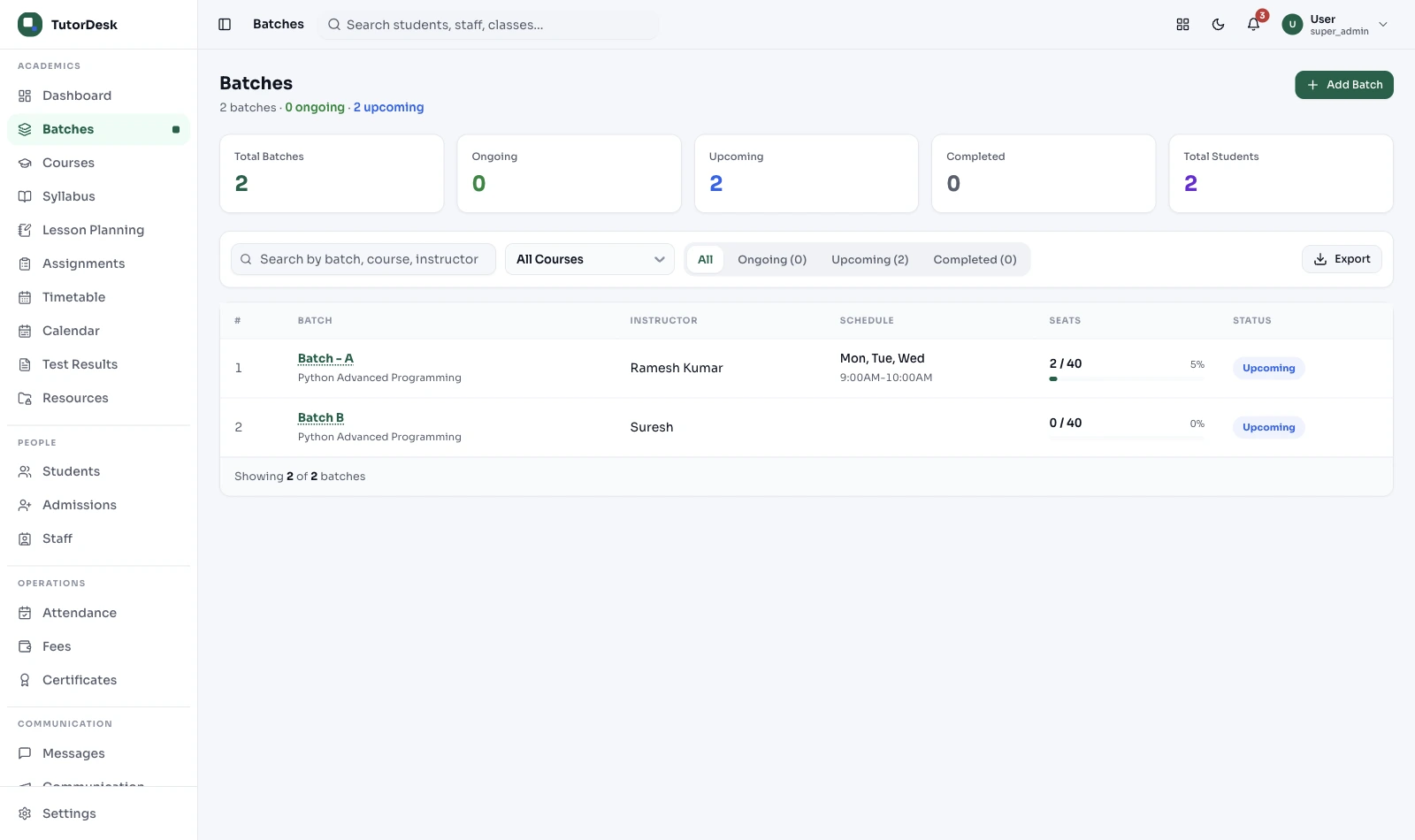
A student can join in August week three; the fee schedule starts from their date and the batch seat count updates itself.
A tap per child per session; the parent of a seven-year-old knows the class happened and their child was in it.
Exam-board grading fees, recital charges and schedules run beside tuition, visible on the same family statement.
Visiting gurus on per-session terms and core faculty on salary, with the load counted from the same timetable that parents see.
Yes. A batch can carry a monthly fee while workshops and grading sessions bill as one-off items, all on the same family ledger with the same receipts, so a student doing weekly tabla plus a summer workshop is one account, not two spreadsheets.
Attendance records make missed sessions visible, and the office reschedules against batch capacity. Academies typically publish a make-up policy, valid within the month, subject to seats, and the seat counts make honouring it practical instead of an argument.
Grading fees, costume charges and recital contributions run as line items alongside tuition, each visible on the receipt. That separation keeps the annual-day accounting clean and the parent conversation honest.
Records live in the academy's system rather than personal phones and chats, with access limited to your staff — the structure India's DPDP Act expects for children's data, and the practical alternative to student lists floating in WhatsApp.
Each art form runs as its own course with its own batches, fees and teachers under one login, so a music-and-dance academy sees each stream's health separately and the family's ledger together.
A 20-minute demo with your batch timings and fee card — set up for a music, dance or arts academy.


