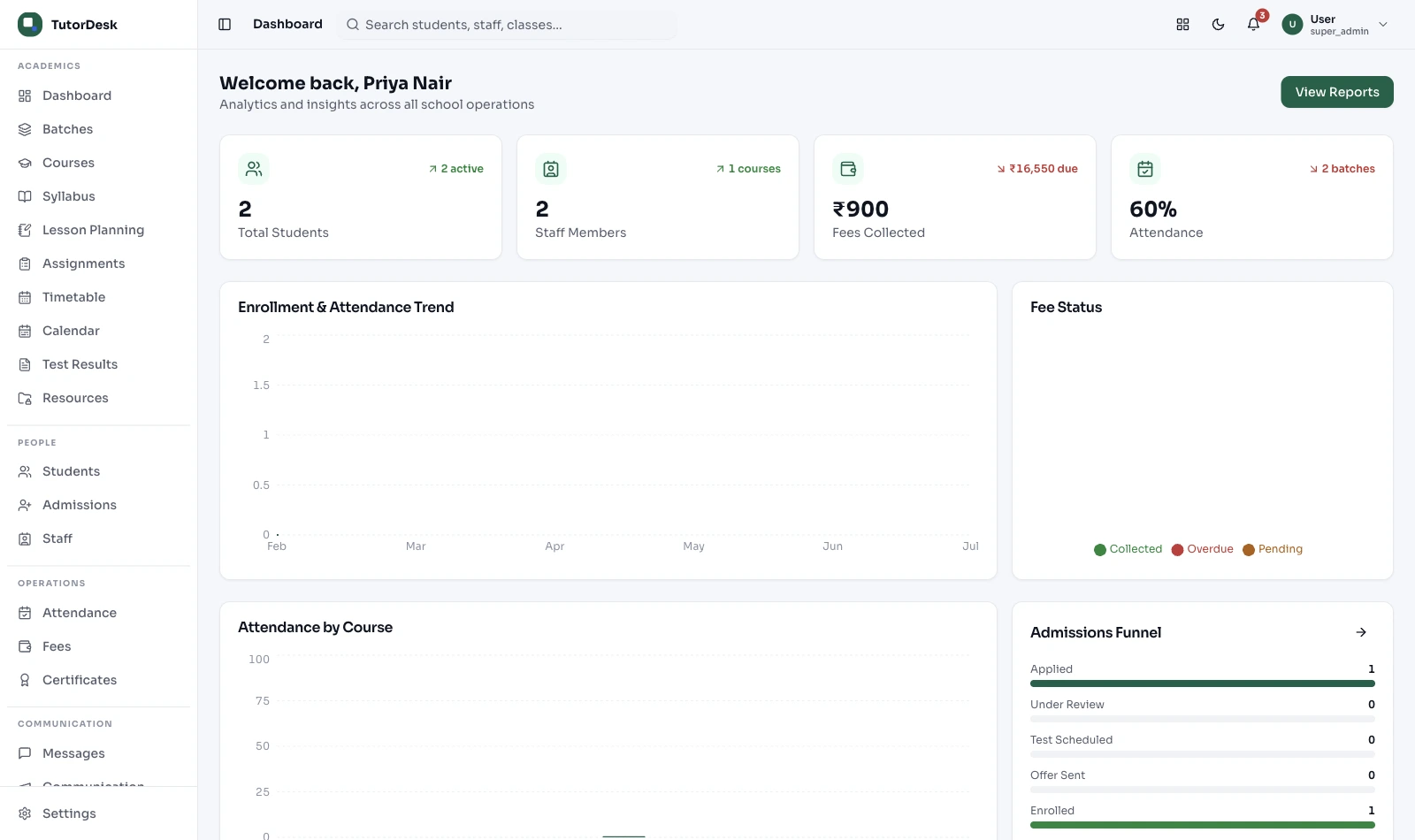
A computer training centre runs a catalogue, not an academic year: Tally this month, typing next, a Python weekend batch, students joining every week. TutorDesk runs the operations underneath — rolling admissions, per-course fees, lab-capacity scheduling, completion records and the certificates that make the catalogue credible.
Nothing about a computer institute maps to June-to-March. A student walks in on a Tuesday, wants the Tally course, and expects to start Thursday. That means enrolment must be per course, batches must open and close on their own cycles, and fees must attach to the course rather than a term. TutorDesk treats every course as its own product — duration, fee, batch calendar — so the front desk can enrol, collect and slot a walk-in into the next starting batch in one sitting, any week of the year.
Short courses stack: the typing student adds Excel, the Excel student adds Tally, the Tally student asks about GST filing. The institutes that grow treat the catalogue as a ladder and track who finished what — because a completion record is a sales lead for the next course. Completion history per student, recorded against real attendance, also protects the thing a training centre actually sells: a certificate that means the course happened. Certificates issued from records, not memory, keep that promise auditable.
Capacity in a computer institute is machines, not chairs. A 20-system lab caps every batch at twenty, and an idle lab hour is unsold inventory exactly like an empty seat. Scheduling batches against lab slots — morning typing, afternoon Tally, evening programming — turns the same room into three revenue streams, and occupancy per slot tells you which courses deserve a second batch. The occupancy calculator works as well for lab slots as it does for classrooms.
Course fees in this segment are modest, frequent and often cash-adjacent — which is precisely why clean receipts and a real ledger matter. Instalments for longer diplomas, one-shot fees for short courses, and automatic reminders for the balance all run through the same collection machinery. If you charge GST on fees, run the maths once on the GST-on-fees calculator and read our plain-English GST guide — then let receipts carry the correct components automatically. The other quiet win of a real ledger is defaults: a student three sessions into a Tally course with a pending balance is a normal Tuesday, and the difference between collecting it and writing it off is whether the reminder goes out automatically or waits for someone to notice. Read the fee-structure guide for how institutes price the catalogue itself.
Most computer institutes market some version of “job assistance”, and the distance between a credible claim and an empty one is records. A placement conversation with an employer runs on evidence: this student completed Tally and Advanced Excel, attended forty-one of forty-four sessions, finished the practical assessments. Completion and attendance histories generated from the system give the placement desk something to send that a certificate alone cannot, and they protect the institute’s name when a candidate falls short — the record shows what was actually delivered. Keep the promise modest, keep the records exact, and the placement claim becomes an asset instead of a liability.
Yes — enrolment is per course and per batch, not per academic year. A walk-in can be enrolled, billed and slotted into the next starting batch in one sitting.
Each course carries its own duration, fee and batch calendar. Short certificate courses, diplomas and weekend batches coexist without pretending to share a term structure.
Completion is recorded against enrolment and attendance, so certificates are generated from records rather than memory — which is what keeps them credible to employers and parents.
Set batch capacity to your machine count per lab slot; live seat counts prevent overbooking and show which slots have room. Idle lab hours become visible — and sellable.
Yes — branches run their own batches, labs and fee collections under one account, with reporting per centre and combined. See the second-branch playbook before you expand.
Updates go to whoever matters — the student themselves for adult learners, parents for school-age students. Receipts, schedules and completion records work identically either way.
A 20-minute demo set up for a computer training centre — rolling batches, lab slots and per-course fees included.


