


HR software for construction firms
Site-wise attendance, daily-wage and contract labour, PF and ESI for the full workforce, and principal-employer compliance tracking.
What does HR software for construction firms do?
It runs attendance, leave and payroll for construction firms — applying PF, ESI and TDS to every payslip and generating upload-ready return files, while handling what makes this industry different: sites, daily wages and principal-employer liability. PeopleDeck prices this per employee, per month.
Sites, daily wages and principal-employer liability
Construction payroll is site-wise: daily-wage labour, contractor gangs and your own staff on the same project. As principal employer you carry PF and ESI exposure for contract labour: the records have to prove compliance.
Construction payroll is really three payrolls wearing one hard hat. Your own staff (engineers, supervisors, office) run on monthly salaries. Site labour runs on daily wages and musters, joining and leaving as phases open and close. And contractor gangs bring the hardest layer: their wages are the contractor's to pay, but as principal employer you carry exposure if the contractor's PF and ESI lapse, and the department will ask you, not them, for proof. A spreadsheet can fake the first layer, struggles with the second, and silently fails the third until an inspection makes it loud. PeopleDeck runs your staff and site labour natively, and keeps the principal-employer evidence — contractor registrations, challan proofs, muster alignment — organised against each site.
How PeopleDeck runs it
- ✓ Site-wise attendance and daily-wage muster rolls
- ✓ Principal-employer records for contractor labour, ready for inspection
- ✓ PF, ESI, professional tax and TDS applied to every payslip — upload-ready return files, never filed on your behalf
- ✓ Self-service payslips, Form 16 data and leave balances for every employee
A month in construction payroll
-
1
Sites open with their own musters
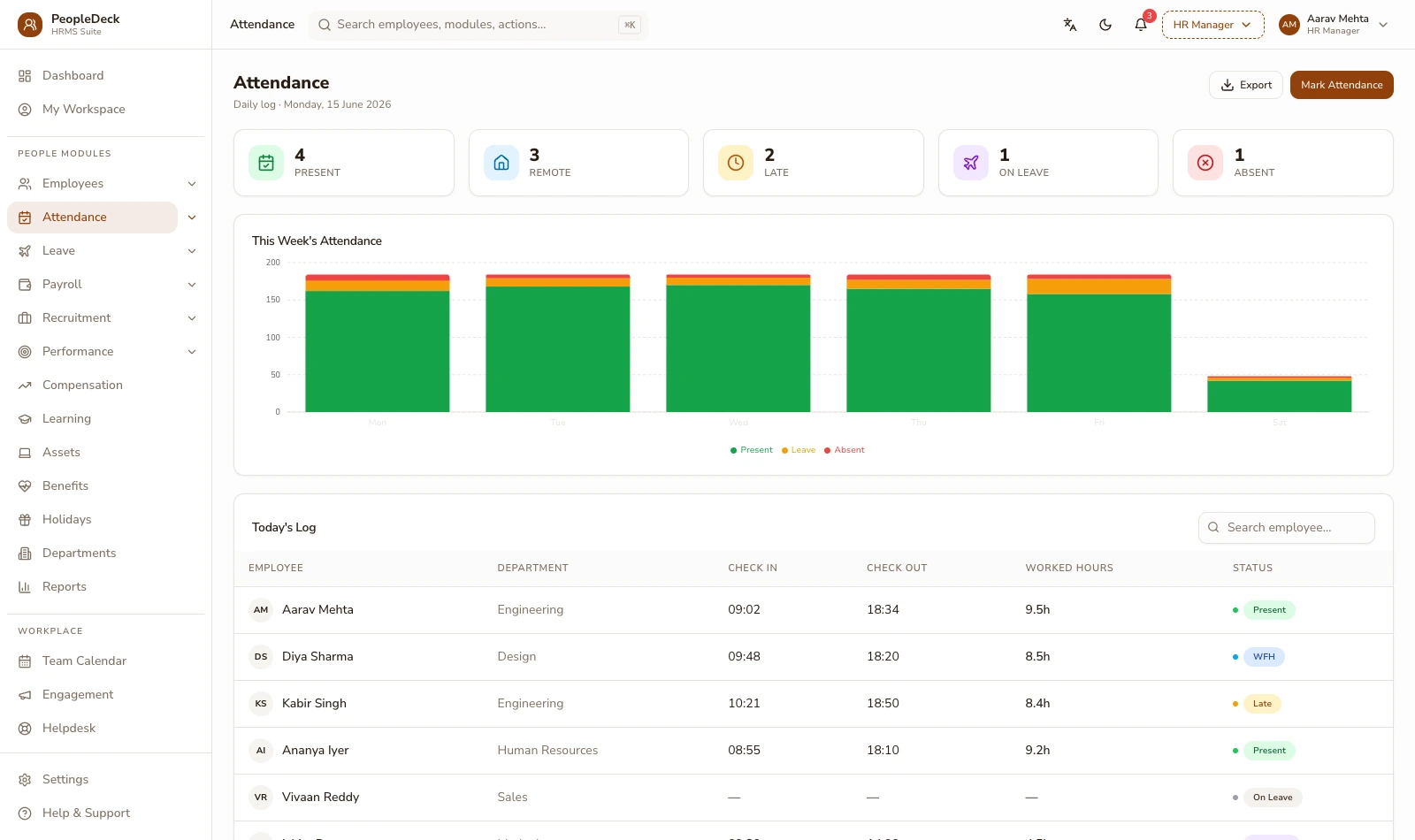
Each project site runs its own attendance — biometric or supervisor-marked musters for daily-wage labour, standard capture for staff. A mason on ₹800 a day at Site A is a different record from the same trade at Site B, because the sites bill differently.
-
2
Phase churn lands as records
Twenty bar-benders join for the slab phase; a dozen leave when it pours. Daily-wage joiners activate with minimal onboarding, leavers settle to the day, and none of it disturbs the salaried run.
-
3
Contractor compliance collected monthly
Contractors upload their ECR and challan proofs against each site as part of the monthly cycle, chased by checklist, not by phone call. Gaps show as red flags on the site's compliance view while there is time to escalate.
-
4
The run pays and evidences
Staff salaries and labour wages compute (daily rates times muster days, overtime per site rules) with PF and ESI applied on qualifying wages, and per-site cost and compliance reports generate alongside the statutory files. What the client's auditor or the labour office asks for is an export, not an excavation.
A worked example
Site A this month: a supervisor on ₹45,000 monthly, and a carpenter at ₹850 a day who worked 23 muster days with four hours of recorded overtime. The carpenter's gross computes to ₹19,550 plus ₹425 overtime, under the ESI ceiling, so contributions apply on ₹19,975; PF applies on the wage per the site's structure. The supervisor's salary runs as standard monthly. Meanwhile the shuttering contractor's gang of 15 appears not on your payroll but in your evidence pack: their contractor's ECR for the month, challan reference, and headcount aligned to your gate register. When the client's compliance audit lands next quarter, Site A answers with a folder generated by the routine, not a fortnight of reconstruction.
Roll the example up to the project: Site A's month closes with staff cost, own-labour wages, overtime and the contractor evidence pack in one report: the same shape the client's quantity surveyor and the labour office both ask for, produced by the month's routine rather than for the occasion. Multiply across sites and the head office finally reads labour cost per project from source records.
Figures are illustrative, for mechanism only; your structures and rates will differ.
Key terms in construction payroll
Principal employer
The party engaging contract labour through contractors — liable if the contractor defaults on PF or ESI. The defence is contemporaneous evidence: registrations, monthly challans, aligned musters, collected before the default, not after the notice.
Muster roll
The daily attendance register for wage labour, site by site. It is simultaneously the wage input, the statutory record and the audit exhibit, which is why it must reconcile with what was actually paid.
Wage-cum-attendance settlement
Daily-wage exits settle immediately: muster days times rate, minus advances, on the last working day. Waiting for a monthly cycle loses the worker, and the paper trail with them.
Is PeopleDeck the right fit?
Built for you if
- ✓ You run multiple sites with site-specific labour and rates
- ✓ Daily-wage musters are the backbone of your wage bill
- ✓ Principal-employer exposure for contractor gangs keeps you up at night
- ✓ Clients or lenders audit your site compliance
- ✓ Phase-driven churn makes joiners and leavers a weekly event
Not the fit if
- ✕ You want project-management or BOQ software. This is the workforce layer
- ✕ All labour is supplied by contractors and you want their payroll run here; their payroll is theirs; your evidence of it is what this holds
Mechanism deep-dives: the payroll engine · attendance & leave · statutory compliance
Switching without a bad payday
Construction firms switch mid-stream — projects do not pause for software. The pattern that works: bring head-office staff onto the system first (a standard monthly run), then migrate sites one at a time, starting with the site whose client audits hardest. Each site's musters move from paper or Excel to captured attendance, its labour rates and overtime rules are encoded once, and one wage cycle runs in parallel before the site cuts over.
Contractor evidence starts accumulating from the first month — registrations, monthly challan proofs, aligned headcounts, so the principal-employer file builds itself site by site. Six months in, the difference is felt at the next compliance notice: the response is an export from the routine, and the site engineer who used to spend audit week reconstructing musters spends it on the site. Retain the muster books from the transition year; inspectors read continuity, and a clean handover from paper to system is itself evidence of good faith.
Not your industry?
Running a school or college? Staff payroll belongs inside your ERP: SchoolDeck staff payroll or CampusAlly payroll.
Related industries
Frequently asked questions
What does HR software for construction firms include?
Attendance and rosters, leave, onboarding to full-and-final, and payroll with PF, ESI and TDS applied to every payslip, plus sites, daily wages and principal-employer liability handled natively. Employees get self-service payslips.
What is principal-employer compliance here?
When contractors supply labour, the principal employer remains answerable for their PF and ESI. PeopleDeck keeps contractor headcount, wages and contribution records site-wise so you can evidence it.
How is PeopleDeck priced?
Per employee per month, in rupees. You pay for the headcount you run, no module bundles, no per-site fees.
Does PeopleDeck file PF and ESI returns?
No; it applies PF, ESI, professional tax and TDS and generates upload-ready ECR and return files. Filing stays with you or your consultant.
How do advances against wages work?
Site advances record against the worker and recover from the next wage computation automatically — visible on the payslip, so the deduction is never a surprise and the site cashbook reconciles with payroll.
Can supervisors mark attendance without connectivity?
Musters capture on mobile and sync when the site finds signal — remote sites stay on the system rather than on paper that gets transcribed, and transcribed wrong, later.
What if a worker moves between sites mid-month?
Their muster days split across sites and each site's cost report carries its share, while the worker gets one payslip. Site-wise billing stays honest without splitting the person in two.
How are weather stoppages and idle days handled?
Marked days record against the site with your pay treatment (paid idle, unpaid stoppage, or transferred muster) so the wage computation and the client's records tell the same story about the week the site stood still.
Payroll for construction firms, without the spreadsheets.
Per employee, per month: attendance to upload-ready returns.
Start free