


HR software for restaurants
Shift attendance, tip and service-charge handling, high-turnover onboarding, and PF and ESI payroll across outlets.
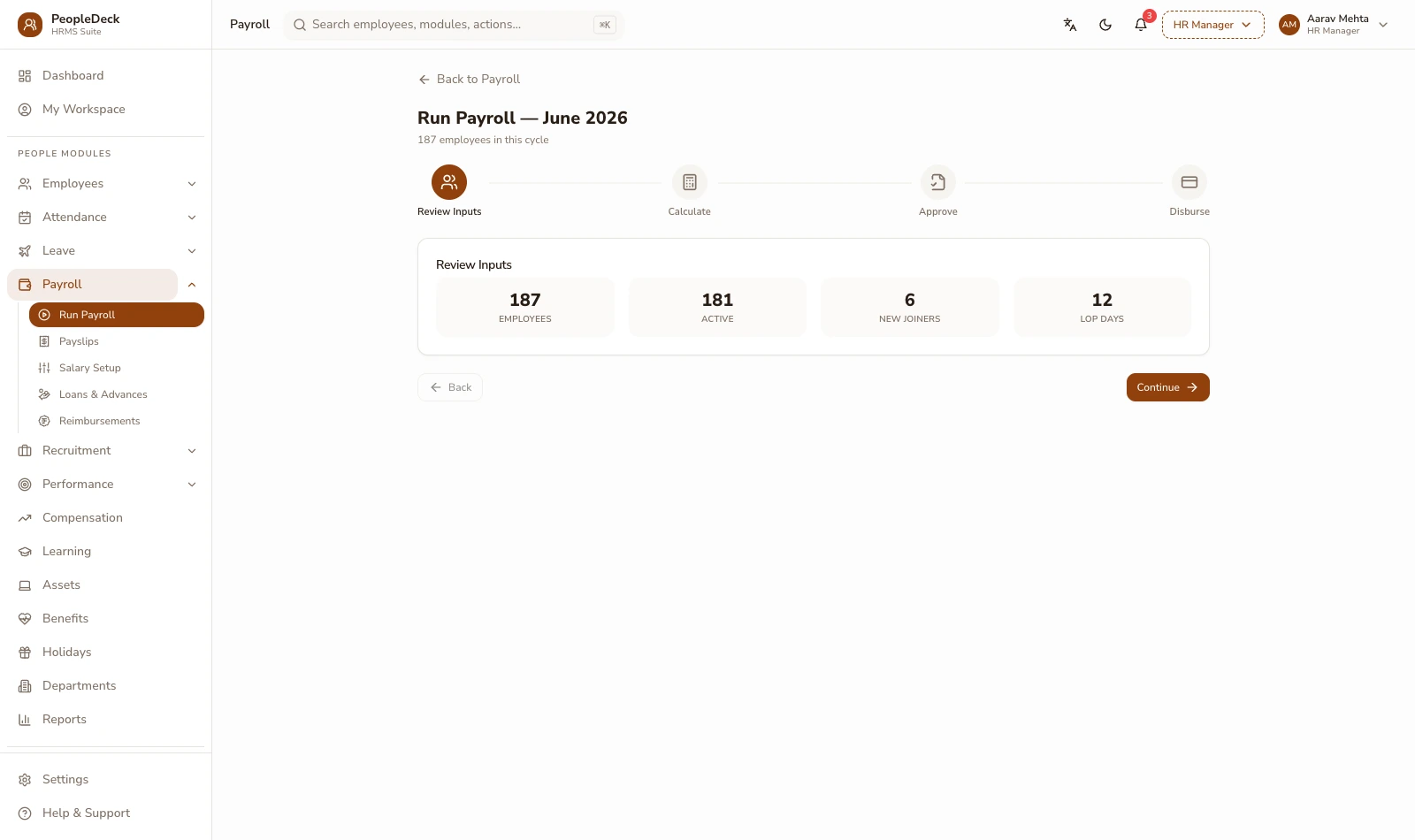
What does HR software for restaurants do?
It runs attendance, leave and payroll for restaurants — applying PF, ESI and TDS to every payslip and generating upload-ready return files, while handling what makes this industry different: tips, service charge and turnover. PeopleDeck prices this per employee, per month.
Tips, service charge and turnover
Restaurant pay is shifts plus tips plus service-charge splits, and the roster changes every week. Add kitchen-to-floor turnover and onboarding becomes a monthly routine, not an event.
Restaurant payroll fails at the edges, not the middle. The middle is easy, a fixed salary for the manager and the head chef. The edges are the twenty-two-day-a-month steward whose roster changed four times, the service-charge pool that must split by points across everyone who worked the fortnight, the delivery-window part-timer, and the commis who joined on the 9th and left on the 26th. Every one of those edges is normal restaurant life, and each one is a manual calculation in a spreadsheet world. PeopleDeck's position is that the edges are the product: rosters that change weekly are the expected input, service-charge distribution is a computed earning, and mid-month joins and exits are pro-rated by the engine rather than by the owner at midnight before payday. The measure of a restaurant payroll system is not the quiet months; it is whether the month with a festival week, three exits and a new outlet opening still closes on one preview, with every edge case carrying its own arithmetic on the payslip.
How PeopleDeck runs it
- ✓ Tip and service-charge distribution recorded per employee, per period
- ✓ Fast onboarding and exits built for high-turnover floors
- ✓ PF, ESI, professional tax and TDS applied to every payslip — upload-ready return files, never filed on your behalf
- ✓ Self-service payslips, Form 16 data and leave balances for every employee
A month in restaurant payroll
-
1
The week's roster is the source of truth
Shifts publish weekly — split shifts, double shifts, the Friday extension. Staff punch against the roster, and the variance between planned and worked is visible daily, while the manager can still fix causes instead of discovering them at month-end.
-
2
Turnover processed as routine
The new commis onboards with a checklist (documents, bank, UAN) and is payroll-ready before their first shift. The steward who quit mid-month gets a computed full-and-final: worked days, pending leave, service-charge share to date.
-
3
Pools distributed by rule
Service charge collected in the period distributes by the point system you define (role weights, days worked) as payslip lines everyone can see. The distribution argument moves from the kitchen to a printed rule.
-
4
The run closes the month
Salaries, pool shares and overtime compute together; PF, ESI and PT apply where wages qualify; payslips publish to phones; upload-ready files generate. The owner approves one preview instead of maintaining one spreadsheet.
A worked example
A steward on ₹14,000 fixed gross works 24 of 26 rosterable days, earns a ₹2,300 service-charge share for the month, and covered two double shifts. The engine pro-rates fixed pay to ₹12,923, adds the pool share and ₹700 of double-shift premium, brings gross to ₹15,923 — inside ESI's ₹21,000 ceiling, so 0.75% employee and 3.25% employer apply to the full wage; PF applies on basic. The payslip shows all four earning lines separately, which matters the day the steward asks why this month differs from last. Meanwhile the commis who left on the 26th receives a same-week settlement: 26 worked days, encashed leave, pool share to exit date, computed, documented, done.
Zoom out to the outlet view: the month's wage bill splits kitchen versus floor versus delivery support, with the service-charge pool shown as a distributed line across all of them. The owner reads labour percentage against the month's sales without building a single formula, and when the second outlet opens, its numbers arrive in the same shape from day one.
Figures are illustrative, for mechanism only; your structures and rates will differ.
Key terms in restaurant payroll
Service-charge pool
The collected service charge distributed to staff by a defined rule. Run through payroll it becomes taxable, visible earnings, which protects the employer the day a dispute or an inspection arrives.
Split shift
One working day in two blocks — lunch and dinner service. Attendance policy pairs the punches so a four-punch day computes as one day, not two half-day errors.
Pro-rata settlement
Pay computed for the exact fraction of the month worked. In high-turnover kitchens this is the most-used calculation in payroll, and the one spreadsheets get wrong most often.
Is PeopleDeck the right fit?
Built for you if
- ✓ Your roster changes weekly and pay follows it
- ✓ Service charge or pooled earnings need rule-based distribution
- ✓ Turnover means joiners and leavers every single month
- ✓ You run multiple outlets under one owner entity
- ✓ The owner currently is the payroll system
Not the fit if
- ✕ You want POS or billing software. This runs the people, not the tables
- ✕ Every worker is informal cash-paid daily, a payroll system needs employees on the record
Mechanism deep-dives: the payroll engine · attendance & leave · statutory compliance
Switching without a bad payday
Restaurants usually switch from a notebook-and-UPI arrangement or from the accountant's monthly spreadsheet. Either way the sequence is identical: get every worker on the record with documents and bank details (the onboarding checklist does the collecting), define the wage rules you actually use (fixed, per-shift, hourly, pool points) and run one parallel month against the current method. The parallel month always surfaces the same two things: informal arrangements that need regularising, and pro-rata arithmetic the spreadsheet had been getting quietly wrong.
Go-live is a payday: payslips reach phones, the service-charge rule is printed policy instead of kitchen lore, and the owner approves a preview instead of computing one. From that month forward, every joiner is fifteen minutes of checklist and every leaver is a computed settlement — turnover stops being a payroll event and becomes a record.
A habit worth adopting at go-live: photograph and file each worker's wage-rule acceptance in their record. In a sector where staff move between outlets and owners monthly, the signed rule beside the computed payslip settles most disputes before they start.
Not your industry?
Running a school or college? Staff payroll belongs inside your ERP: SchoolDeck staff payroll or CampusAlly payroll.
Related industries
Frequently asked questions
What does HR software for restaurants include?
Attendance and rosters, leave, onboarding to full-and-final, and payroll with PF, ESI and TDS applied to every payslip, plus tips, service charge and turnover handled natively. Employees get self-service payslips.
Can it split service charge across staff?
Yes — service-charge and tip pools are distributed per employee and land on the payslip as their own lines, so the split is visible and auditable.
How is PeopleDeck priced?
Per employee per month, in rupees. You pay for the headcount you run, no module bundles, no per-site fees.
Does PeopleDeck file PF and ESI returns?
No; it applies PF, ESI, professional tax and TDS and generates upload-ready ECR and return files. Filing stays with you or your consultant.
Can it handle staff working across two outlets?
Yes — outlets run as locations; a cook covering the second branch punches there and the hours cost to that outlet, while one payslip and one statutory identity follow the employee.
What about part-time and delivery-window staff?
Part-timers run on their own shift patterns with hourly or per-shift wage rules; the engine computes from recorded time exactly as for full-timers, and statutory lines apply where wages meet the thresholds.
Does the service-charge distribution satisfy the 2026 guidance on transparency?
It gives you the mechanics: a written rule, computed shares, payslip lines showing each distribution. Whether and how you levy service charge is your policy call: the system makes whatever you decide provable.
Do minimum-wage rates for restaurant categories apply automatically?
The wage structures you define are checked against the notified scheduled-employment floors you configure for your state and category, computed months that fall short flag for top-up before the run is approved.
Payroll for restaurants, without the spreadsheets.
Per employee, per month: attendance to upload-ready returns.
Start free