


Payroll for remote teams
Employees across states, professional tax that changes at every border, attendance with no office to punch into: all of it computed correctly in one run, with payslips that reach everyone wherever they work.
What makes remote payroll different?
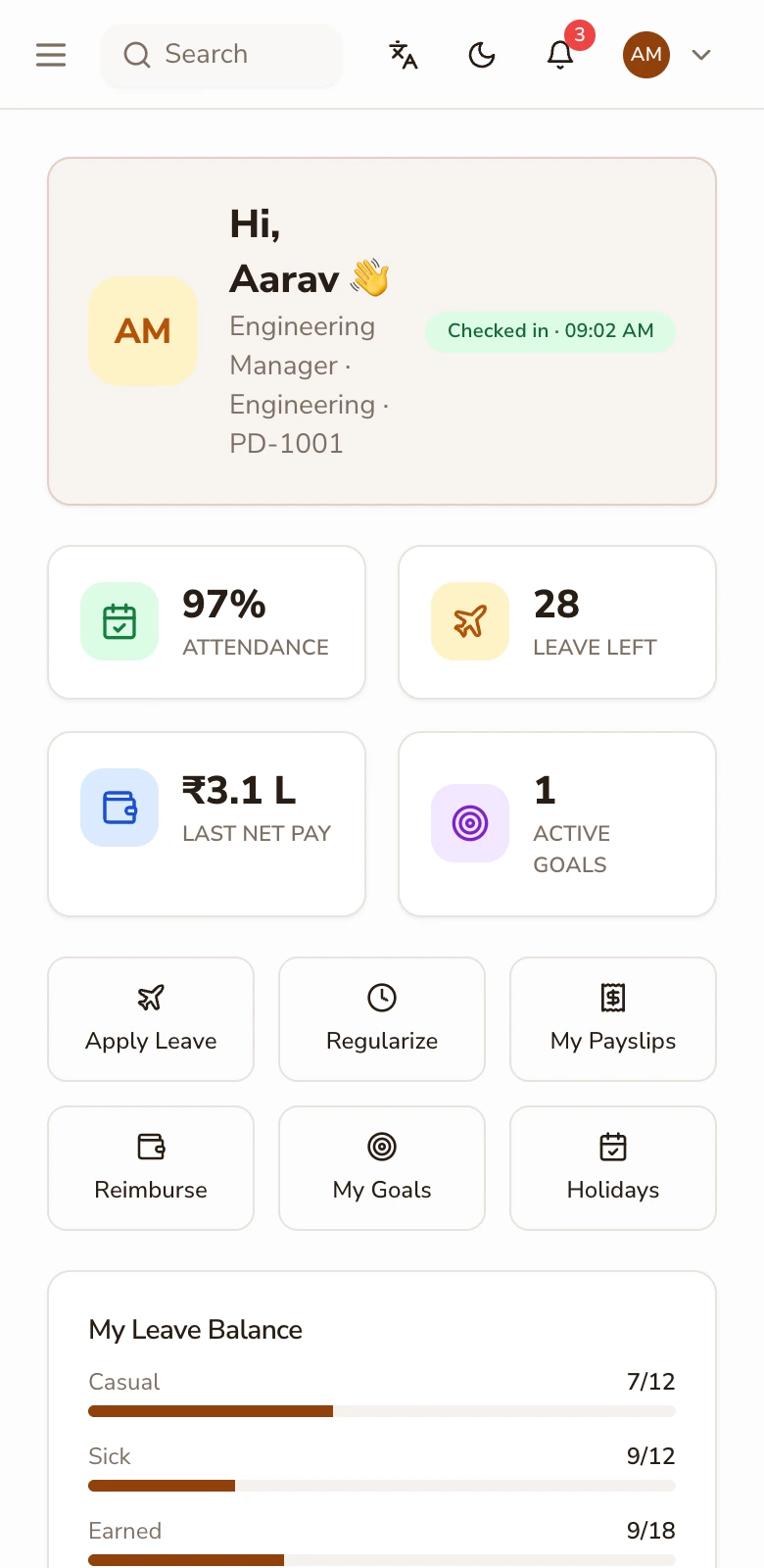
Payroll for a distributed team is ordinary payroll plus geography. Salaries, PF, ESI and TDS compute the same for an employee in Indore as in Bengaluru, but professional tax is a state subject that follows each person's work location, attendance must be captured without shared hardware, and every HR interaction that used to happen at a desk has to happen in an app. PeopleDeck treats work location as a first-class, effect-dated field: it drives each employee's PT treatment, their holiday calendar where you localise it, and nothing else needs to care where anyone sits.
The failure mode this replaces is quiet and cumulative. A spreadsheet payroll built when everyone sat in one office keeps deducting one state's PT for people who moved two states ago; new hires in new states get the founder's home-state treatment by default; and attendance policy becomes fiction because nobody encoded what "flexible" actually promised. None of it hurts until a PT assessment, a labour-department query or a disputed exit makes the records load-bearing. At that point the geography debt comes due all at once.
Professional tax: one team, many regimes
Professional tax is the layer distributed teams get wrong most, because it is the one statutory component that genuinely differs at every border. The same salary carries different PT depending on where its earner works, and "different" includes cadence and mechanism, not just amount:
Monthly slab states
Karnataka, Maharashtra, West Bengal, Telangana, Madhya Pradesh, Gujarat and others deduct monthly by wage slab, with each state's slabs and exemptions its own. The deduction appears on the payslip every month.
Half-yearly assessment
Tamil Nadu assesses professional tax half-yearly rather than monthly, a different rhythm that a monthly-minded payroll misses in both directions, deducting when it shouldn't or missing the assessment when due.
Local-body administration
Kerala routes professional tax through municipal and panchayat local bodies, so the employee's specific location within the state matters, not just the state itself.
No-levy states
Delhi, Haryana, Uttar Pradesh and Rajasthan levy no professional tax at all. The correct treatment for your Gurugram and Noida hires is a payslip with no PT line, which is itself a rule the system must know, not an omission.
PeopleDeck maps each employee's recorded work state to its current treatment and applies it in the run: slab, cadence and exemptions per state, updated when states revise them. A team spread across six states gets six correct treatments on one payday, and the payslip of the employee in Jaipur correctly shows nothing at all.
Running a distributed month
-
1
Attendance without an office
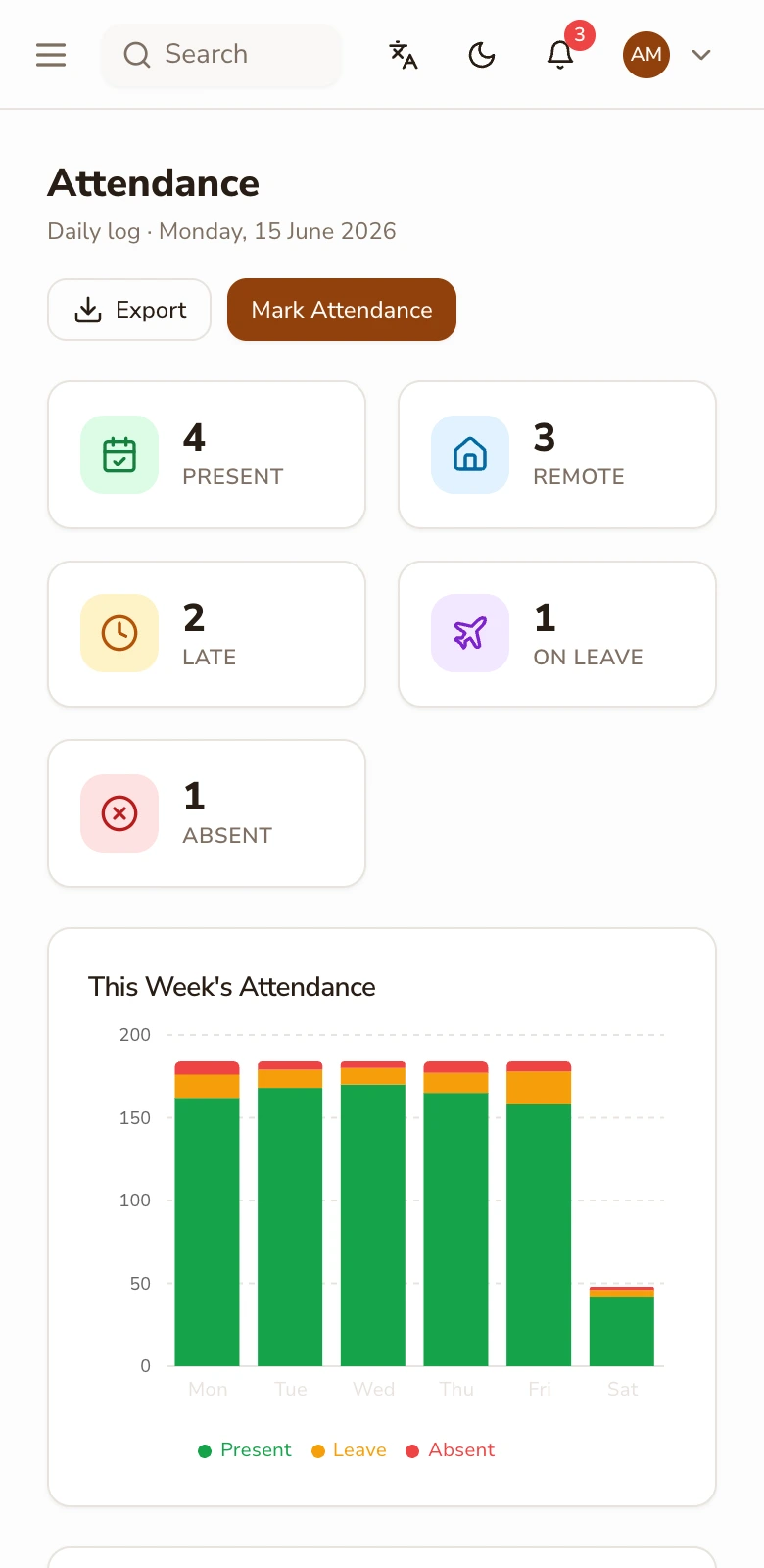
Web and mobile punches (location-stamped where your policy wants it) capture the working day. Policy rules encode what you actually promised: core hours, async days, flexible weeks. The rules evaluate the punches; nobody eyeballs a timesheet.
-
2
Leave and approvals in the same app
Requests route to managers with balances and team calendars attached; approvals happen from anywhere. Regional holiday calendars apply per location where you localise them, so Onam and Chhath both land correctly.
-
3
One run, state-correct
Salaries compute from attendance and structures; PF and TDS apply centrally; ESI applies by wage; PT applies per each person's work state. Several regimes run in one computation, each visible on its payslip's workings.
-
4
Payday reaches everyone the same way
One bank file pays the whole team; payslips publish to self-service; declarations, proofs and reimbursements flow through the same app. The employee experience is identical in a metro and a hill town, which is the point of remote-first.
Mechanism deep-dives: attendance & leave · self-service · statutory compliance
A worked example
A 45-person product company runs its team from Bengaluru, Pune, Chennai, Kochi, Jaipur and Noida. One monthly run applies Karnataka's and Maharashtra's monthly PT slabs to the Bengaluru and Pune staff, holds Tamil Nadu's half-yearly cycle for Chennai, records the Kochi designer's local-body levy, and correctly deducts nothing for Jaipur and Noida. In August, a backend engineer relocates from Pune to Jaipur: her work state changes with an effect date, and her September payslip simply loses its PT line, no ticket, no correction run. In October the company makes its first Hyderabad hire; Telangana's treatment applies from the record, and the offer went out the same week. PF, ESI and TDS computed identically for everyone throughout, because those layers never cared about geography in the first place.
Illustrative scenario. State treatments as currently in force; slabs and cadences follow each state's live rules at run time.
The honest boundaries
Built for you if
- ✓ Your team spans two or more states, or soon will
- ✓ Relocations happen and payroll finds out late
- ✓ Attendance policy should encode flexibility, not pretend office hours
- ✓ Every HR interaction must work without a desk to walk to
- ✓ Hiring in a new state should be a record, not a research project
Not the fit if
- ✕ You need payroll for employees under foreign law. PeopleDeck computes Indian statute; international contractors belong in payables
- ✕ You want activity monitoring of remote workers. This is punches and policies, never surveillance
Two more boundaries worth stating plainly. Remote attendance here means web and mobile punches evaluated by policy, not biometric hardware shipped to bedrooms and not screenshots. And PT compliance means the deduction applied per state and the records kept register-ready; registrations in each state remain an establishment task your consultant handles, flagged early so a first hire in a new state never outruns the paperwork.
Running a school or college with distributed staff? In-ERP payroll lives with SchoolDeck staff payroll and CampusAlly payroll. If you are choosing PeopleDeck as a remote-first company, the buyer's view is at PeopleDeck for remote-first companies.
Primary sources for the figures on this page: Ministry of Labour & Employment · State tax portals via india.gov.in. Verification date is printed beside each figure; maintained by Databus Technology Solutions.
Frequently asked questions
How does professional tax work for a remote team spread across states?
Professional tax is a state levy that follows where the employee works, and every state treats it differently: Karnataka and Maharashtra deduct monthly by slab, Tamil Nadu assesses half-yearly, Kerala routes it through local bodies, while Delhi, Haryana, Uttar Pradesh and Rajasthan levy none. PeopleDeck maps each employee's recorded work state to its treatment, so one payroll run applies several different PT regimes correctly, including the states where the correct treatment is nothing.
How do remote employees mark attendance without a biometric device?
Through web and mobile punches, a login-based check-in, optionally location-stamped per your policy. Attendance policy rules (core hours, flexible days, weekly offs) evaluate the punches exactly as they would device punches, and the result feeds payroll the same way. No hardware ships anywhere.
What happens when a remote employee relocates to another state?
One effect-dated change to their work state re-maps professional tax treatment from the move date. Deductions start, stop or change slab automatically in the next run, with arrears computed if the change is recorded late. The statutory map follows the person; nobody maintains it by memory.
Do PF and ESI change based on where a remote employee lives?
PF is central: the same 12% + 12% on the ₹15,000 ceiling applies regardless of state. ESI applies by wage (up to ₹21,000) with facility coverage administered regionally. The state-sensitive component of a distributed payroll is professional tax, plus state-specific labour welfare fund contributions where applicable, which is exactly the layer PeopleDeck maps per work state.
Can we pay remote employees in different cities from one account?
Yes. One run computes everyone, and the bank transfer file covers the whole team regardless of geography. Payslips, tax declarations, reimbursements and Form 16 data reach every employee through self-service, so payday is identical in Kochi and Gurugram.
Does PeopleDeck support employees working outside India?
PeopleDeck computes Indian payroll under Indian statute. Team members employed abroad under foreign law need a payroll built for that jurisdiction, and international contractors invoicing you are a payables matter, not payroll. The honest boundary keeps your Indian establishment's records clean.
How do investment declarations and proofs work with no office?
Entirely digitally. Employees declare through self-service, upload proofs from wherever they are, and TDS reprojects from approved declarations. The January proof-collection scramble becomes a dashboard of pending items, chased by reminder rather than by desk visit.
Pay your team, wherever they work.
State-wise PT, remote attendance and digital payslips. Per employee, per month.
Start free