


HR software for textile and garment units
Piece-rate and shift wages, large-workforce attendance, PF and ESI applied, and payslips across the factory floor.
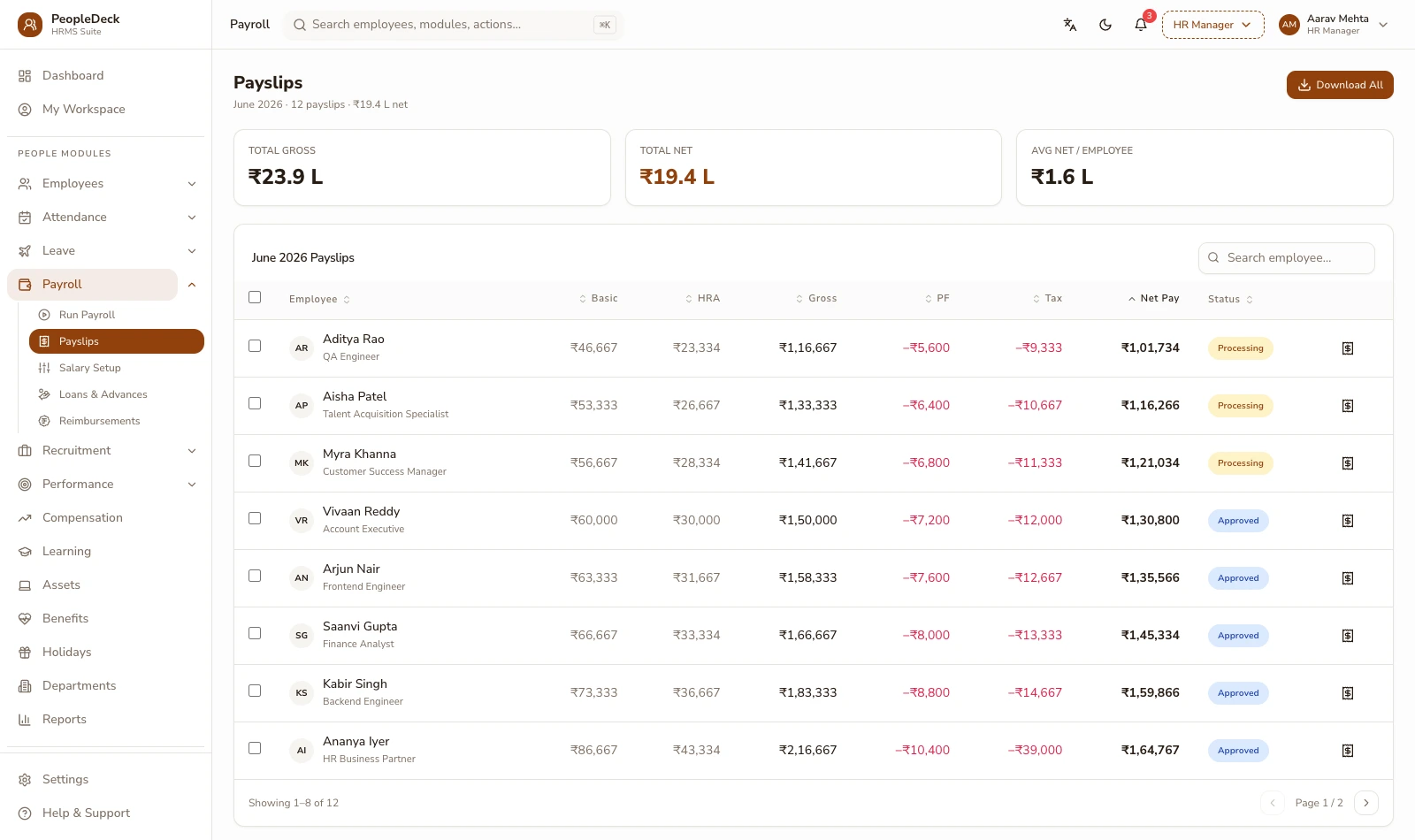
What does HR software for textile and garment units do?
It runs attendance, leave and payroll for textile and garment units — applying PF, ESI and TDS to every payslip and generating upload-ready return files, while handling what makes this industry different: piece-rates on the factory floor. PeopleDeck prices this per employee, per month.
Piece-rates on the factory floor
Textile units pay by the piece: a stitcher's week is counted in units, not hours. Piece-rate wages, shift workers and staff salaries all land in the same run, and PF and ESI apply across it.
Piece-rate is what makes textile payroll its own discipline. A stitcher's month is 2,300 units across four garment styles with different rates; a checker's is a daily wage; the floor supervisor draws a salary; and all three stand in the same shed under the same PF and ESI registrations. The failure mode is treating piece-rate as 'outside payroll' (paid from production sheets, off the statutory record) which builds a liability that surfaces at the first inspection or the first buyer audit. Export houses know the audit version of this: compliance codes ask for wage records that reconcile with production. PeopleDeck computes piece earnings from production entries, applies statutory contributions on the resulting wage, and keeps salaried, daily-rated and piece-rated workers correctly side by side in one run. The proof of textile payroll is order-crunch month: double shifts on two styles, a rate revision mid-run, and thirty temporary joiners, and the wage computation still reconciling with the production register to the piece.
How PeopleDeck runs it
- ✓ Piece-rate wage capture per worker, per count
- ✓ Large-floor attendance with shift and overtime handling
- ✓ PF, ESI, professional tax and TDS applied to every payslip — upload-ready return files, never filed on your behalf
- ✓ Self-service payslips, Form 16 data and leave balances for every employee
A month in textile payroll
-
1
Rates and styles set the frame
Each style-operation pair carries its piece rate — stitching style A at ₹12, style B at ₹15, checking per dozen. Rate revisions are effect-dated, so mid-month changes compute correctly for before and after.
-
2
Production entries become wage input
Daily production logs (per worker, per style) enter from the floor (sheets, supervisor entry or import). The worker's accumulating month is visible to them and to the supervisor, which kills the month-end tally dispute.
-
3
Attendance still matters
Piece workers punch too: attendance drives ESI applicability, weekly-off and holiday computations, and the minimum-wage floor check, a piece month that computes under the floor flags for top-up rather than shipping as-is.
-
4
One run across three wage types
Piece earnings, daily wages and salaries compute together; PF and ESI apply on qualifying wages regardless of wage type; payslips itemise units and rates; and the establishment's ECR and return files generate: one statutory identity for the whole shed.
A worked example
A stitcher produces 1,150 units of style A at ₹12 and 700 of style B at ₹15 (piece earnings of ₹24,300) across 25 attended days. PF applies per the wage structure; ESI does not (above ₹21,000 this month), which the system tracks month by month since piece earnings swing. Beside her, a checker at ₹450 daily worked 24 days: ₹10,800 gross, well under the ESI ceiling, both contributions applied. The payslips show units, rates and days, so when the buyer's social-compliance auditor samples March wages against production records next quarter, the two agree line by line, because they were never two records. The minimum-wage check also ran silently: had the stitcher's month computed below the notified floor, the run would have flagged a top-up before approval.
The unit-level rollup completes it: the month's wage bill splits by style and by wage type (piece, daily, salaried) so the merchandiser costing the next order reads real labour per style, and the compliance officer sees contribution coverage across the whole shed. Both are by-products of paying people correctly, not separate exercises.
Figures are illustrative, for mechanism only; your structures and rates will differ.
Key terms in textile payroll
Piece rate
Payment per unit produced, per style-operation. Statutorily it is still wages — PF, ESI and minimum-wage floors apply to the computed earnings, which is why production data must flow into payroll, not around it.
Minimum-wage floor check
Piece months are compared against the notified scheduled-employment minimum; shortfalls flag for top-up. Buyers' compliance codes test exactly this, worker by worker.
Style-wise costing
Because piece wages compute per style, the same records that pay workers also cost each style's labour: the number merchandisers argue about, finally derived from source.
Is PeopleDeck the right fit?
Built for you if
- ✓ Piece-rate, daily-wage and salaried workers share one floor
- ✓ Production data currently lives apart from wage records
- ✓ Buyer or export compliance audits sample your wages
- ✓ Rate revisions per style happen mid-year
- ✓ ESI applicability swings month to month with piece earnings
Not the fit if
- ✕ You want production-planning or ERP software. This consumes production data, it doesn't schedule it
- ✕ Your job-workers are independent units billing you per lot; that is procurement, not payroll
Mechanism deep-dives: the payroll engine · attendance & leave · statutory compliance
Switching without a bad payday
Textile units switch at a season boundary if they can, mid-season if they must. The order of work: worker master with wage types declared honestly (the switch is the moment to bring off-record piece payments onto the record), style-operation rate cards encoded with effect dates, then one wage cycle in parallel — production sheets feeding both the old tally and the new engine, reconciling worker by worker.
The parallel month's discoveries are predictable and valuable: workers whose piece months compute under the minimum-wage floor, ESI missed in months when swinging earnings dipped below the ceiling, and rate cards that drifted from what the floor was actually told. Each becomes a correction made once. From go-live, the buyer-audit posture changes permanently: wage records and production records cannot disagree, because they are the same records. Keep one season of parallel rate cards in the archive; when a buyer's auditor asks how rates evolved, the effect-dated history answers in one export.
Units that switched at a season boundary report one unexpected benefit: the rate-card negotiation with master tailors becomes calmer, because last season's actual per-style earnings are on record, both sides argue from the same numbers.
Not your industry?
Running a school or college? Staff payroll belongs inside your ERP: SchoolDeck staff payroll or CampusAlly payroll.
Related industries
Frequently asked questions
What does HR software for textile and garment units include?
Attendance and rosters, leave, onboarding to full-and-final, and payroll with PF, ESI and TDS applied to every payslip, plus piece-rates on the factory floor handled natively. Employees get self-service payslips.
Does piece-rate pay still attract PF?
Yes — PF and ESI apply to piece-rate earnings like any wages. PeopleDeck computes contributions on actual piece earnings and carries them into the upload-ready files.
How is PeopleDeck priced?
Per employee per month, in rupees. You pay for the headcount you run, no module bundles, no per-site fees.
Does PeopleDeck file PF and ESI returns?
No; it applies PF, ESI, professional tax and TDS and generates upload-ready ECR and return files. Filing stays with you or your consultant.
How do piece rates handle rework and rejection?
Rejected pieces net off per your policy — either at entry (only passed pieces logged) or as a recorded deduction line, so the worker sees the arithmetic instead of suspecting it.
Can advances against wages be recovered?
Yes — recorded advances recover from subsequent computations automatically with payslip visibility, keeping the floor cashbook and payroll in agreement.
What about overtime for piece-rated workers?
Hours beyond standard time flag from attendance; overtime for piece workers computes per your configured rule on the applicable rate, and the flagged hours keep you honest against Factories Act limits.
Can it run different units under one management?
Yes, each unit runs under its own registrations with its own rate cards and registers, while management reads consolidated cost and compliance across units; the portal sees each establishment correctly.
Payroll for textile and garment units, without the spreadsheets.
Per employee, per month: attendance to upload-ready returns.
Start free