


HR software for hospitals
Nurse and staff rosters, night-shift differentials, PF and ESI applied, and self-service payslips across clinical and support teams.
What does HR software for hospitals do?
It runs attendance, leave and payroll for hospitals — applying PF, ESI and TDS to every payslip and generating upload-ready return files, while handling what makes this industry different: rosters and night-shift differentials. PeopleDeck prices this per employee, per month.
Rosters and night-shift differentials
Nurse rosters rotate weekly, night shifts carry differentials, and clinical and support staff sit on different pay structures. Payroll that only understands 9-to-5 salaries breaks here.
A hospital's payroll complexity is clinical rostering wearing a finance costume. The ICU runs three rotating shifts with mandated nurse-patient ratios; night duty carries a differential that is part of the wage, not a favour; doctors may be salaried, on visiting fees, or on a retainer-plus-share model; and housekeeping and security are often a mix of own staff and outsourced crews. When payroll cannot see the roster, the ward in-charge becomes a human middleware layer, translating clinical schedules into attendance spreadsheets every month. PeopleDeck removes the translation: the roster is the attendance source, differentials are priced rules, and each staff category (clinical, paramedical, administrative, support) computes under its own structure inside one run. The test of hospital payroll is the month everything happens at once, an accreditation audit, a nursing batch rotation and two consultant onboardings, and the run still closes on schedule because none of those events required manual arithmetic.
How PeopleDeck runs it
- ✓ Nurse and ward rosters with rotation and night-differential pay
- ✓ Clinical, para-medical and support staff on separate structures in one run
- ✓ PF, ESI, professional tax and TDS applied to every payslip — upload-ready return files, never filed on your behalf
- ✓ Self-service payslips, Form 16 data and leave balances for every employee
A month in hospital payroll
-
1
Ward rosters publish with ratios visible
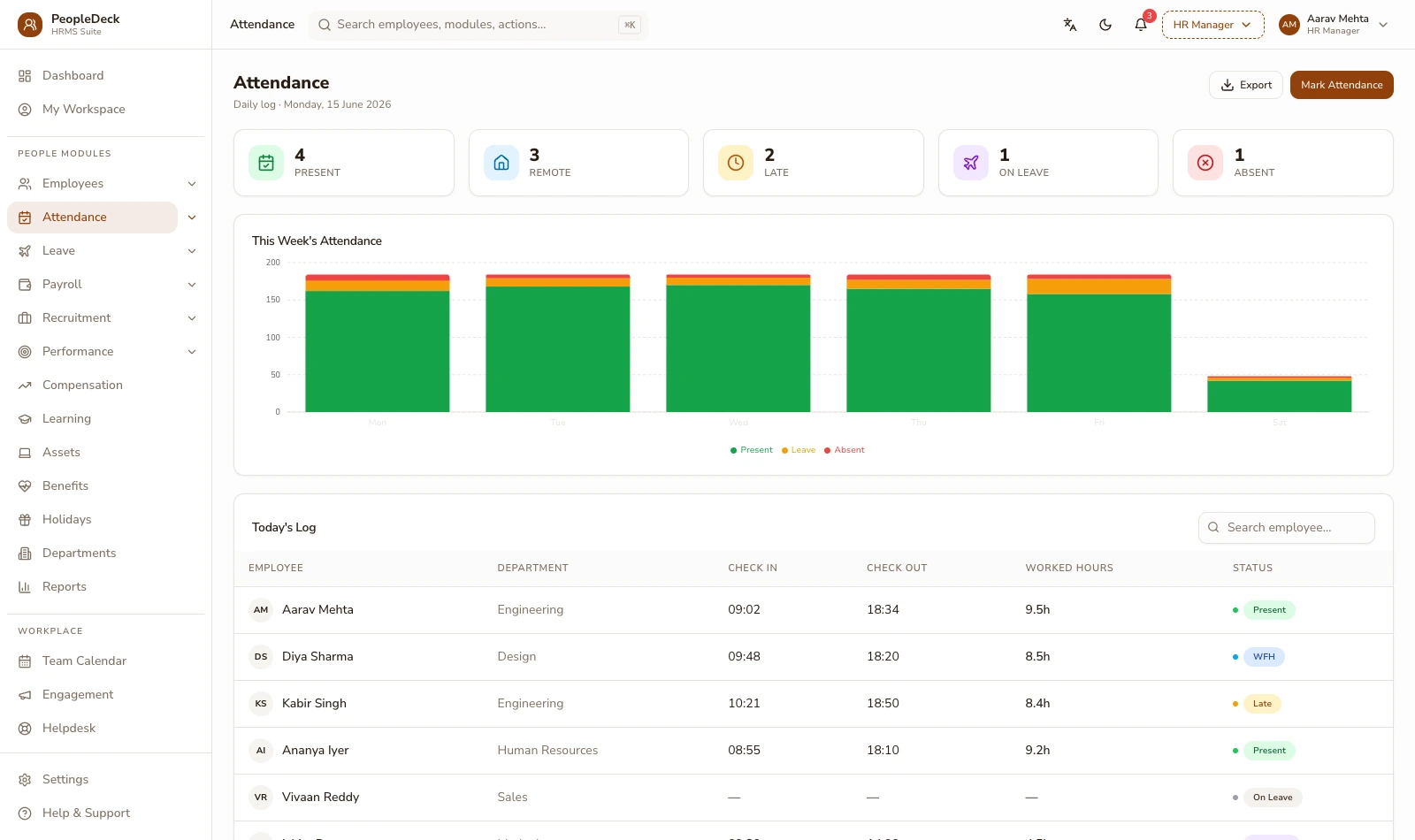
Nursing superintendents plan rotations (morning, evening, night) with coverage per ward visible at planning time. Night differentials and on-call allowances attach to the roster slots, so scheduling a nurse for nights is also, automatically, paying her for them.
-
2
Swaps and on-calls captured as they happen
A swap between two staff nurses is a recorded roster edit; an on-call registrar called in at 2 a.m. logs a duty that carries its allowance. Nothing waits in a diary for month-end transcription.
-
3
Categories close on their own structures
Clinical staff on shift structures, admin on standard hours, consultants on retainer terms, each category's attendance closes against its own rules, and exceptions route to the person who can actually resolve them.
-
4
One run, category-correct
The run computes each structure (differentials, on-call hours, retainers) applies PF, ESI, PT and TDS per employee, publishes payslips, and generates the establishment's upload-ready statutory files. Finance reads it by cost centre: ward, department, unit.
A worked example
A staff nurse on ₹26,000 gross works a rotation with nine night shifts at a ₹200 differential and one on-call recall at ₹500. The engine adds ₹2,300 of variable earnings, computes PF on basic, notes ESI does not apply (wage above ₹21,000), deducts Karnataka PT at the applicable slab, and shows the differential arithmetic on the payslip line by line. In the same run, a visiting physician's ₹80,000 monthly retainer processes under Section 194J-style professional TDS rather than salary TDS (kept correctly outside the salary structure) while the outsourced housekeeping crew appears only as the contractor's compliance documents, not as your employees. Three treatments, one run, no category bleeding into another.
The cost-centre cut matters as much as the individual payslip: the run reports nursing cost per ward, differential load per unit, and consultant retainers as their own line: the numbers the hospital's finance committee actually debates. Because they derive from the rosters themselves, the numbers survive scrutiny; nobody assembled them, so nobody's assembly can be questioned.
Figures are illustrative, for mechanism only; your structures and rates will differ.
Key terms in hospital payroll
Night differential
A per-shift or per-hour addition for notified night duty. In hospitals it is recurring wage, not incidental overtime, so it must enter wage bases and payslips as a structured earning, every month.
Rotation roster
A repeating shift pattern cycling staff through mornings, evenings and nights. Payroll accuracy depends on the pattern living in the system, because the pattern is the attendance baseline.
Retainer vs salary
Consultants on retainers are professionals, not employees — different TDS section, no PF or ESI. Keeping the two populations cleanly separated is a compliance requirement, not a bookkeeping preference.
Is PeopleDeck the right fit?
Built for you if
- ✓ Nursing rosters rotate and night duty carries pay consequences
- ✓ You employ clinical, admin and support categories on different structures
- ✓ Consultants and retainers must stay separate from salaried staff
- ✓ Multiple units or centres report into one management
- ✓ Ward in-charges currently compile attendance by hand
Not the fit if
- ✕ You want a hospital-management or EMR system. This is workforce, not patients
- ✕ Your entire staff is outsourced through agencies: the payroll obligation sits with the contractors
Mechanism deep-dives: the payroll engine · attendance & leave · statutory compliance
Switching without a bad payday
Hospitals switch carefully, and should. The sequence respects that: the employee master imports first with categories and structures intact (clinical, paramedical, administrative, support) then ward rosters are encoded as the patterns matrons already use, then one full month runs in parallel with the existing process while both produce payslips and only one gets paid. The parallel month is where differential rules, on-call rates and category boundaries get corrected against reality, with the engine's arithmetic visible line by line.
Go-live happens on a month boundary with leave balances and gratuity tenure carried as opening records, so nobody's accruals reset. Consultants' retainer terms migrate into the professional-fee track, cleanly outside salary. The measure of success is mundane: the first month in which no ward in-charge transcribed a roster into a spreadsheet because the roster was already the record. The matrons who feared losing roster control usually end up its strongest defenders, because the system enforces the rotation they always intended.
A note on unions and staff associations where they exist: computed, itemised payslips change the negotiation floor — discussions start from agreed arithmetic rather than contested totals, which shortens them considerably.
Not your industry?
Running a school or college? Staff payroll belongs inside your ERP: SchoolDeck staff payroll or CampusAlly payroll.
Related industries
Frequently asked questions
What does HR software for hospitals include?
Attendance and rosters, leave, onboarding to full-and-final, and payroll with PF, ESI and TDS applied to every payslip, plus rosters and night-shift differentials handled natively. Employees get self-service payslips.
How does it handle nurse night-shift pay?
Night and rotation differentials are set per roster, so a nurse's payslip reflects the shifts actually worked, no month-end spreadsheet of allowances.
How is PeopleDeck priced?
Per employee per month, in rupees. You pay for the headcount you run, no module bundles, no per-site fees.
Does PeopleDeck file PF and ESI returns?
No; it applies PF, ESI, professional tax and TDS and generates upload-ready ECR and return files. Filing stays with you or your consultant.
How does it handle nurse-patient ratio compliance?
Coverage per ward per shift is visible at rostering time, so gaps show before the shift, not after. The system evidences who was scheduled and who was present: the staffing record inspections ask for.
Can doctors on different engagement models coexist?
Yes — salaried duty doctors run through payroll with statutory lines; visiting consultants on professional fees process with the correct TDS treatment outside the salary structure. The separation is enforced by configuration, not vigilance.
What about biometric attendance in a 24x7 facility?
Punches capture across devices around the clock and reconcile against the roster, including the night that crosses midnight: the shift belongs to the day it was rostered, so night staff never lose a day to a calendar technicality.
Can it handle staff on deputation between units?
Yes, a nurse deputed to the sister unit for a fortnight is rostered there, costed there, and paid once under her home establishment; the cost transfer between units is a report, not a second payroll.
Payroll for hospitals, without the spreadsheets.
Per employee, per month: attendance to upload-ready returns.
Start free