


HR software for logistics and warehousing
Driver and loader attendance, trip and overtime pay, PF and ESI applied, and payslips across hubs and warehouses.
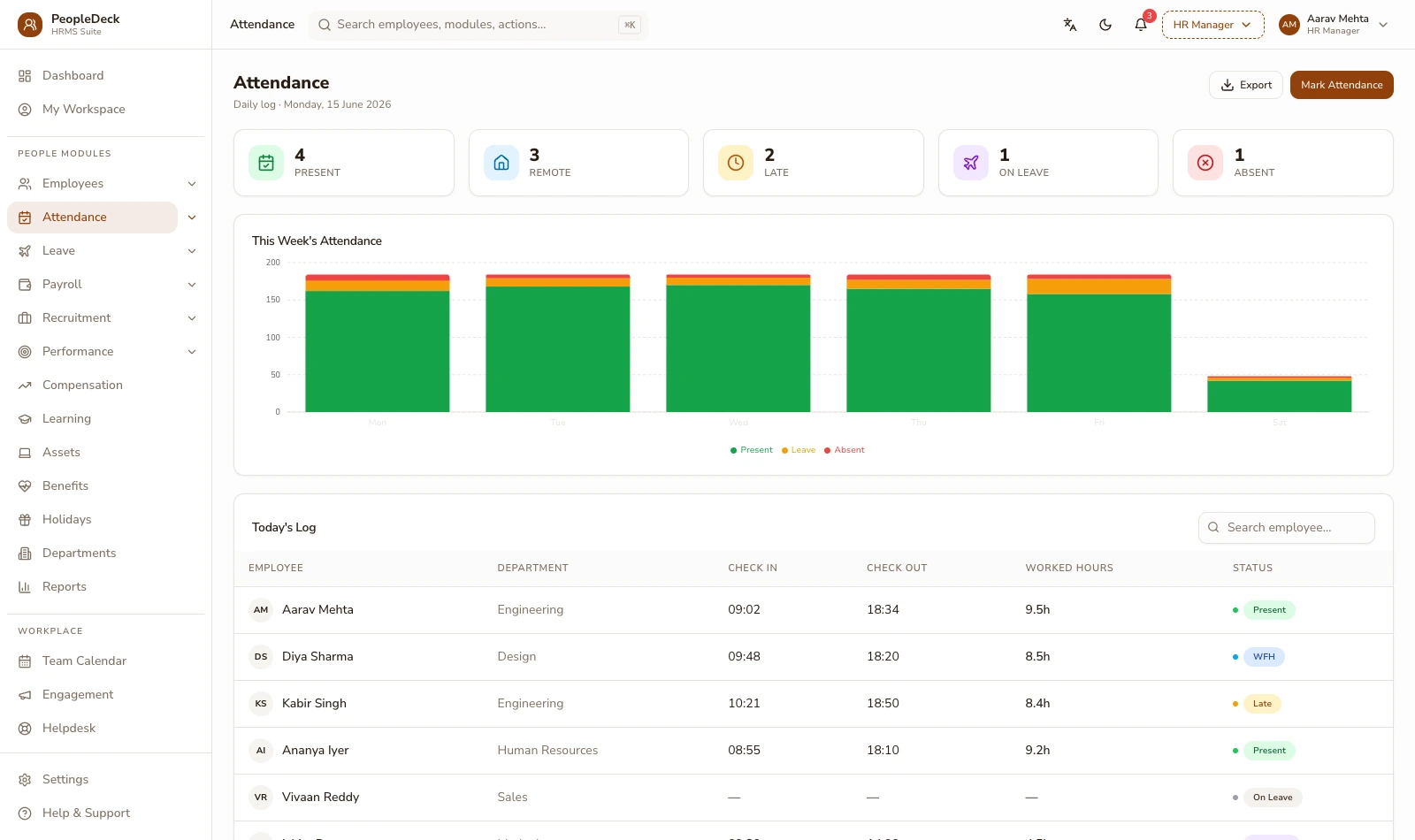
What does HR software for logistics and warehousing do?
It runs attendance, leave and payroll for logistics and warehousing — applying PF, ESI and TDS to every payslip and generating upload-ready return files, while handling what makes this industry different: trips, hubs and overtime. PeopleDeck prices this per employee, per month.
Trips, hubs and overtime
Drivers earn by trip, loaders by shift, and both clock in across hubs that never share a wall. Logistics payroll has to merge trip counts, overtime and multi-location attendance into one clean run.
Logistics payroll breaks along its own geography. A driver's month is trips — long-haul slabs, per-kilometre components, halting allowances — logged across highways the office never sees. A loader's month is hub shifts with overtime that spikes every festival season. A hub supervisor draws a salary but approves everyone else's variable pay. Three wage grammars, one employer, and attendance scattered across locations that never share a wall. The spreadsheet version of this ends the same way every month: the trips register, the attendance muster and the payout sheet disagree, and the argument is settled by memory. PeopleDeck's approach is to make each wage grammar a first-class computation (trip-based, shift-based, salaried) fed by capture that happens where the work happens, reconciled continuously instead of at month-end. The system earns its keep in peak season, when volumes double and the wage bill must scale without the errors scaling with it.
How PeopleDeck runs it
- ✓ Trip-based pay components alongside shift wages
- ✓ Attendance across hubs and warehouses in one run
- ✓ PF, ESI, professional tax and TDS applied to every payslip — upload-ready return files, never filed on your behalf
- ✓ Self-service payslips, Form 16 data and leave balances for every employee
A month in logistics payroll
-
1
Trips and shifts logged where they happen
Drivers' trips enter against routes with their slab rates and allowances; hub staff punch at their hub. Every wage-bearing event is captured at source with a date, a place and an owner; nothing waits in a diary for month-end transcription.
-
2
Overtime and incentives accrue visibly
Loader overtime beyond shift hours flags as it accrues, per hub rules; driver incentives (on-time delivery, trip counts) compute from the logged trips. Supervisors approve variable pay during the month, in context.
-
3
Hubs close independently, the run closes once
Each hub's attendance closes against its own roster; the trips register closes against dispatch records. Exceptions route to hub supervisors, who resolve their own geography instead of head office chasing everyone's.
-
4
One computation across three wage types
Trip earnings, shift wages and salaries compute in one run; PF and ESI apply on qualifying wages regardless of wage type; payslips itemise trips, hours and allowances; ECR and return files generate per establishment.
A worked example
A long-haul driver runs 11 trips: eight at the ₹1,800 slab, three at ₹2,400, plus ₹3,100 of halting allowances — gross ₹28,700, so ESI does not apply this month, while PF applies on the structured basic. His payslip lists each trip with its rate, which is why the payout argument that used to consume the first week of every month has quietly died. At the hub, a loader on ₹13,500 with 22 shifts and 14 overtime hours at 1.5x computes to ₹15,003 — inside the ESI ceiling, both contributions applied. The hub's month closes with wage cost per hub and per function visible, and head office reads the network's labour cost the way it reads fuel: from records, not estimates.
Roll it up and the month answers management questions from source: cost per hub, overtime concentration by week, trip-earning distribution across the driver pool. Peak-season planning starts from last peak's actual wage bill rather than the operations head's recollection, and the numbers survive the CFO's scrutiny because every one drills down to a logged trip or a punched shift.
Figures are illustrative, for mechanism only; your structures and rates will differ.
Key terms in logistics payroll
Trip-based wages
Earnings computed per completed trip — slab rates by route class, plus halting and night allowances. Statutorily still wages: they enter PF and ESI bases when qualifying, which flat 'driver bhatta' cash payments hide.
Halting allowance
Payment for en-route waiting days. Because it recurs and attaches to trips, it belongs on the payslip as a computed line: the difference between a defensible wage record and a cash register.
Hub-wise closing
Each location's attendance and overtime close under local supervision before the central run computes: the only structure that scales past the third hub without a reconciliation war.
Is PeopleDeck the right fit?
Built for you if
- ✓ Drivers, loaders and staff earn under different wage logics
- ✓ Your workforce is spread across hubs, warehouses and routes
- ✓ Festival-season overtime spikes are a fact of the calendar
- ✓ Trip records and wage records currently disagree monthly
- ✓ Attrition among drivers and loaders is a monthly routine
Not the fit if
- ✕ You want fleet management or route optimisation. This pays the people, not the trucks
- ✕ Your drivers are market hires paid per trip in cash with no employment relationship: payroll needs employees on the record
Mechanism deep-dives: the payroll engine · attendance & leave · statutory compliance
Switching without a bad payday
Logistics operators switch hub by hub, keeping the network running. The sequence that works: head-office and supervisory staff first (a standard salaried run) then the largest hub, with its shift rules and overtime rates encoded and one wage cycle run in parallel against the current sheets. The parallel cycle surfaces what it always surfaces in this industry: overtime computed from memory, halting allowances paid flat regardless of trips, and ESI missed on wage components that qualified. Each becomes a rule, corrected once.
Drivers migrate with their route-slab structures as the trips register moves onto the system, often the moment the whole exercise pays for itself, because the trips-versus-payout reconciliation stops being a monthly negotiation. Remaining hubs follow on the proven template, each a fortnight's exercise rather than a project. Two peak seasons later, the difference is structural: the network's wage bill scales with volume, and the errors no longer scale with it. The habit worth keeping: revise route-slab rates by effect date, never by overwriting: the old rate must keep computing old trips.
Not your industry?
Running a school or college? Staff payroll belongs inside your ERP: SchoolDeck staff payroll or CampusAlly payroll.
Related industries
Frequently asked questions
What does HR software for logistics and warehousing include?
Attendance and rosters, leave, onboarding to full-and-final, and payroll with PF, ESI and TDS applied to every payslip, plus trips, hubs and overtime handled natively. Employees get self-service payslips.
Can drivers be paid per trip?
Yes — trip counts enter as a pay component next to base wages and overtime, so a driver's payslip shows base, trips and OT as separate lines.
How is PeopleDeck priced?
Per employee per month, in rupees. You pay for the headcount you run, no module bundles, no per-site fees.
Does PeopleDeck file PF and ESI returns?
No; it applies PF, ESI, professional tax and TDS and generates upload-ready ECR and return files. Filing stays with you or your consultant.
How do driver advances and fuel adjustments work?
Advances record against the driver and recover from the next computation, itemised on the payslip. Fuel and toll settlements stay in your trip accounting: payroll takes only the wage-bearing lines, which keeps both books clean.
Can attendance capture work without smartphones at small hubs?
Yes — shared kiosks, biometric devices or supervisor-marked musters all feed the same record. A hub of six loaders needs a device, not a rollout project.
What about ESI when a driver's earnings swing across the ceiling?
Applicability follows the contribution-period rules, not the single month: the system tracks the period wage correctly so a high-trips month doesn't wrongly drop a driver from coverage.
Does it handle inter-hub transfers mid-month?
A loader moved to the bigger hub for peak fortnight is rostered there; his hours cost to that hub while one payslip follows him. Hub-wise cost stays honest without splitting the person's record.
Can it produce per-client cost for dedicated fleet operations?
Yes — hubs or routes dedicated to a client carry that tag, so the people-cost of a dedicated operation reports cleanly for contract pricing and renewal negotiations.
Payroll for logistics and warehousing, without the spreadsheets.
Per employee, per month: attendance to upload-ready returns.
Start free