


Labour law compliance, kept in the records
Minimum and timely wages, contributions applied, registers that reconcile: payroll aligned to the Code on Wages and Code on Social Security frameworks, with the evidence accumulating month by month.
What does labour law compliance mean for payroll?
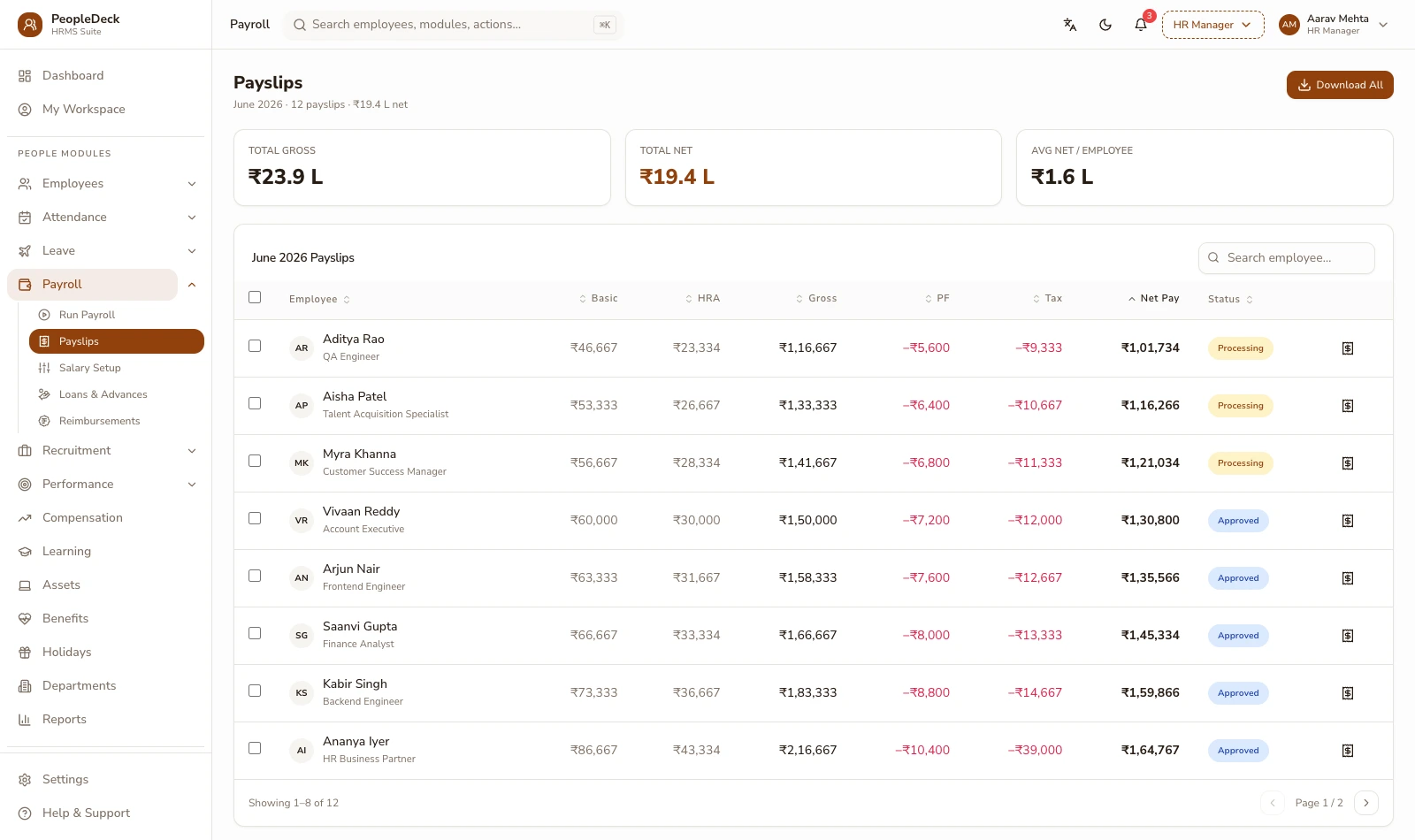
For an employer, labour law compliance in payroll comes down to four continuous obligations: pay at least the notified minimum wage for each category of work, pay it on time, deduct and contribute what the social-security framework requires, and hold records that prove all three: wage registers, attendance, payslips, contribution trails and settlement statements that reconcile with one another. PeopleDeck operationalises those obligations inside the payroll run itself: floors checked at computation, statutory rates applied to every payslip, and the registers accumulating as a by-product of paying people rather than as a separate clerical exercise.
One sentence of honesty before anything else: software cannot make you compliant, and this page will not pretend otherwise. Compliance is a legal state that depends on classifications, applicability and facts a system cannot judge; that is your consultant's and counsel's territory. What software can do is eliminate the two failure modes that cause most findings in practice: arithmetic applied wrongly or inconsistently, and records that are incomplete or disagree with each other. Those are mechanical problems, and mechanising them is exactly what a payroll engine is for.
The codes, and where payroll meets them
India consolidated 29 central labour laws into four codes. Implementation is operational, with rules continuing to roll out state by state, which is precisely why treatment needs to live in maintained configuration rather than in anyone's memory of the 2020 headlines. Two of the four sit directly on payroll:
Code on Wages, 2019
Universalises minimum wage and timely-payment obligations across employments, and defines "wages" in a way that expects basic pay plus dearness and retaining allowances to form at least half of remuneration for computation purposes — constraining the low-basic structures once used to shrink PF and gratuity. Payroll consequences: category-wise wage floors, payment timelines, and wage composition that survives the definition.
Code on Social Security, 2020
Carries the PF, ESI, gratuity and maternity frameworks (the EPF wage ceiling of ₹15,000 was formally notified under its Chapter III on 29 May 2026) and brings gig and platform workers and inter-state migrant workers into scope for the first time. Payroll consequences: contributions applied on correct bases, coverage tracked, and gig engagements recorded distinctly as state rules activate.
Industrial Relations Code, 2020
Governs standing orders, disputes and retrenchment. It touches payroll at the edges, in notice pay, retrenchment compensation and settlement computations on exit, where the record of what was paid, when and on what basis becomes the employer's primary evidence.
OSH & Working Conditions Code, 2020
Consolidates safety and working-time law. Payroll meets it through working hours, overtime at premium rates and leave entitlements: the attendance-side facts that must reconcile with what the wage register says was paid.
How PeopleDeck keeps the month aligned
-
1
Wage floors checked at computation
The state-notified minimum wages you configure for your categories become run-time checks: every computed wage (monthly, daily-rated or piece-rate) is compared against its floor, and shortfalls flag for top-up before the run can be approved. The check that matters is the one that runs every month.
-
2
Composition made explicit
Salary structures declare their components (basic, DA, allowances) so how each structure sits against the wages definition is visible rather than buried. When your consultant reviews structures against the rules taking effect in your states, they review a table, not a guess.
-
3
Contributions and premiums applied
PF, ESI, professional tax and TDS apply to every payslip at current rates; overtime computes at premium rates from recorded hours with statutory limits tracked; gratuity accrues at 15/26 of wages per completed year. Applied and generated, never filed on your behalf.
-
4
Registers as a by-product
Wage registers, attendance and overtime records, contribution histories and settlement statements accumulate from each approved run, per establishment, reconciling by construction. An inspection or inquiry meets an export — contemporaneous records, not reconstructions.
Mechanism deep-dives: statutory compliance · the payroll engine · attendance & leave
A worked example
A 70-person packaging unit runs three worker categories: monthly-salaried staff, daily-rated helpers and machine operators on a skilled-category rate. At month-end the run computes a helper's 24 days at the configured daily rate and checks the result against the state's notified floor for unskilled work in that scheduled employment; it passes. An operator's month, after an absence-heavy fortnight, computes below the skilled floor; the run flags it, and the supervisor discovers a week of punches never synced from the floor device. The correction happens before approval, not after a notice. Meanwhile a staff member's overtime (11 recorded hours) computes at the premium rate with the quarterly limit tracked, gratuity accrues for everyone past a year of service, and the month closes with wage register, attendance record and payslips that agree because they are one record. When the establishment's annual inspection samples March, the response is four exports.
Illustrative scenario, for mechanism only. Wage floors are state- and category-specific notified figures; configure yours with your consultant.
What this software is, and is not
It is
- ✓ A computation engine that applies current statutory rates every month
- ✓ A floor-checker that catches sub-minimum computations before approval
- ✓ A record-keeper whose registers reconcile by construction
- ✓ A generator of upload-ready files your consultant reviews and files
- ✓ The organised factual basis your advisers work from
It is not
- ✕ Legal advice, or a substitute for a consultant on classification and applicability
- ✕ A guarantee of outcomes before an inspector, tribunal or court
- ✕ A filing agent: nothing reaches a portal without your sign-off
- ✕ A verdict engine; it computes and evidences; people decide
The rollout caveat, stated plainly: the codes are operational with rules activating state by state, and the details (floors, thresholds, procedural requirements) continue to move. PeopleDeck maintains treatment as configuration with effect dates, which means a new notification lands as an update applied from its date, with prior months preserved under the rules that governed them. That is also exactly the change-history an inquiry expects to see.
Contribution mechanics in depth live at PF & ESI compliance. Running a school or college? In-ERP staff payroll belongs with SchoolDeck staff payroll or CampusAlly payroll.
Primary sources for the figures on this page: Ministry of Labour & Employment · India Code (the four labour codes) · Chief Labour Commissioner. Verification date is printed beside each figure; maintained by Databus Technology Solutions.
Frequently asked questions
What are the four labour codes and which ones touch payroll?
India consolidated 29 central labour laws into four codes: the Code on Wages 2019, the Code on Social Security 2020, the Industrial Relations Code 2020 and the Occupational Safety, Health and Working Conditions Code 2020. Payroll is touched most directly by the first two. The Code on Wages governs minimum wages, timely payment and wage composition, while the Code on Social Security carries PF, ESI, gratuity and maternity benefit, and brings gig and platform workers into the framework. Implementation is operational with rules rolling out state by state.
Does using compliance software mean we are legally compliant?
No software can promise that, and you should distrust any that does. PeopleDeck applies current statutory rates to every payslip, checks computed wages against the floors you configure, and maintains the registers and records the frameworks expect, which removes the arithmetic and record-keeping failure modes. Legal positions — classification of workers, applicability questions, disputes — belong with your consultant or counsel, who will work faster because the facts are organised.
What does the Code on Wages change about wage structure?
Its definition of wages effectively expects basic pay plus dearness and retaining allowances to form at least half of total remuneration for computation purposes, which constrains structures that minimised basic pay to shrink PF and gratuity. PeopleDeck's structures make the composition explicit, so you can see (and your consultant can certify) how each structure sits against the definition as rules take effect in your states.
Which records must an employer be able to produce?
Wage registers, attendance and overtime records, payslips, contribution histories with challan references, and settlement records on exit, per establishment, per period, all reconciling with each other. PeopleDeck accumulates all of these as by-products of each approved run, exportable in inspection-ready form, so an inquiry meets an export rather than a reconstruction.
How does minimum wage compliance work in the system?
Minimum wages are state-notified by scheduled employment and skill category. You configure the floors that apply to your categories; each run checks computed wages (including piece-rate and daily-wage computations) against them and flags shortfalls for top-up before approval. The check runs every month, not just at structure design.
What changed for gig and platform workers?
The Code on Social Security 2020 brings gig and platform workers into the social-security framework for the first time, with registration and aggregator contribution provisions activating as states notify rules. If you engage gig workers, PeopleDeck records the engagements distinctly from employment and tracks the contribution hooks as the rollout hardens, so each state notification lands as configuration rather than crisis.
Does PeopleDeck file returns or represent us before authorities?
Neither. It applies rates, computes wages and generates upload-ready files and registers; filing happens under your establishment's authority, and representation is your consultant's role. The system's job is to make sure that what they file and argue from is complete, consistent and computed correctly.
Records that hold up. Every month.
Floors checked, contributions applied, registers reconciled. Per employee, per month.
Start free