


Joining to exit: one clean flow
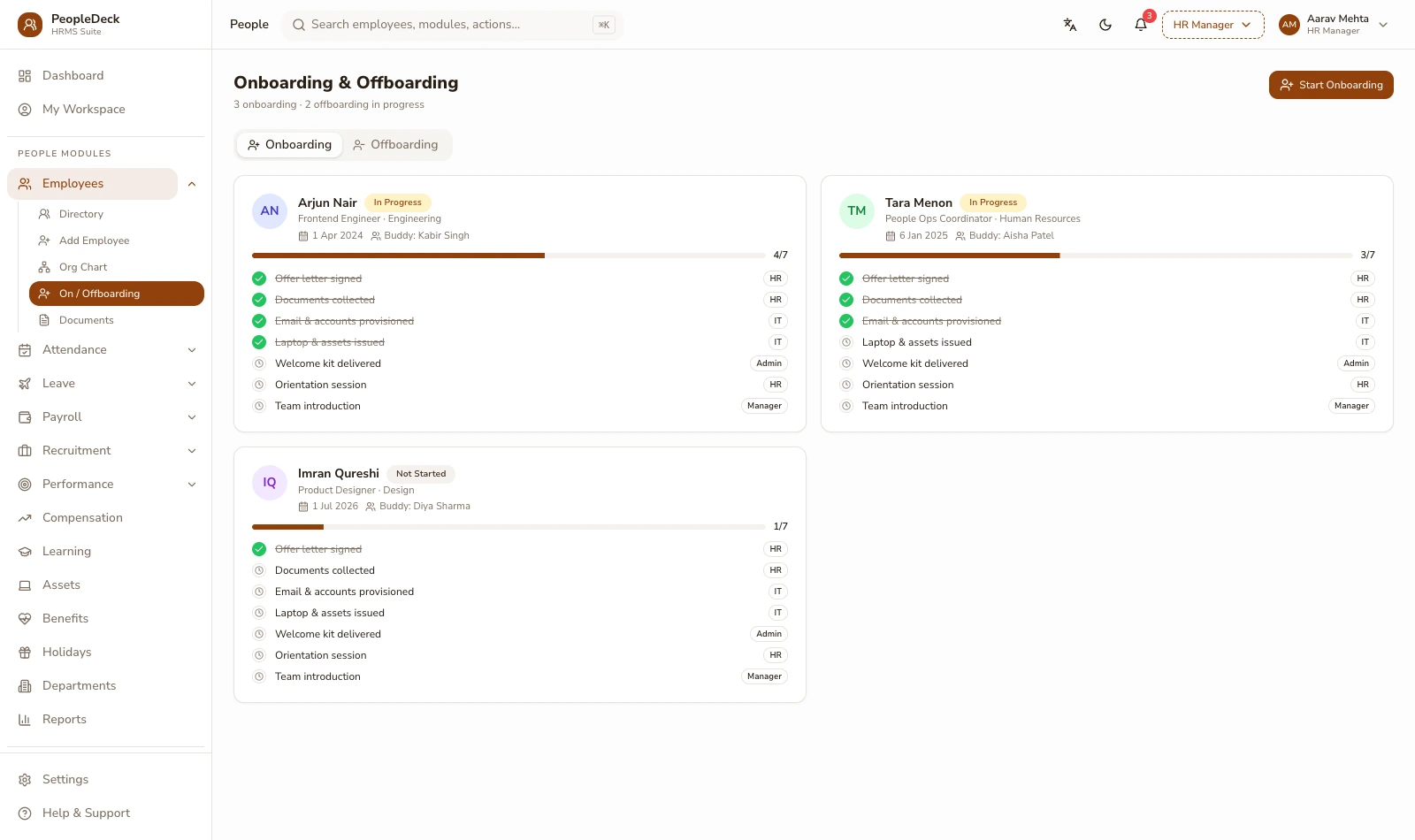
Onboarding and offboarding are the two moments HR is judged on, and both are workflows here, not paperwork piles. Joining runs on checklists that collect documents, statutory IDs and bank details before day one; exit runs the flow in reverse, recovering assets and computing a full-and-final settlement from leave balance, dues and notice pay, with the working shown for a human to approve.
How it works
-
1
Start before day one
The moment an offer is accepted (including straight from the recruitment pipeline) a joining checklist opens: personal details, education and experience documents, UAN and ESIC where they exist, PAN, bank account, photograph, policy acknowledgements. The candidate completes most of it from home. HR reviews once instead of chasing five times, and day one is an induction, not a documentation drive.
-
2
Land the record payroll-ready
Everything the checklist collects writes into the employee database in payroll-ready shape: statutory IDs validated, bank details captured through the same approval discipline as any later change, the right salary structure mapped from the offer. First-month payroll includes the joiner automatically, pro-rata from the joining date, PF and ESI applied from day one: the compliance gap that spreadsheets create simply never opens.
-
3
Issue and track what the company hands over
Laptops, SIM cards, access cards, tools, uniforms — assets issued at joining are recorded against the person. Through their tenure the register stays current, which is precisely what makes exit day boring: everything issued is known, so everything recoverable is recovered.
-
4
Run exits as a mirror of joining
Resignation or termination opens the offboarding flow: notice period tracked against policy, handover checklist assigned, assets recovered against the register, access closed on the last working day. Each step has an owner and a state, so nothing rides on someone remembering.
-
5
Compute the full-and-final, show the working
The settlement computes from the record: unpaid salary days, leave encashment at the policy rate, recoveries for unreturned assets or notice shortfall, dues either way. The working is itemised (payable and recoverable, line by line) and a person approves it before it pays through an off-cycle run. Exit statutory records are generated for you; nothing is filed on your behalf.
-
6
Treat probation as part of the flow
Between joining and exit sits probation, and it belongs to the same machinery. Confirmation dates are tracked from day one, reminders reach the manager before the date arrives (not after), and the confirmation or extension is a recorded decision that updates the employee record. The quiet failure mode of probation (everyone forgetting until the letter is overdue) stops being possible.
An exit, end to end
Illustrative: a support lead resigns with a 30-day notice policy and serves 22 days. The flow tracks the 8-day shortfall, recovers the laptop per the register, and computes the settlement: 12 unpaid working days of salary, 9 days of earned-leave encashment at the structure's rate, minus notice-shortfall recovery as policy defines. The itemised sheet shows each line and its source; HR approves; the amount pays in an off-cycle run and the record closes with the settlement attached. Total elapsed effort: minutes of review, because every input already existed. His manager receives the confirmation reminder twelve days early; the decision lands on the record before the date, not after it.
The workflow is the audit
Joining and exit are where undocumented promises and missed recoveries are born, and both are expensive precisely because they are usually informal. Running them as owned, stateful checklists means the audit trail writes itself: who collected which document, who issued and recovered which asset, who approved which settlement line. The deep statutory scenario of settlements has its own use-case treatment; this page owns the flow. And as everywhere in PeopleDeck: exit paperwork is generated ready for filing: the filing itself stays with you.
Key terms, plainly
Full and final (FnF)
The exit settlement combining unpaid salary, leave encashment, dues and recoveries into one computed, approved payout, with the itemised working preserved.
Notice shortfall
Days of contractual notice not served, typically recovered from the settlement at the rate policy defines, computed, shown and human-approved here.
Joining checklist
The stateful list of documents, IDs and acknowledgements a joiner completes before day one, writing directly into the employee master.
Asset register
The per-employee record of company property issued and recovered: the difference between a boring exit and a dispute.
Leave encashment
Unused earned leave converted to pay at exit under policy, computed at the structure's rate into the settlement, taxed as the rules require.
What you get
- ✓ Offer-to-joining checklists completed before day one
- ✓ Statutory IDs, documents and bank details captured payroll-ready
- ✓ Asset issue and recovery tracked per person, joining to exit
- ✓ Notice, handover and access closure run as owned steps
- ✓ Itemised FnF computed from the record, approved by a human, paid off-cycle
| Settlement line | Source |
|---|---|
| Unpaid salary days | Attendance & payroll records |
| Leave encashment | Leave balance × structure rate |
| Notice shortfall recovery | Notice policy vs days served |
| Asset recovery | Asset register |
| Other dues / advances | Payroll ledger |
Works with: Employee database · Recruitment & ATS · Payroll engine
From joining folders to joining flows
Most companies onboard with a folder: forms to print, sign, scan and chase. Moving to a flow inverts the effort: the joiner does the data entry once, correctly, from home, and HR's job becomes review. The subtle win is compliance timing: because statutory IDs and bank details arrive before day one, the first payroll includes the joiner with PF and ESI applied from the start, which is exactly the gap that later costs an afternoon of correction filings. Exits benefit even more: a settlement computed from records that were maintained all along takes minutes, and the asset register turns 'did he return the laptop?' from an investigation into a lookup.
Flow setup checklist
- 1.Build the joining checklist: documents, IDs, bank, acknowledgements
- 2.Map offer grades to salary structures for automatic assignment
- 3.Define the asset categories you issue and track
- 4.Set notice-period and encashment policy by grade
- 5.Configure the FnF approval chain
- 6.Dry-run one joiner and one exit before switching over
Is this the right fit?
Built for you if
- ✓ Joiners spend day one filling forms and week one waiting for access
- ✓ Assets leave with employees because no register says what they had
- ✓ Every exit settlement is a negotiation because nothing was computed
Not the fit if
- ✕ You want background-verification services — PeopleDeck records the process; verification vendors do the verifying
- ✕ You want automated exit interviews with sentiment analysis — banned family; exits here are records and computations
Related features
Running a school or college? Staff payroll belongs inside your ERP: SchoolDeck staff payroll or CampusAlly payroll.
Frequently asked questions
How fast can a new hire be onboarded?
As fast as they complete the checklist, typically before day one, since most of it happens from home after offer acceptance. The record lands payroll-ready either way.
What goes into the full-and-final computation?
Unpaid salary, leave encashment, dues, and recoveries for notice shortfall or unreturned assets, each line itemised with its source, approved by a person before payout.
Can offer data flow in from recruitment?
Yes, an accepted offer hands the candidate into onboarding with the data recruitment already collected, so nothing is asked twice.
Is the FnF paid inside regular payroll?
It pays through an off-cycle run with its own approval and trail — settlements should not wait for month-end, and month-end should not absorb settlement complexity.
What if an exiting employee owes an advance?
Outstanding advances sit in the payroll ledger and appear as a recovery line in the settlement working, netted transparently.
Does the tool file exit statutory returns?
No — exit records and statutory outputs are generated ready for filing; the filing itself remains with you or your consultant.
How is PeopleDeck priced?
Per employee per month, in rupees — joiners count when they join, leavers stop counting when they leave.
Can contractors be onboarded too?
Yes — contract staff run through the same checklists with their own document set and engagement dates, kept distinct from employee payroll where the law distinguishes them.
Who approves the final settlement?
Whoever your chain names, typically HR computes, finance reviews, and a named approver releases the off-cycle payment, all recorded.