


PF & ESI compliance, applied right
EPF at 12% + 12% on the ₹15,000 wage ceiling. ESI at 0.75% + 3.25% up to ₹21,000. Applied to every payslip, with ECR and challan files generated ready for upload, and filing authority kept with you.
What does PF and ESI compliance actually require?
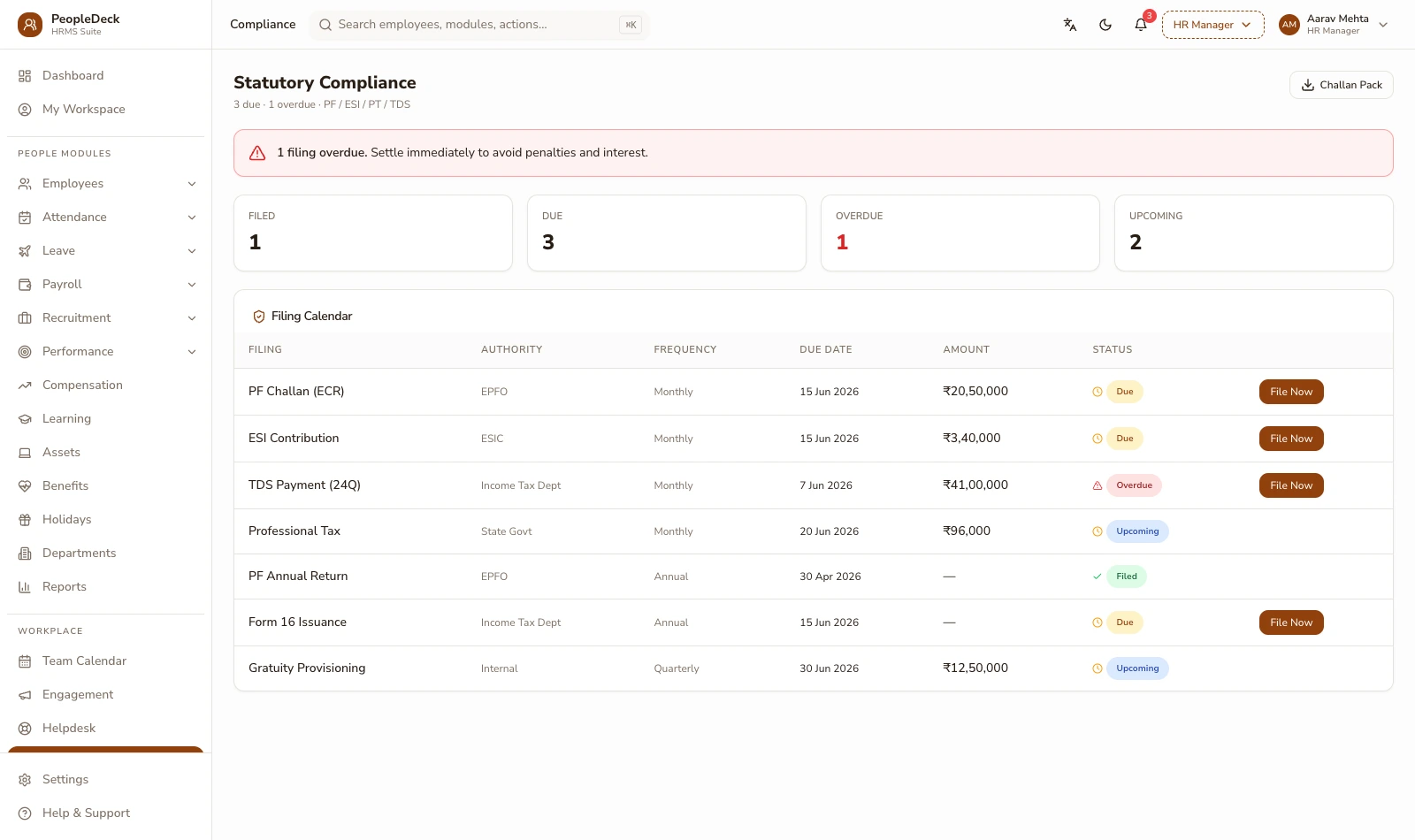
Every month, an employer must compute EPF at 12% of Basic+DA from the employee and 12% from the employer on wages up to the ₹15,000 statutory ceiling, compute ESI at 0.75% employee and 3.25% employer on gross wages up to ₹21,000, deposit both by the 15th, and hold records that prove it, per employee, per month, per registration. PeopleDeck applies these contributions to every payslip as the run computes and generates the ECR and challan files in upload-ready form. It does not file them; you or your consultant do, with sign-off.
The distinction matters more than it sounds. Compliance failures rarely come from not knowing the rates. They come from the arithmetic being manual: a joiner whose contributions started a month late, an allowance that should have entered the ESI wage base and didn't, a raise that dropped someone from coverage mid-contribution-period, an ECR built in a spreadsheet that disagrees with the payslips it summarises. Each is invisible in the month it happens and expensive in the month it is found. Making the computation structural, so that one engine produces the payslip, the register and the return file, removes the gap those errors live in.
The current rates, precisely
EPF — Employees' Provident Fund
- • 12% of Basic+DA from the employee, 12% from the employer
- • Wage ceiling ₹15,000/month, formally notified 29 May 2026 under the Code on Social Security 2020 (Chapter III)
- • Employer's 12% splits: 3.67% EPF + 8.33% EPS, pension contribution capped at ₹1,250/month
- • EDLI 0.50% and administrative charges 0.50%, employer-borne
- • Monthly ECR upload and payment due by the 15th
ESI — Employees' State Insurance
- • 0.75% of gross wages from the employee plus 3.25% from the employer, 4% in total
- • Coverage for employees earning up to ₹21,000/month (₹25,000 for persons with disability)
- • Two contribution periods: April–September and October–March
- • Once covered at a period's start, covered through the period, even if wages cross the ceiling
- • Monthly contribution deposit due by the 15th
Rates and ceilings as re-verified at publication. PeopleDeck applies the rates current at each run. When a notification changes them, the change applies from its effective date and the old rates stay preserved for old months.
A compliant month, step by step
-
1
Coverage decided at onboarding, not at the first audit
Each joiner's record declares PF membership (UAN captured or registration flagged) and ESI applicability from their wage. Contributions start with the first payslip — the day-one requirement that late, manual enrolment breaks most often.
-
2
Wage bases built from the structure, not from habit
PF computes on Basic+DA per the structure; ESI computes on gross, including the allowances that legally belong in it: the night allowance, the attendance incentive. What enters each base is a declared rule, visible on every payslip's workings.
-
3
Edge cases computed, not adjudicated
Mid-month joiners pro-rate; exits contribute to the last working day; wage revisions apply from effect dates with arrears carrying their own contributions; ESI's contribution-period rule holds coverage through raises. The cases that consume a manual processor's afternoon compute in the run.
-
4
Files generated from the approved run
Once the run is approved, the ECR and ESI contribution files generate in portal-ready formats, reconciling to the payslips by construction. You review, you upload, you pay by the 15th — the system prepared; you filed.
Mechanism deep-dives: statutory compliance · the payroll engine · onboarding & exits
A worked example
Take an employee with Basic+DA of ₹14,000 and gross wages of ₹18,500. EPF: 12% of ₹14,000 is ₹1,680 from the employee and ₹1,680 from the employer, of which ₹1,166 (8.33% of ₹14,000) goes to EPS and ₹514 to EPF, with EDLI and admin charges computed on top. ESI: gross ₹18,500 is under the ₹21,000 ceiling, so ₹139 (0.75%) deducts from the employee and ₹602 (3.25%) accrues from the employer. Now give the same employee a raise to ₹22,000 gross in July: ESI coverage continues through September (the April–September contribution period rule) with contributions on the full ₹22,000, and only from October does the employee exit coverage. Meanwhile a colleague on ₹16,000 Basic+DA contributes PF on the ₹15,000 ceiling: ₹1,800 and ₹1,800, EPS capped at ₹1,250. Every one of these numbers appears on the payslip with its working, and the month's ECR reconciles to them line by line.
Figures are illustrative, for mechanism only; your structures will differ. Rates as currently notified.
Where manual PF-ESI processing goes wrong
The late-start joiner
Contributions begin a month after joining because enrolment waited for the paperwork. Inspections check joining dates against coverage start first; it is the easiest gap to find and the hardest to explain.
The excluded allowance
Recurring allowances paid outside the ESI wage base understate contributions month after month. The liability compounds silently until an assessment names it, with interest and damages attached.
The mid-period exit from coverage
An employee's raise crosses ₹21,000 and the processor stops ESI immediately, but the contribution period runs to September or March. Stopping early is under-remittance, found at reconciliation.
The register that disagrees with the return
Payslips from one spreadsheet, ECR from another, and a correction applied to only one of them. When wage register and return diverge, every subsequent inspection starts from suspicion.
Each of these failure modes shares a root: the payslip, the register and the return being assembled separately. PeopleDeck computes them from one run, so they cannot disagree, and the approval that authorises payday is the same act that makes the month's evidence complete.
Applied and generated, never filed for you
PeopleDeck's boundary is deliberate: it applies PF and ESI to every payslip and generates every return file in upload-ready form, but it never touches the EPFO or ESIC portals on your behalf. Filing is an act of the establishment; your registrations, your digital signatures, your authority, and keeping it that way means nothing is remitted that you did not review and sign off. Your consultant stays in the loop where you want them: many establishments have the CA review the generated files before upload, which takes minutes because every figure carries its basis. What the system removes is the arithmetic and the assembly; what it preserves is your control over what reaches a government portal.
Running a school or college instead? Staff payroll compliance belongs inside your ERP: SchoolDeck staff payroll for schools, CampusAlly payroll for higher education. PeopleDeck is the standalone HRMS for any business, priced per employee; see pricing.
Primary sources for the figures on this page: EPFO · ESIC · Ministry of Labour & Employment. Verification date is printed beside each figure; maintained by Databus Technology Solutions.
Frequently asked questions
What are the current PF contribution rates and wage ceiling?
EPF is 12% of Basic+DA from the employee and 12% from the employer, computed on the statutory wage ceiling of ₹15,000 per month, which was formally notified on 29 May 2026 under the Code on Social Security 2020. The employer's 12% splits into 3.67% EPF and 8.33% EPS (pension, capped at ₹1,250 per month), with EDLI at 0.50% and administrative charges at 0.50% on top. The monthly ECR is due by the 15th.
What are the ESI rates and who is covered?
ESI is 0.75% of gross wages from the employee and 3.25% from the employer (4% total) for employees earning up to ₹21,000 per month. Coverage is tracked across two contribution periods (April–September and October–March): once covered at the start of a period, an employee stays covered through it even if wages cross the ceiling mid-period. Deposits are due by the 15th.
Does PeopleDeck file PF and ESI returns for us?
No, and by design so. PeopleDeck applies the contributions to every payslip and generates upload-ready ECR and return files, but filing stays with you or your consultant. Nothing reaches a government portal without your sign-off, which keeps authority exactly where the law places it.
What happens when an employee crosses the ESI wage ceiling mid-year?
The contribution-period rule applies: an employee covered at the start of April–September or October–March remains covered until that period ends, contributions continuing on full wages. PeopleDeck tracks the period wage so a raise or incentive spike never drops someone from coverage a month early — one of the most common manual-payroll errors.
How do new joiners get UAN and ESI numbers?
Onboarding collects the existing UAN (or flags a new registration as needed) and captures ESI details before the first run, so contributions start from day one of employment — the requirement inspections check first. Registration itself happens on the portals; the system keeps the record and the deadline visible.
What records should we be able to produce at a PF or ESI inspection?
Contribution histories per employee, ECR copies with challan references, wage registers reconciling to payslips, and joining and exit dates aligned with coverage start and end. PeopleDeck accumulates all of these as a by-product of each approved run, exportable per period.
Is PF mandatory for an employee earning above ₹15,000?
Membership is mandatory up to the ceiling; above it, existing members continue and new higher-paid employees can be enrolled per your policy, with contributions computed on the ceiling or on actual wages as your structure defines. PeopleDeck applies whichever treatment your structure declares, consistently — the trap is inconsistency, not either choice.
PF and ESI, right every month.
Applied on every payslip, files generated for upload. Per employee, per month.
Start free