


HR software for hotels
Department rosters, shift and night-allowance pay, seasonal staffing, and PF and ESI payroll from one property dashboard.
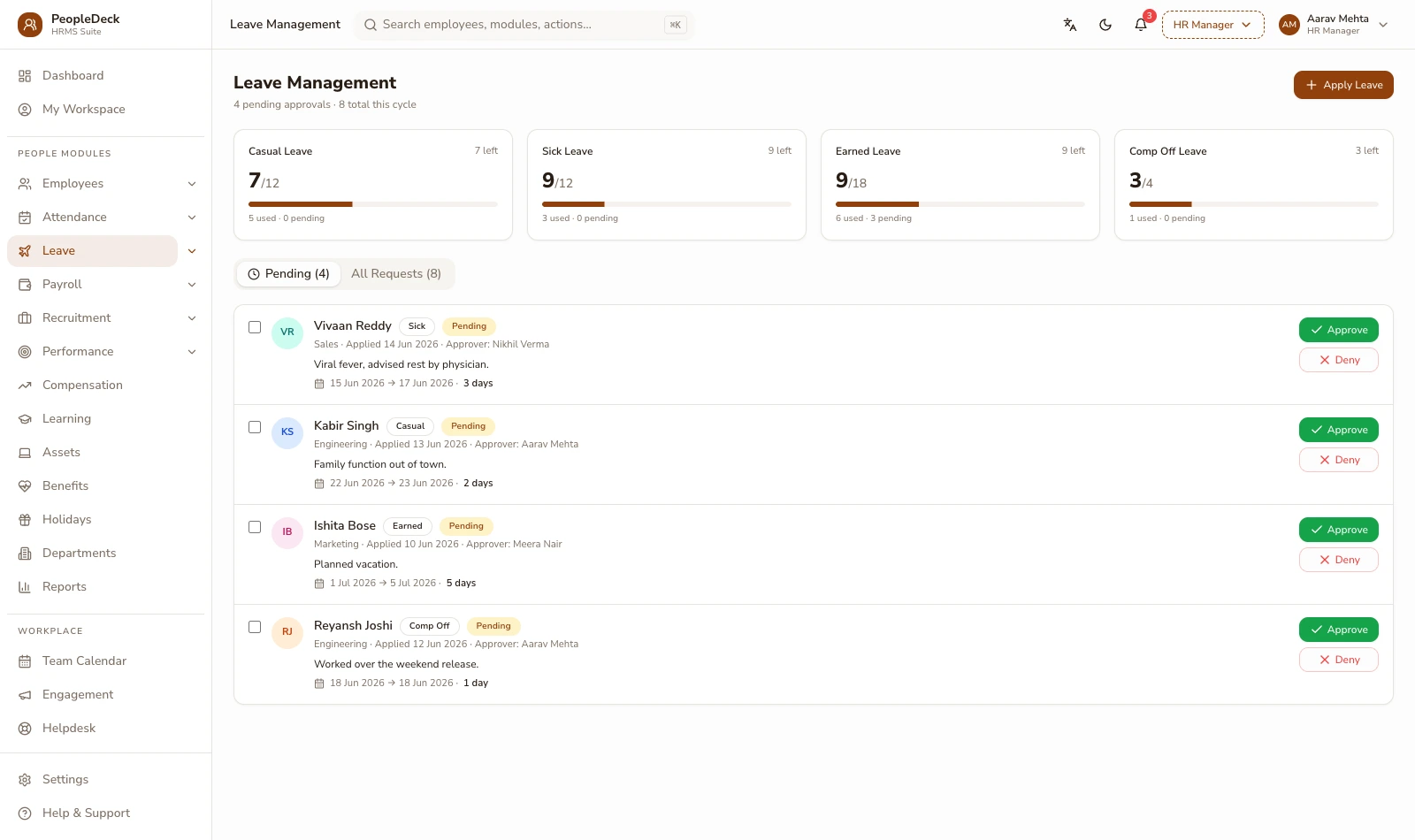
What does HR software for hotels do?
It runs attendance, leave and payroll for hotels — applying PF, ESI and TDS to every payslip and generating upload-ready return files, while handling what makes this industry different: departments, seasons and night allowances. PeopleDeck prices this per employee, per month.
Departments, seasons and night allowances
A hotel runs housekeeping, F&B, front office and maintenance as separate rosters with different shift patterns, and headcount swells every season. Payroll has to follow the department, not fight it.
The operational truth of hotel payroll is that no two departments experience the same month. Housekeeping runs on occupancy, a wedding block means overtime and borrowed staff from the banquet roster; F&B splits into kitchen brigades and service shifts with different meal-break rules; front office rotates through nights that carry allowances; maintenance is on call. A payroll system that treats the property as one homogeneous roster forces supervisors to reconcile these differences in side-sheets, and the side-sheets are where errors and disputes are born. PeopleDeck keeps each department's roster, shift rules and allowance logic separate at capture and merges them only where they should merge: in the run, on one payday, under one set of statutory files for the property.
How PeopleDeck runs it
- ✓ Department-wise rosters — housekeeping, F&B, front office, maintenance
- ✓ Seasonal joiners and leavers handled without breaking the monthly run
- ✓ PF, ESI, professional tax and TDS applied to every payslip — upload-ready return files, never filed on your behalf
- ✓ Self-service payslips, Form 16 data and leave balances for every employee
A month in hotel payroll
-
1
Rosters set the month up
Department heads publish their rosters — housekeeping's occupancy-driven weeks, F&B's split shifts, front office's night rotation. Night allowances and department rules attach to the roster itself, so the pay consequences of a schedule are decided when it is planned, not reconstructed at month-end.
-
2
Season and swaps absorbed mid-month
A banquet weekend pulls stewards across departments; a seasonal batch joins with end-dated contracts. Cross-department hours land against the right cost head, and every seasonal joiner starts accruing PF and ESI from day one, no 'we'll regularise them next month'.
-
3
Cut-off closes department by department
Each department's attendance closes against its own roster, and exceptions — missed punches during a full-house night, unapproved swaps — surface per department head, who clears their own list. HR consolidates instead of chasing.
-
4
One run for the property
The run computes salaries, night allowances, overtime and seasonal pro-ratas together; PF, ESI, PT and TDS apply to every payslip; ECR and return files generate for the property's registrations. Payday is one event, not four department events.
A worked example
Take a front-office associate on ₹18,000 gross who worked eight night shifts at a ₹150 night allowance, plus one paid holiday worked. The engine adds ₹1,200 of allowances and a compensatory-off credit, computes ESI on the allowance-inclusive wage (still under the ₹21,000 ceiling), applies PF on basic, and shows each line with its source, which roster, which rule. Now the seasonal steward hired for the wedding quarter at ₹18,000 with a March 15 end date: their final payslip pro-rates automatically, gratuity does not trigger (tenure short of five years), leave encashes per policy, and the full-and-final statement generates the day the contract ends. Neither case required a spreadsheet; both left an audit trail.
The property-level view completes the picture: this month's payroll cost splits by department — housekeeping absorbed the wedding overtime, F&B carried the seasonal batch, so the general manager reads labour cost against occupancy rather than as one opaque total. The same split feeds next season's budgeting, because last year's wedding quarter is now a queryable record instead of a manager's recollection.
Figures are illustrative, for mechanism only; your structures and rates will differ.
Key terms in hotel payroll
Night allowance
A fixed or per-shift amount for hours worked in notified night windows. Because it is wage-linked, it enters the ESI wage base, a detail hotels miss when allowances are paid as untracked cash.
Compensatory off
Leave credited for working a weekly off or holiday — common in full-occupancy weeks. Tracked as a balance with expiry rules, so it neither vanishes nor accumulates silently.
Fixed-term employment
Season-length contracts with an end date. Statutory treatment matches permanent staff during tenure; the settlement computes at contract close rather than waiting for a resignation.
Is PeopleDeck the right fit?
Built for you if
- ✓ You run departments with genuinely different shift patterns
- ✓ Seasonal headcount swings are a fact of your year
- ✓ Night and holiday allowances are part of the wage structure
- ✓ Multiple properties need consolidated but separable payroll
- ✓ Turnover makes onboarding a monthly routine
Not the fit if
- ✕ You want a property-management system. This is HR and payroll, not bookings
- ✕ Your staff are all on one identical 9-to-6 pattern; you'd be paying for flexibility you don't need
Mechanism deep-dives: the payroll engine · attendance & leave · statutory compliance
Switching without a bad payday
Most hotels arrive from one of two places: an outsourced payroll bureau that never understood departments, or an Excel estate maintained by an HR executive who dreads the 25th. The switch runs the same way from either: import the staff master with departments and structures, encode the roster patterns and allowance rules each department actually uses, then run one month in parallel (PeopleDeck beside the old method) and reconcile. The parallel month is where trust is earned: every variance is either the old sheet's rounding or a rule that needs one correction, and both are visible because the engine shows its arithmetic.
Go-live lands on a month boundary, seasonal contracts migrate with their end dates intact, and leave balances carry over as opening figures. The first fully-live month typically coincides with the first payday nobody stayed late for, and the property keeps its history, because the old records import as reference rather than being abandoned in a drawer.
One practical tip from properties that have made the switch: encode the banquet department's casual-call rules honestly rather than leaving them informal — banquet casuals are the hardest records to reconstruct at an inspection, and the easiest to capture correctly at the roster.
Not your industry?
Running a school or college? Staff payroll belongs inside your ERP: SchoolDeck staff payroll or CampusAlly payroll.
Related industries
Frequently asked questions
What does HR software for hotels include?
Attendance and rosters, leave, onboarding to full-and-final, and payroll with PF, ESI and TDS applied to every payslip, plus departments, seasons and night allowances handled natively. Employees get self-service payslips.
Does it work for seasonal staff?
Yes — fixed-term staff onboard with an end date, accrue PF and ESI like anyone else, and full-and-final settles automatically when the season closes.
How is PeopleDeck priced?
Per employee per month, in rupees. You pay for the headcount you run, no module bundles, no per-site fees.
Does PeopleDeck file PF and ESI returns?
No; it applies PF, ESI, professional tax and TDS and generates upload-ready ECR and return files. Filing stays with you or your consultant.
Can one employee work across two departments in a month?
Yes: hours land against the department where they were rostered, so the banquet cover a housekeeping associate did is costed to F&B while their payslip stays whole. Department-wise cost reports reflect where the work actually happened.
How are tips and service charge handled in hotels?
If your property pools and distributes service charge through payroll, it enters as a structured earning line, taxed correctly. Cash tips outside the payroll never touch the system: the payslip records what the employer pays.
Do multiple properties need multiple accounts?
No — properties run as locations under one account, each with its own rosters and cost heads, while statutory files generate per registered establishment. You see the group; the portal sees each property correctly.
Can night-audit and overnight shifts cross the date line cleanly?
Yes, a shift belongs to the day it was rostered, so the 11 p.m.–7 a.m. front-office shift counts as one attendance day with its night allowance, never as two half-days across a calendar boundary.
Payroll for hotels, without the spreadsheets.
Per employee, per month: attendance to upload-ready returns.
Start free