


HR software for pharma companies
Plant-shift attendance, field-force incentives, PF and ESI applied, and payslips across manufacturing and sales teams.
What does HR software for pharma companies do?
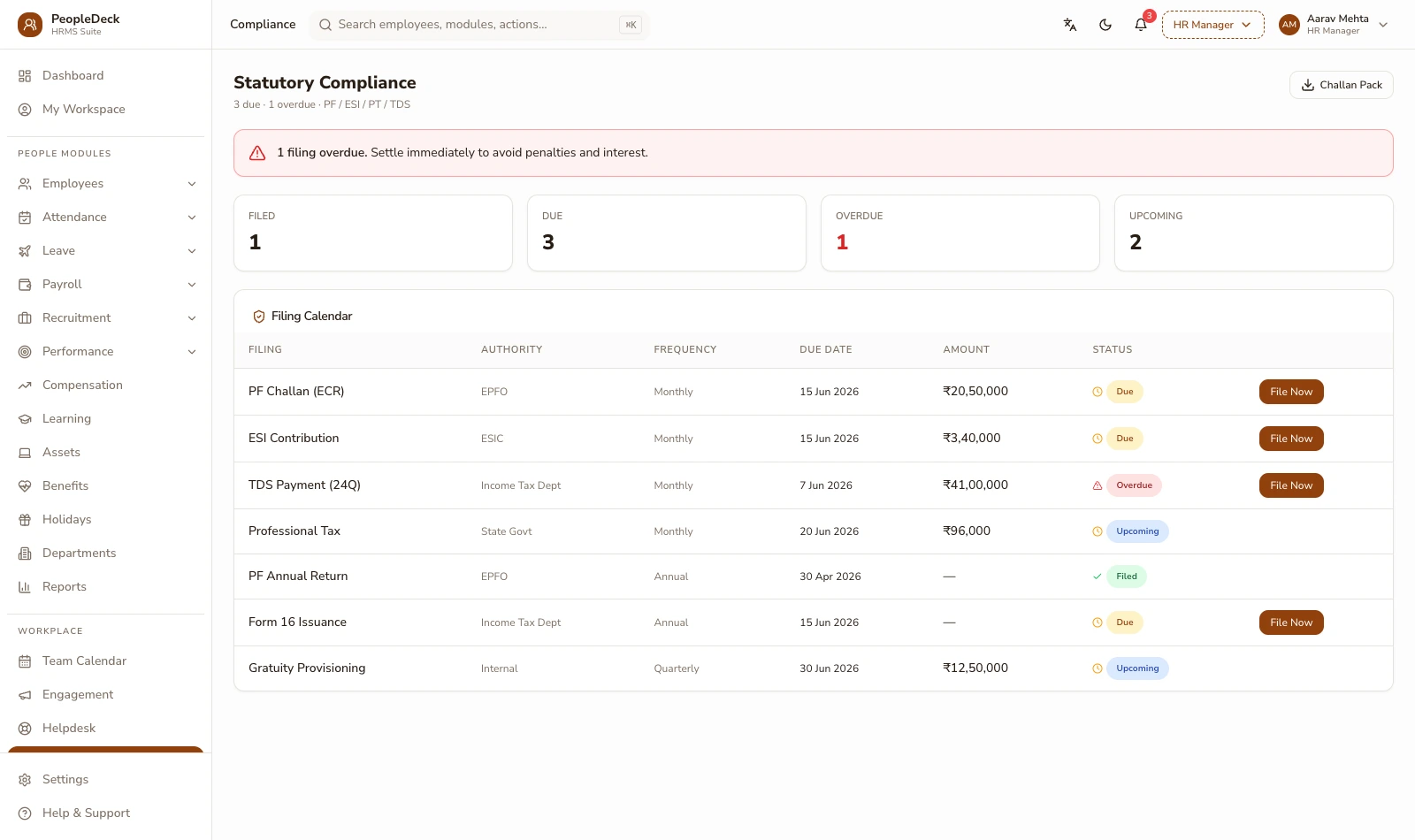
It runs attendance, leave and payroll for pharma companies — applying PF, ESI and TDS to every payslip and generating upload-ready return files, while handling what makes this industry different: plant shifts and field-force incentives. PeopleDeck prices this per employee, per month.
Plant shifts and field-force incentives
Pharma runs a plant on shifts and a medical-rep field force on incentives: two workforces with nothing in common except the employer. One payroll run has to serve both.
Pharma payroll pairs the sector's two unlike halves. The plant is regulated manufacturing: GMP-disciplined shifts, qualified-personnel grades where a QC chemist's structure differs from a production operator's, contractor crews in packing and warehousing, and audit expectations shaped by an industry where documentation is the product's shadow. The field is the medical-rep force (prescriber-facing, not distributor-facing like FMCG) earning incentives on prescription generation and target achievement, with expense-heavy months of travel, samples and conference duty flowing through claims. The two halves share nothing operationally, yet one establishment must pay both correctly. PeopleDeck runs plant payroll with grade structures and shift discipline, runs the rep force with scheme-based incentives and integrated expense settlement, and keeps the whole record at the documentation standard a pharma company's own quality culture (and its auditors) take as the baseline.
How PeopleDeck runs it
- ✓ Plant-shift attendance with overtime and differentials
- ✓ Field-force incentive structures computed per rep, per cycle
- ✓ PF, ESI, professional tax and TDS applied to every payslip — upload-ready return files, never filed on your behalf
- ✓ Self-service payslips, Form 16 data and leave balances for every employee
A month in pharma payroll
-
1
The plant runs on grades and shifts
Production, QC and QA staff carry grade structures; shifts rotate with premiums; overtime tracks against limits. Certification-linked grade moves apply with effect dates, arrears computed: the qualification ladder reflected in pay, on the record.
-
2
The field runs on schemes and claims
Rep incentives — target achievement, prescription-linked components per your compliance policy — compute from approved data under effect-dated schemes. Tour claims, daily allowances and expense settlements route through approval and pay with the run or on their own cycle.
-
3
Contractors evidence their layer
Packing and warehouse contractor gangs stay on the contractors' payrolls while their compliance evidence (registrations, ECR, challans) collects monthly against your principal-employer file, site by site.
-
4
One establishment closes correctly
Plant wages, rep salaries, incentives and settled claims compute with PF, ESI where applicable, multi-state PT for the field and TDS throughout; payslips itemise; registers and statutory files generate audit-ready.
A worked example
A QC chemist in grade Q2 on ₹32,000 works a rotation with six night shifts at ₹150 and clears her Q3 certification effective the 20th: the run splits the month across grades to the day, computes the differential arrears, and shows the workings. In the field, a medical rep on ₹30,000 with a ₹7,500 quarterly-scheme instalment and ₹9,200 of approved tour claims sees three cleanly separated lines: salary with statutory deductions, incentive citing its scheme, and expense reimbursement untaxed as claims: the separation that keeps both the taxman and the rep satisfied. His PT deducts for Maharashtra; his Hyderabad counterpart's for Telangana. The month's registers hold plant and field in one establishment record, at the documentation standard a GMP company recognises as its own.
Management reads both halves from one place: plant cost per line and grade mix against output, field cost per territory against scheme achievement, claims trend by region. At budget season, the perennial pharma debate (field-force expansion versus plant automation) starts from each side's actual, evidenced cost rather than duelling estimates.
Figures are illustrative, for mechanism only; your structures and rates will differ.
Key terms in pharma payroll
Qualified-personnel grades
Structures attached to certification levels — operator, chemist, officer. Grade moves are effect-dated and arrear-computing, keeping the qualification ladder and the wage record synchronised.
Prescriber-facing incentives
Rep schemes built on target achievement and prescription generation (distinct from FMCG's distributor-sales logic) computed from approved data under published, effect-dated schemes.
Claims-versus-wages separation
Tour expenses reimburse tax-free as claims; incentives tax as income. Keeping the lanes separate on the payslip is both a tax requirement and the rep force's most-watched fairness signal.
Is PeopleDeck the right fit?
Built for you if
- ✓ Plant grades and field schemes must run under one establishment
- ✓ Reps earn on prescriber-facing schemes with heavy expense flows
- ✓ QC and production staff climb certification-linked structures
- ✓ Contractor gangs work packing and warehouse lines
- ✓ Your quality culture expects payroll documentation to match GMP standards
Not the fit if
- ✕ You want CRM, e-detailing or sample-tracking software. This consumes approved outcomes as pay inputs
- ✕ All manufacturing is at a third-party CMO; their plant workforce is their payroll; your field force still fits here
Mechanism deep-dives: the payroll engine · attendance & leave · statutory compliance
Switching without a bad payday
Pharma companies switch plant-first or field-first depending on where the pain is louder; the discipline is the same. Plant migration encodes grades, rotations and premium rules, then runs a parallel cycle that reliably surfaces grade arrears never processed and overtime drifting past limits. Field migration encodes the current schemes and the claims policy, then reconciles a parallel month against the regional workings — where the classic finding is incentive formulas interpreted differently by every regional manager.
Both halves converge on one establishment record within a quarter or two, and the company gains what its quality culture always implied it should have: wage documentation that would survive the same scrutiny as a batch record. Inspections, statutory audits and internal reviews draw from exports; the rep force trusts the three-lane payslip; the plant's union conversations open on shared arithmetic. The discipline to keep: schemes, grades and premiums change only with effect dates and owners, in a documentation culture, an undocumented pay change is the one artifact that should never exist. Documentation culture transfers both ways; teams that live with batch records take to computed payroll faster than any other industry we describe on these pages.
Not your industry?
Running a school or college? Staff payroll belongs inside your ERP: SchoolDeck staff payroll or CampusAlly payroll.
Related industries
Frequently asked questions
What does HR software for pharma companies include?
Attendance and rosters, leave, onboarding to full-and-final, and payroll with PF, ESI and TDS applied to every payslip, plus plant shifts and field-force incentives handled natively. Employees get self-service payslips.
Can MR incentives be automated?
Yes — incentive structures are defined per cycle and computed into the run, so a rep's payslip shows base, allowances and incentives as separate lines.
How is PeopleDeck priced?
Per employee per month, in rupees. You pay for the headcount you run, no module bundles, no per-site fees.
Does PeopleDeck file PF and ESI returns?
No; it applies PF, ESI, professional tax and TDS and generates upload-ready ECR and return files. Filing stays with you or your consultant.
How are rep expense claims kept clean against incentives?
Claims route through approval with receipts and settle as untaxed reimbursement; incentives compute from schemes and tax as income. The two never blend on the payslip: the separation audits and reps both check first.
Can UCPMP-style compliance constraints shape incentive schemes?
Schemes are your policy encoded — whatever your compliance framework permits computes transparently, with published formulas and cited data, which is itself the defensible posture.
How do plant shift premiums and Factories Act limits interact?
Premiums attach to rostered shifts; overtime computes at statutory rates with hours tracked against limits and breaches flagged before they become findings: the plant's discipline, extended to its wages.
What about field-force attrition and territory handovers?
Exits settle with scheme instalments computed to date and claims closed; the territory's incumbent history stays on record, so the successor's targets and the region's cost trend keep their continuity.
Can it support multiple divisions (branded, generics, OTC) with different field schemes?
Yes — divisions run their own schemes and hierarchies under the shared establishment, costs report per division, and a rep moving divisions carries a dated transfer like any other governed change.
Payroll for pharma companies, without the spreadsheets.
Per employee, per month: attendance to upload-ready returns.
Start free