


Claims without: the shoebox
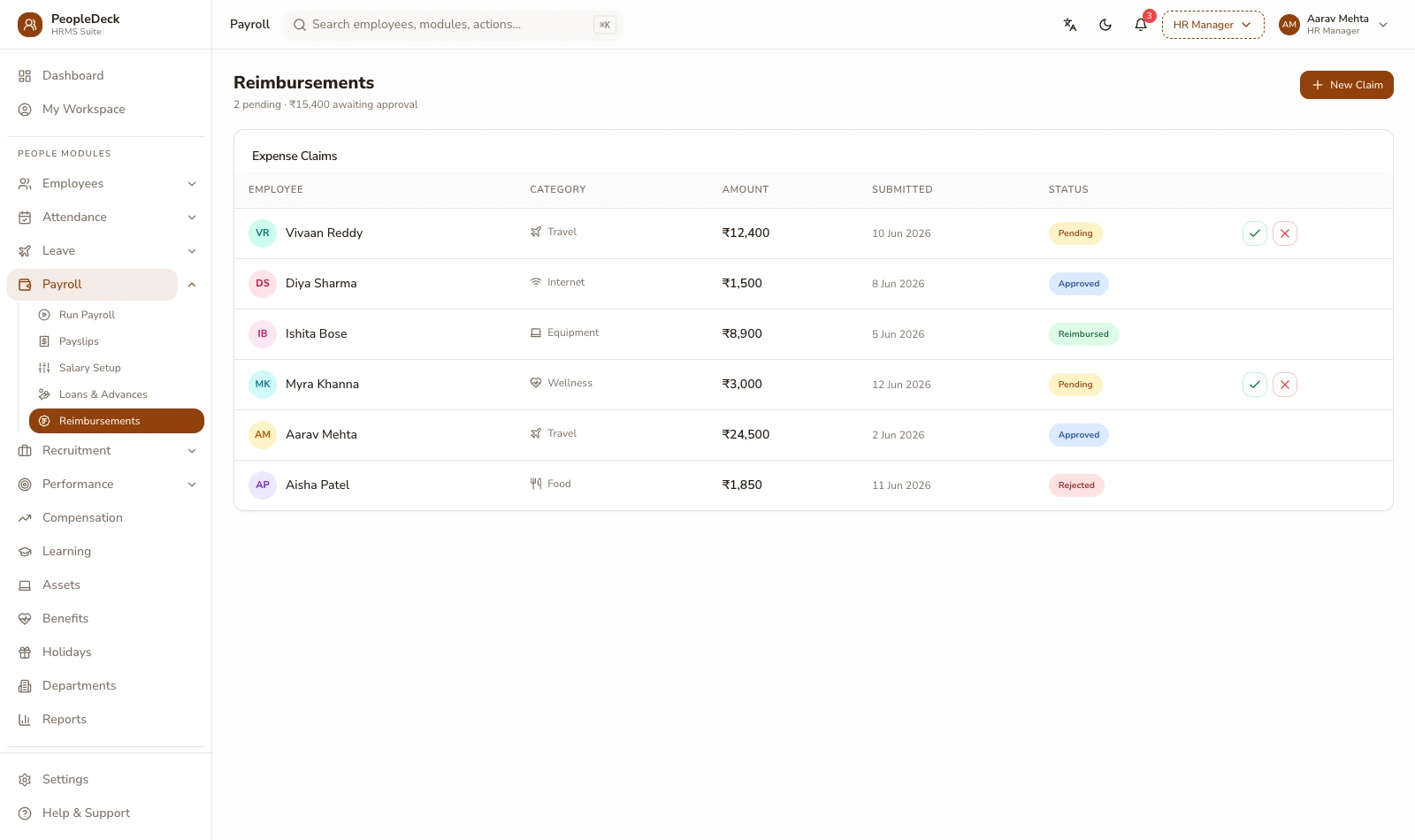
Expense management here is the whole loop: employees submit claims with receipts from the portal or app, policy limits check themselves at submission, approvals route by your rules, and approved amounts pay out through the payroll run or a separate payout, every step categorised, limited and logged. This is employee expense only, by design; vendor bills belong to your accounting stack. Approvals route by amount and reporting line, and every paid rupee traces back to its receipt.
How it works
-
1
Submit at the moment the expense exists
A sales executive photographs the fuel receipt at the pump; a technician snaps the spare-part bill at the counter. The claim carries the receipt image, category, amount, date and (where you use them) the cost centre or project it belongs to. Claims filed in the moment are complete claims; the month-end shoebox of faded receipts stops being a thing.
-
2
Let policy answer before a human has to
Each category carries its rules: per-claim and per-month limits, receipt requirements above a threshold, eligible grades or roles. The rules run at submission, an over-limit claim is flagged to the employee immediately and routes for exception approval rather than bouncing between inboxes. People stop having awkward conversations the policy should have had.
-
3
Route approvals like you route everything else
Claims route by reporting line, amount band or category, a ₹400 conveyance claim might need one manager; a ₹40,000 travel claim might need two levels and finance. Approvers see the receipt, the policy state and the claimant's recent history in one view, and their decision is a recorded action.
-
4
Pay through payroll or on its own, per category
Approved claims either join the next payroll run as a reimbursement line (non-taxable where the rules say so, shown separately on the payslip) or pay through a standalone reimbursement run when waiting for payday is wrong; your choice, set per category. Either path keeps the same trail from receipt to payout.
-
5
Close the loop for finance
Every paid claim carries its category, cost centre, approver chain and receipt, so expense reporting by department, project or category is a filter, not a reconstruction. When finance asks 'why is conveyance up 40% this quarter', the answer is three clicks of drill-down, receipts attached.
-
6
Give the policy a feedback loop
Once claims run through categories and limits, the policy itself becomes measurable: which limits are constantly hit, which categories carry the spend, where exceptions cluster. Quarterly, that is a fifteen-minute review that keeps policy matched to reality: tightening what leaks, raising what genuinely constrains work, instead of a document nobody has read since it was written.
One claim's life, receipt to payslip
Illustrative: a field engineer in Nagpur files a ₹1,850 local-travel claim with two receipts photographed on-site, against a ₹3,000 monthly cap. Policy validates instantly; the claim routes to her manager, who approves from the app with the receipts on screen. Category is set to pay via payroll: the amount appears on her next payslip as a separate reimbursement line (outside taxable earnings, clearly labelled) and the claim record closes holding receipts, approver and payout reference. Finance's monthly expense report already includes it, categorised and cost-centred. At quarter-end, finance's category report shows conveyance clustering at the cap: the policy review raises the cap ₹500 and the exception queue empties.
Employee expenses only, and why the line matters
This module reimburses employees for travel, meals, telecom, local conveyance, tools bought in the field. It is deliberately not a vendor-bill or procurement system: purchase orders, vendor GST invoices and supplier payments belong to your accounting stack, where input-credit and vendor-ledger logic live. Keeping the two apart is what keeps both auditable, an employee reimbursement trail stays clean when it never mixes with supplier payables. Claims data, like all PeopleDeck data, stays India-hosted and access-controlled.
The audit consequence is worth naming: because every paid rupee traces to a receipt, an approver and a policy state, expense audits become sampling exercises instead of excavations, and the awkward category of 'approved because asking felt rude' quietly disappears from your books.
Key terms, plainly
Reimbursement line
The payslip line that pays an approved claim, separate from earnings, marked non-taxable where rules allow, traceable back to the claim and receipt.
Per-category limit
The policy cap on a claim type (per claim or per month) enforced at submission with exceptions routed, not silently allowed.
Exception approval
The recorded escalation for an over-limit or out-of-policy claim, so exceptions are decisions with owners instead of quiet allowances.
Standalone payout run
A reimbursement payment made outside payroll, same approvals, same trail, used where waiting for payday is not reasonable.
What you get
- ✓ Receipt-backed claims from the portal and app, categorised at source
- ✓ Policy limits and receipt rules enforced at submission
- ✓ Approval routing by amount, category or reporting line
- ✓ Payout via payroll line or standalone run, per category
- ✓ Category and cost-centre reporting with receipts attached
| Belongs here | Belongs in accounting |
|---|---|
| Travel, meals, conveyance claims | Vendor GST invoices |
| Field purchases by employees | Purchase orders |
| Telecom and tool reimbursements | Supplier payments and ledgers |
| Payslip reimbursement lines | Input tax credit |
Works with: Employee self-service · Payroll engine · Mobile app
Retiring the reimbursement spreadsheet
The monthly claims sheet survives on habit: employees hoard receipts, someone types them up, finance queries the illegible ones, and payment lands two cycles late. Switching flips the sequence: claims are born digital at the receipt moment, policy answers instantly, and finance's month-end is a review of exceptions rather than a data-entry sprint. Set the policy honestly during rollout: the limits you actually intend, the categories you actually reimburse, the receipts you actually require. A policy the system enforces evenly is also the end of the awkward-exception economy that spreadsheets quietly ran. Finance teams keep the last word: any claim category can be frozen mid-quarter when budgets demand it, with the freeze logged like everything else.
Rollout checklist
- 1.Define categories with limits, receipt rules and tax treatment
- 2.Choose payroll-line vs standalone payout per category
- 3.Set approval routing by amount and reporting line
- 4.Load cost centres and projects for tagging
- 5.Pilot with one field team for a fortnight
- 6.Retire the sheet; claims live where receipts are photographed
Is this the right fit?
Built for you if
- ✓ Reimbursements take two cycles because claims arrive as paper batches
- ✓ Policy exists in a PDF nobody applies evenly
- ✓ Finance cannot slice spend by team or project without rebuilding it
Not the fit if
- ✕ You want corporate-card reconciliation feeds; claims here start from receipts, not card statements
- ✕ You want vendor invoice processing — supplier payables belong in accounting, by design
Related features
Running a school or college? Staff payroll belongs inside your ERP: SchoolDeck staff payroll or CampusAlly payroll.
Frequently asked questions
Can claims pay outside the salary run?
Yes — per category you choose payroll payout or a standalone reimbursement run; both keep the receipt-to-payout trail.
Do policy limits block a claim?
Over-limit claims are flagged at submission and route for exception approval — visible rules, recorded exceptions, no silent bounces.
Are reimbursements taxed?
Categories carry their tax treatment: genuine reimbursements stay outside taxable earnings and appear as separate payslip lines; anything taxable is computed as such by payroll.
Can claims carry a project or cost centre?
Yes — claims tag to cost centres or projects at submission, and expense reports slice by them directly.
What stops duplicate claims?
Same-amount-same-date checks flag likely duplicates to the approver, and every claim's receipt and history sit on one record for the human call.
Can finance export everything?
Yes — paid claims export with category, cost centre, approver chain and payout reference, ready for the books.
How is PeopleDeck priced?
Per employee per month, in rupees — claims are part of the product for everyone, not a per-claim fee.
Can advances be issued and settled?
Yes — travel advances issue through approval and settle against subsequent claims, with the balance visible until it closes.
Can mileage be claimed at a per-km rate?
Yes — distance-based categories compute at the rate you set, so field teams claim kilometres instead of guessing amounts.