


Reviews that inform: humans who decide
PeopleDeck runs your appraisal cycle — goals and KRAs set per role, self and manager reviews collected against them, ratings consolidated into one record, and then stops, deliberately. The system compiles facts for a decision; it never becomes the decision. No auto-computed increments, no sentiment scoring, no algorithmic verdict on a person. Cycles fit annual, half-yearly or quarterly rhythms, and every outcome stays on the permanent record.
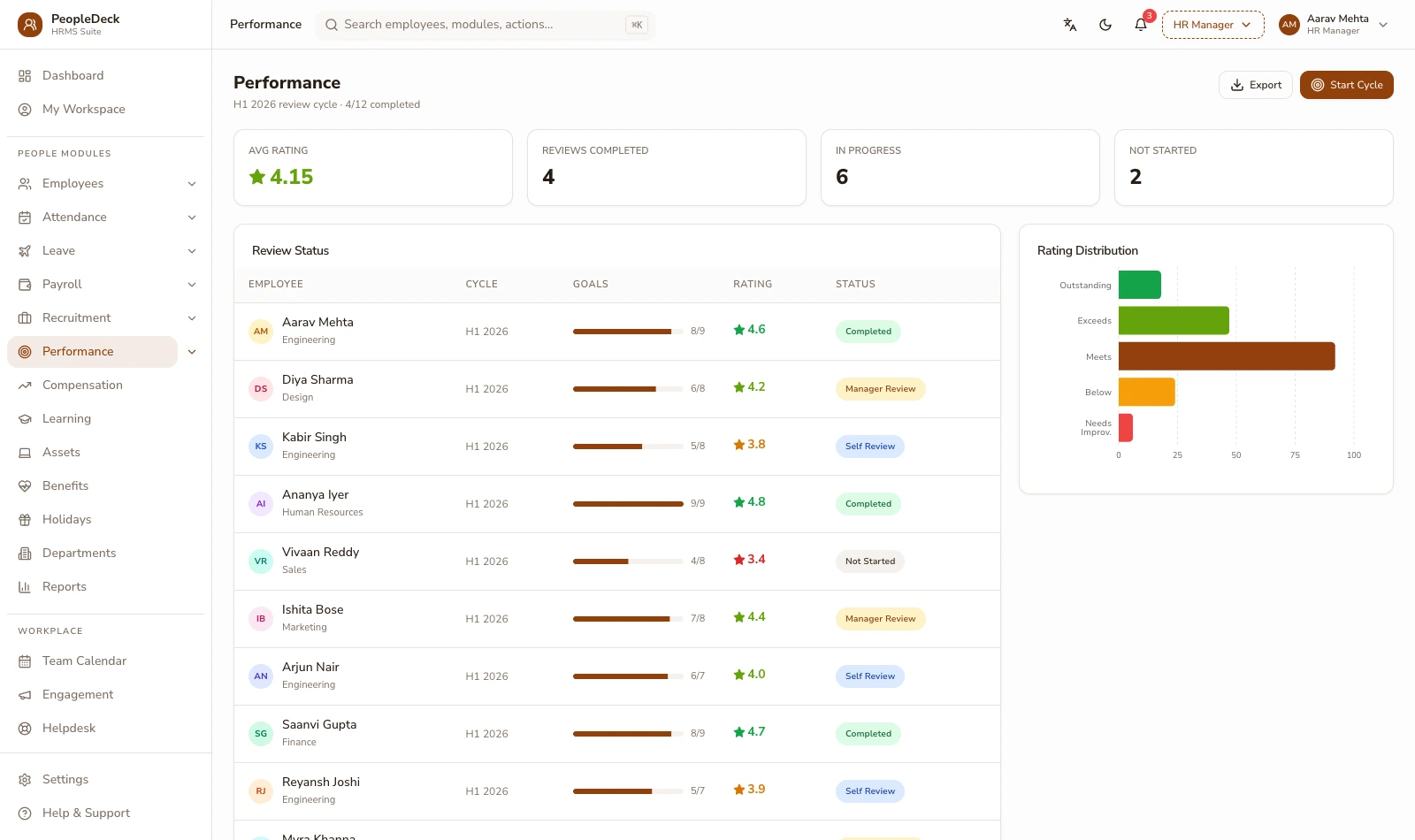
How it works
-
1
Define the cycle you actually run
Annual, half-yearly or quarterly; company-wide or per department; simple manager reviews or self-plus-manager with a calibration step: the cycle is configuration, not consulting. Deadlines, reminders and completion tracking come with it, so the cycle that used to live in a coordinator's follow-up emails runs itself.
-
2
Set goals people can actually be reviewed against
Goals and KRAs are set per role or per person, weighted, and visible to both sides all cycle, not rediscovered the week reviews open. Mid-cycle check-ins and goal edits are recorded with dates, so the year's story is on the record rather than reconstructed from memory.
-
3
Collect reviews against the same facts
Self-assessment and manager review answer the same goal sheet. Attendance patterns, tenure, and training records can be surfaced alongside as context — facts feeding the reviewer, not scores replacing them. Drafts stay private until submission; visibility is role-based throughout.
-
4
Consolidate into one record per person
Ratings, comments, goal outcomes and the cycle's history consolidate into a single appraisal record. Calibration views let leadership compare distributions across teams, as information for the humans calibrating, never as an auto-normalisation that rewrites anyone's rating.
-
5
Hand the record to a human decision
Increments, promotions, improvement plans — whatever follows the cycle is entered by a person with the record in front of them. A rating can feed payroll as an input, but only as a figure someone approves; the system never converts a score into a salary change on its own.
-
6
Let the record outlive the manager
Managers change; the appraisal record should not reset when they do. Because cycles accumulate per person (goals, reviews, ratings, outcomes) a new manager inherits history instead of hearsay, and an employee's trajectory survives reorganisations. This is also the fairness argument: consistency across cycles is only checkable when the cycles are comparable and kept.
One cycle, honestly described
Illustrative: a 40-person company runs a half-yearly cycle. HR configures self-plus-manager reviews with five weighted goals per role; the system opens the cycle, chases the stragglers, and closes with completion at a glance. Leadership sees consolidated records and a distribution view across three teams, notices one team's ratings skew high, and discusses it in calibration, a conversation, minuted by people. Two promotions and one improvement plan are decided and entered by managers. Payroll receives approved increment figures as inputs to next month's structures. At no point did the software decide anything about anyone. When one team's manager moved on mid-year, her successor read three cycles of records before the first one-on-one, no reset, no folklore.
Facts, not a verdict: the line this page exists to hold
Performance tooling is where HR software most often oversteps, so the boundary is explicit: PeopleDeck never auto-decides a rating, a raise, a promotion or a termination, and it does not do sentiment analysis, attention tracking or engagement scoring of any kind, that family of claims is banned from the product, not just from the marketing. What the system does is make the factual record complete, comparable and durable, because the quality of a human decision is bounded by the quality of the record it is made on.
This restraint is also what makes the tool adoptable: managers engage honestly with a system that records their judgement rather than replacing it, and employees trust a cycle whose ratings were visibly made by people who know their work. The credibility of the record is the product.
Key terms, plainly
KRA
Key Responsibility Area: the weighted responsibility a person is reviewed against, set per role and visible to both reviewer and reviewed all cycle.
Calibration
The human moderation step where leadership compares rating distributions across teams before finalising — supported by views, decided by people.
Appraisal record
The consolidated, durable record of a cycle for one person: goals, self and manager reviews, ratings and outcomes.
Improvement plan
A structured, time-bound record of expectations and support following a review — created and owned by a manager, tracked like any workflow.
What you get
- ✓ Cycles configured your way: cadence, participants, review structure
- ✓ Weighted goals and KRAs, visible all cycle, edits on the record
- ✓ Self and manager reviews on the same goal sheet, role-based visibility
- ✓ Consolidated records with distribution views for human calibration
- ✓ Outcomes entered by people; ratings feed payroll only as approved inputs
| Does | Never does |
|---|---|
| Compiles reviews and ratings into a record | Auto-decides a rating or increment |
| Shows distribution views for calibration | Auto-normalises anyone's score |
| Surfaces attendance/tenure as context | Sentiment, attention or engagement scoring |
| Feeds approved figures to payroll | Converts a score into pay on its own |
Works with: Employee database · Payroll engine · Employee self-service
Running your first structured cycle
Teams moving from ad-hoc annual chats to a structured cycle should resist the urge to configure everything at once. A strong first cycle is modest: five weighted goals per role, self-plus-manager reviews, one calibration conversation. What the structure changes immediately is evidence — reviews reference goals that were visible all along, and disagreements become discussions about recorded facts rather than duels of recollection. By the second cycle, the appraisal record starts doing its real work: promotion cases read from history, improvement plans have baselines, and the increment conversation starts from the same page — literally. That restraint is also what makes review data usable years later: it records what people said and decided, uncoloured by a score nobody remembers agreeing to.
First-cycle checklist
- 1.Pick the cadence and participants for cycle one
- 2.Set five weighted goals per role, no more to start
- 3.Configure self + manager review forms
- 4.Schedule one calibration review of rating distributions
- 5.Record outcomes as human decisions with effective dates
- 6.Retrospect the cycle before configuring the next
Is this the right fit?
Built for you if
- ✓ Appraisals happen in documents that vanish after the meeting
- ✓ Increments get decided without a consistent record behind them
- ✓ You want structure without buying surveillance-flavoured 'engagement' tooling
Not the fit if
- ✕ You want AI to score, rank or flag employees; that is exactly what this module refuses to do
- ✕ You want continuous OKR cascades for a 5,000-person org — PeopleDeck's cycles target SME-scale honesty, not enterprise ceremony
Related features
Running a school or college? Staff payroll belongs inside your ERP: SchoolDeck staff payroll or CampusAlly payroll.
Frequently asked questions
Does it auto-calculate increments?
No; it consolidates the cycle into a record; any pay change is entered and approved by a person. The rating can inform the figure, never generate it.
Can we run confidential reviews?
Yes — drafts are private until submission and visibility is role-based throughout, including calibration views restricted to leadership.
Does it support 360-degree feedback?
Cycles support self and manager reviews with additional reviewer roles where configured — always as named, accountable inputs to the same record.
Can goals change mid-cycle?
Yes, with the change recorded and dated, so the review reflects the goals as they actually evolved rather than as they began.
Does any AI score my employees?
No, no sentiment analysis, no attention tracking, no engagement scores. The product compiles human inputs; it does not manufacture judgements.
How do outcomes reach payroll?
As approved figures a human enters (an increment amount, an effective date) which payroll then computes with arrears if backdated.
How is PeopleDeck priced?
Per employee per month, in rupees — performance cycles included, not an upsell module.
Can probation reviews use the same system?
Yes — probation confirmations run as short cycles with their own forms, so the confirmation decision has a record like any appraisal.
Are past cycles comparable?
Yes, each person's appraisal records accumulate cycle over cycle, so trajectory is visible when a promotion case is argued.