


HR software for creative and digital agencies
Project staffing, variable and freelance pay, PF and ESI applied, and self-service for distributed teams.
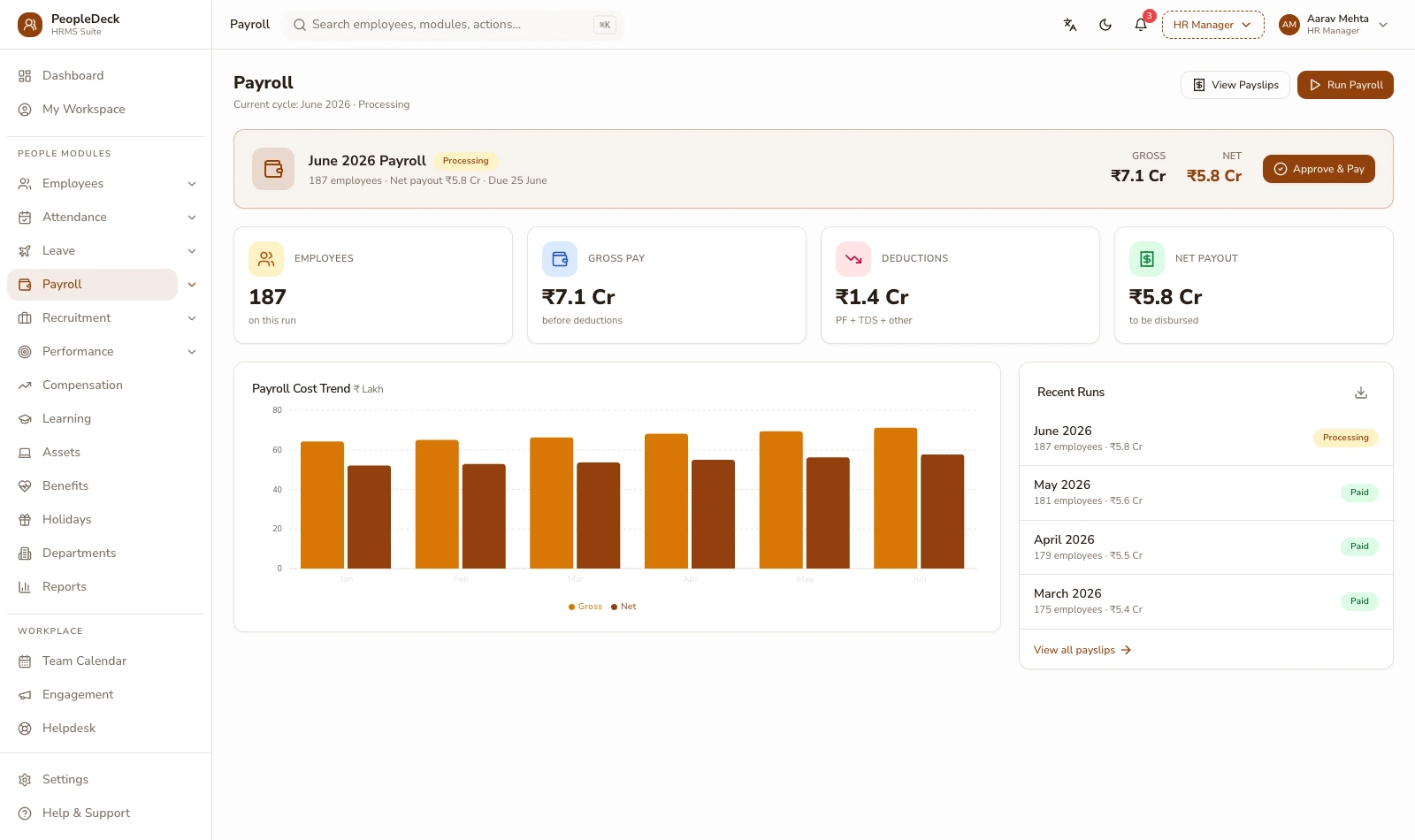
What does HR software for creative and digital agencies do?
It runs attendance, leave and payroll for creative and digital agencies — applying PF, ESI and TDS to every payslip and generating upload-ready return files, while handling what makes this industry different: projects, retainers and freelancers. PeopleDeck prices this per employee, per month.
Projects, retainers and freelancers
Agency teams re-form around every project, pay mixes salary with variable components, and half the roster might be freelance. Payroll needs to keep employees and freelancers cleanly apart while both show up in project costs.
Agency payroll mirrors agency economics: people are the inventory, and the inventory reorganises around every pitch won. A designer is 40% on the FMCG retainer, 30% on a product launch, and the rest on new business; a copywriter's month includes a retention bonus and an overdue increment backdated to April; and beside the payroll sit the freelancers (editors, animators, strategists) who must be paid promptly, taxed under the right section, and never confused with employees. The confusion is the expensive part: a freelancer processed like an employee creates statutory mess, and an employee treated like a freelancer creates worse. PeopleDeck keeps the two populations structurally apart — employees with salaries, PF and TDS under salary sections; freelancers with professional fees under 194J-style treatment, while both flow into the same project-cost picture the founders actually manage by. The month's creative chaos stays creative; the money layer underneath stays boringly correct. The test of agency payroll is pitch-win month: three new hires, a team reshuffled across four accounts, two freelancers converted to staff, and the month still closing on one preview, with every account's cost already true.
How PeopleDeck runs it
- ✓ Employee payroll beside freelancer payout records — kept statutorily separate
- ✓ Variable and incentive components per project or retainer
- ✓ PF, ESI, professional tax and TDS applied to every payslip — upload-ready return files, never filed on your behalf
- ✓ Self-service payslips, Form 16 data and leave balances for every employee
A month in agency payroll
-
1
Allocations follow the work
People carry project allocations (percentages or timesheets) that re-map when accounts win, lose or reshuffle. Effect dates mean February's costing stays true even after March's reorganisation.
-
2
Variable pay enters as structured input
Retention bonuses, backdated increments, spot awards, each enters with its type and effect date. Backdated changes compute their own arrears with workings shown, instead of an HR side-calculation.
-
3
Freelancers process in their own lane
Freelance invoices route through approval with TDS at the professional rate, paid on their cycle (not payroll's) and never touching PF, ESI or salary TDS. The separation is enforced by category, not vigilance.
-
4
The run costs the studio
Salaries compute with statutory lines; the month's people-cost (employees plus freelance spend) lands per client and project. Account profitability finally includes the real cost of the people who made the work.
A worked example
A senior designer on ₹85,000 gross gets an increment to ₹95,000 effective April, processed in June: the run computes two months of arrears with month-wise workings on the payslip, reprojects TDS across the remaining year, and updates the retainer account's cost from April in the project reports. The same month, a freelance motion designer bills ₹60,000 for the launch film: approved, TDS deducted at the professional rate, paid on the freelancer cycle, and costed to the launch project — without ever appearing in payroll. The founders' month-end view shows the FMCG retainer consuming ₹4.1 lakh of people-cost against its ₹6 lakh fee, the launch project over its people budget by 12%, and new business burning 18% of studio capacity — numbers that used to be a quarterly guess.
Over a few quarters the same data answers the strategic question agencies avoid: which kind of work the studio actually makes money on. Retainers versus projects, film versus digital, this client versus that, each carries its true people-cost, so pricing the next pitch starts from evidence rather than bravado.
Figures are illustrative, for mechanism only; your structures and rates will differ.
Key terms in agency payroll
Employee vs freelancer treatment
Employees draw salaries with PF and salary-section TDS; freelancers bill fees under professional-section TDS with no statutory contributions. Misclassification in either direction is the agency sector's most common compliance wound.
Backdated increment
A salary revision effective in the past, computing arrears month by month with TDS reprojection. Agencies (chronic late reviewers) process more of these than almost any industry.
Project people-cost
Salary and freelance spend allocated to clients and projects. It is the number that turns account profitability from folklore into management information.
Is PeopleDeck the right fit?
Built for you if
- ✓ Teams re-form around projects and retainers continuously
- ✓ Freelancers are a structural part of your delivery
- ✓ Increments run late and arrive backdated
- ✓ Account profitability is currently estimated, not computed
- ✓ Variable pay (bonuses, spot awards) moves monthly
Not the fit if
- ✕ You want project-management or traffic software. This costs the people, it doesn't schedule the work
- ✕ Your shop is founders plus freelancers with no employees — payables handles that without payroll
Mechanism deep-dives: the payroll engine · attendance & leave · statutory compliance
Switching without a bad payday
Agencies switch between campaigns, not during one. The sequence: employee master with structures and the current allocation map, freelancer roster moved into the payables lane with their PANs and rate cards, then one month in parallel against the current spreadsheet-and-instinct system. The parallel month's findings are predictable for the sector: two freelancers who statutorily look like employees, TDS on professional fees deducted at the wrong rate, and increments promised in review letters that never reached the payroll sheet.
Each finding is a correction made once: the misclassifications regularised, the rates fixed, the increment letters reconciled. From go-live, the founders get the two things agency payroll never gave them: a month-end that doesn't depend on the ops lead's memory, and account-level cost truth in time to affect the next pricing conversation. The discipline to keep: no allocation changes by chat message; if the reshuffle isn't recorded with an effect date, the costing quietly reverts to fiction.
Not your industry?
Running a school or college? Staff payroll belongs inside your ERP: SchoolDeck staff payroll or CampusAlly payroll.
Related industries
Frequently asked questions
What does HR software for creative and digital agencies include?
Attendance and rosters, leave, onboarding to full-and-final, and payroll with PF, ESI and TDS applied to every payslip, plus projects, retainers and freelancers handled natively. Employees get self-service payslips.
Do freelancers get payslips?
Freelancers get payout records, not payslips; they sit outside PF and ESI, which PeopleDeck applies only to employees. Both still appear in your project cost view.
How is PeopleDeck priced?
Per employee per month, in rupees. You pay for the headcount you run, no module bundles, no per-site fees.
Does PeopleDeck file PF and ESI returns?
No; it applies PF, ESI, professional tax and TDS and generates upload-ready ECR and return files. Filing stays with you or your consultant.
How does timesheet-based allocation work for costing?
Where you run timesheets, the month's actual hours drive the project split; where you don't, declared percentages apply. Either way the basis is stored with the month, so historical costing never shifts under you.
Can freelancer payments respect different cycles?
Yes — freelance payables run on their own cadence (weekly, fortnightly, on-approval) independent of payday, with TDS accumulated correctly for quarterly returns.
What about ESOP or phantom-equity components for senior staff?
Cash components process through payroll with correct taxation; grant and vesting records belong in your equity tooling. The payslip carries what is paid, not what is promised.
Do retainer accounts get monthly cost reports automatically?
Yes, each client's month closes with its people-cost from allocations and freelance spend, in the shape finance and the account lead both read, no assembly required.
Can it handle interns and probationers alongside regular staff?
Yes — interns run on stipend structures with their own treatment, probationers carry confirmation dates that trigger structure changes automatically, and both convert to regular records without re-entry.
Payroll for creative and digital agencies, without the spreadsheets.
Per employee, per month: attendance to upload-ready returns.
Start free