


HR software for CA and accounting firms
Article-assistant stipends, staff salaries, PF, ESI and TDS applied, and leave and attendance from one dashboard.
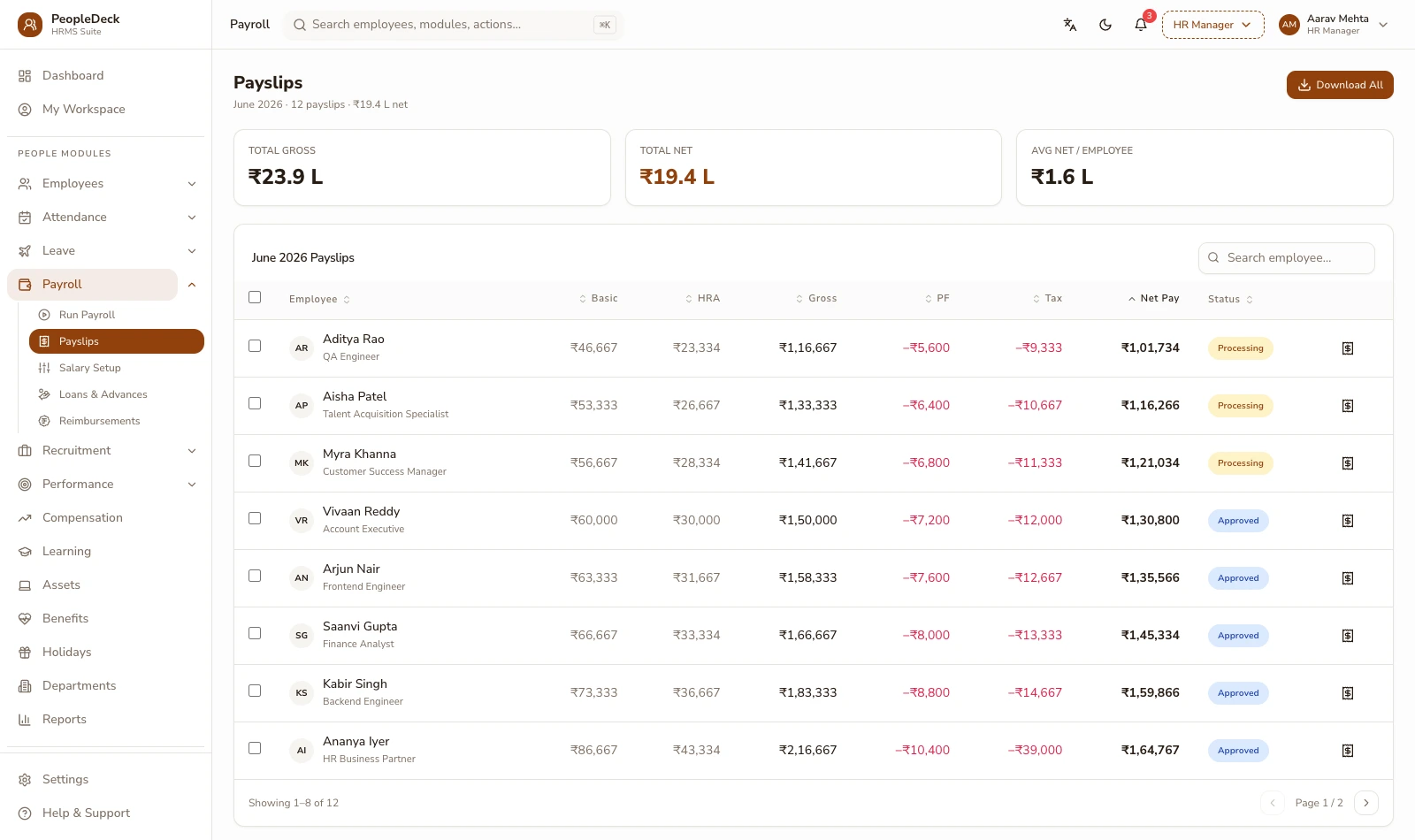
What does HR software for CA and accounting firms do?
It runs attendance, leave and payroll for CA and accounting firms — applying PF, ESI and TDS to every payslip and generating upload-ready return files, while handling what makes this industry different: stipends, staff and your own payroll. PeopleDeck prices this per employee, per month.
Stipends, staff and your own payroll
A CA firm pays article assistants stipends and staff salaries under one roof, with the firm's own PF, ESI and TDS to keep clean. This page is about running your own firm's payroll; running payroll for your clients is a different product conversation.
A CA firm's own payroll is a study in categories the profession itself invented. Article assistants draw stipends under CA Regulations, not salary, no PF or ESI, but with records the Institute expects. Paid assistants and qualified staff draw salaries with the full statutory treatment. Partners draw against profit shares, outside payroll entirely. The irony every practitioner knows: the firm that keeps forty clients compliant runs its own payroll on a spreadsheet nobody audits. This page is about that; your own establishment's payroll, not running payroll for clients. The distinction matters: your clients' payrolls are engagements; your own is an establishment with its registrations, its TDS discipline as an employer, and articled trainees whose stipend records must reconcile with their Institute registrations. PeopleDeck keeps the three populations (stipendiary, salaried, partner) correctly separated by construction, so the firm's own house holds the standard it certifies in others.
How PeopleDeck runs it
- ✓ Article-assistant stipends tracked beside staff salaries
- ✓ Leave and attendance for audit-season workloads
- ✓ PF, ESI, professional tax and TDS applied to every payslip — upload-ready return files, never filed on your behalf
- ✓ Self-service payslips, Form 16 data and leave balances for every employee
A month in CA-firm payroll
-
1
Categories set at onboarding
An article assistant onboards with registration number, stipend per applicable regulation and articleship dates; a paid assistant onboards with a salary structure and statutory lines; partners stay outside payroll. The category decides the treatment — permanently and visibly.
-
2
Attendance with professional texture
Office attendance, exam-leave for articles per Institute norms, client-site days recorded as outdoor duty. Leave categories match how a practice actually works, including the audit-season crunch when everyone's balances stop moving.
-
3
Stipends and salaries compute apart, run together
Stipends compute per regulation without statutory deductions; salaries compute with PF where applicable, PT and TDS. One run, two grammars, no cross-contamination: the error the spreadsheet version makes silently.
-
4
The firm's own compliance closes
Employer TDS on staff salaries computes with Form 16 data maintained; PT applies per state; and the firm's own records: the ones a peer review or an Institute inspection might touch — stay export-ready by default.
A worked example
A firm runs six article assistants on ₹4,000 monthly stipends (second year, per the applicable slab), four paid assistants on salaries from ₹35,000 to ₹65,000, and an office staff of three under ₹21,000. The run computes stipends clean of statutory lines; applies PF and ESI to the office staff who qualify; computes TDS on the assistants' salaries per their declarations; and applies Karnataka PT slab-wise. The senior partner's monthly drawing never appears; it belongs to the partnership accounts. When an article's stipend certificate is needed for the Institute, it generates from the stipend history; when the firm's own TDS return is due, the 24Q data is already accumulated. The firm's payroll takes the office manager an hour — which, for a firm that bills compliance by the hour, is the correct amount.
The management view suits a practice's rhythm: people-cost by service line where teams are tagged (audit, tax, advisory) and stipend cost tracked against articleship capacity. When the firm debates its next paid-assistant hire or its article intake for the year, the actual cost structure is a report, not a partner's estimate on a whiteboard.
Figures are illustrative, for mechanism only; your structures and rates will differ.
Key terms in CA-firm payroll
Article stipend
The regulated payment to articled trainees under CA Regulations — slab-based by year and city class, outside PF and ESI, but requiring records that reconcile with Institute registration dates.
Outdoor duty
Client-site attendance: the bulk of an audit team's calendar. Recorded as duty, it keeps attendance truthful without punishing the work the firm exists to do.
Employer-side TDS discipline
The firm as employer must project, deduct and deposit staff TDS monthly with Form 16 issuance: the same discipline it enforces for clients, applied to its own establishment.
Is PeopleDeck the right fit?
Built for you if
- ✓ Articles, paid staff and partners need cleanly separate treatment
- ✓ Stipend records must reconcile with Institute registrations
- ✓ Audit-season attendance is dominated by client-site days
- ✓ The firm's own TDS and PT run on a spreadsheet today
- ✓ Peer review or expansion is making the firm formalise itself
Not the fit if
- ✕ You want practice-management or client-payroll processing software. This runs your establishment, not your engagements
- ✕ The firm is partners only, with no staff or articles; there is no payroll to run
Mechanism deep-dives: the payroll engine · attendance & leave · statutory compliance
Switching without a bad payday
Firms usually switch in the quiet weeks after filing season. The exercise is small (a practice's headcount rarely crosses fifty) but the correction it forces is real: stipend slabs brought current with the applicable regulation, office-staff ESI checked against the ceiling, and the informal 'adjustments' that crept into the spreadsheet regularised. One parallel month settles it, with the firm's own working papers as the reconciliation standard.
From go-live, the firm's payroll holds the standard its letterhead implies: stipend certificates on demand, Form 16s issued on time from accumulated data, PT state-correct across branches. Partners notice the second-order effect: the office manager's month-end evening disappears, and the firm's own compliance stops being the cobbler's barefoot child. The discipline to keep: onboard every article on their registration date, not their first office day, so the stipend history and the Institute record never drift.
Not your industry?
Running a school or college? Staff payroll belongs inside your ERP: SchoolDeck staff payroll or CampusAlly payroll.
Related industries
Frequently asked questions
What does HR software for CA and accounting firms include?
Attendance and rosters, leave, onboarding to full-and-final, and payroll with PF, ESI and TDS applied to every payslip, plus stipends, staff and your own payroll handled natively. Employees get self-service payslips.
Are article stipends handled differently?
Yes — stipends sit as their own pay structure, separate from staff salary heads, so statutory treatment and reporting stay correct for each.
How is PeopleDeck priced?
Per employee per month, in rupees. You pay for the headcount you run, no module bundles, no per-site fees.
Does PeopleDeck file PF and ESI returns?
No; it applies PF, ESI, professional tax and TDS and generates upload-ready ECR and return files. Filing stays with you or your consultant.
Do stipends attract PF, ESI or TDS?
Stipends under CA Regulations sit outside PF and ESI. TDS applies only if the stipend crosses taxable thresholds, which standard slabs do not: the system keeps the treatment correct by category rather than by monthly judgment.
Can exam leave for articles follow Institute norms?
Yes — exam-leave categories with their entitlements are policy configuration, tracked per article against their attempt schedule, keeping the articleship record defensible.
How do partner drawings stay out of payroll?
Partners are not payroll records — drawings belong to the partnership's capital accounts. The system's category model makes the separation structural, which is precisely what a peer reviewer wants to see.
Can a multi-branch practice run one payroll?
Yes — branches run as locations with state-correct PT, one establishment identity per registration, and consolidated firm-level reporting for the managing partner.
We also run payroll for clients — can this do that?
This product runs your own establishment. Client payroll processing is an engagement service with different multi-company needs, worth a separate conversation, but by design not mixed into your firm's own records.
Payroll for CA and accounting firms, without the spreadsheets.
Per employee, per month: attendance to upload-ready returns.
Start free