


HR software for banks and NBFCs
Branch attendance, variable and incentive pay, PF, ESI and TDS applied, and audit-ready records across the network.
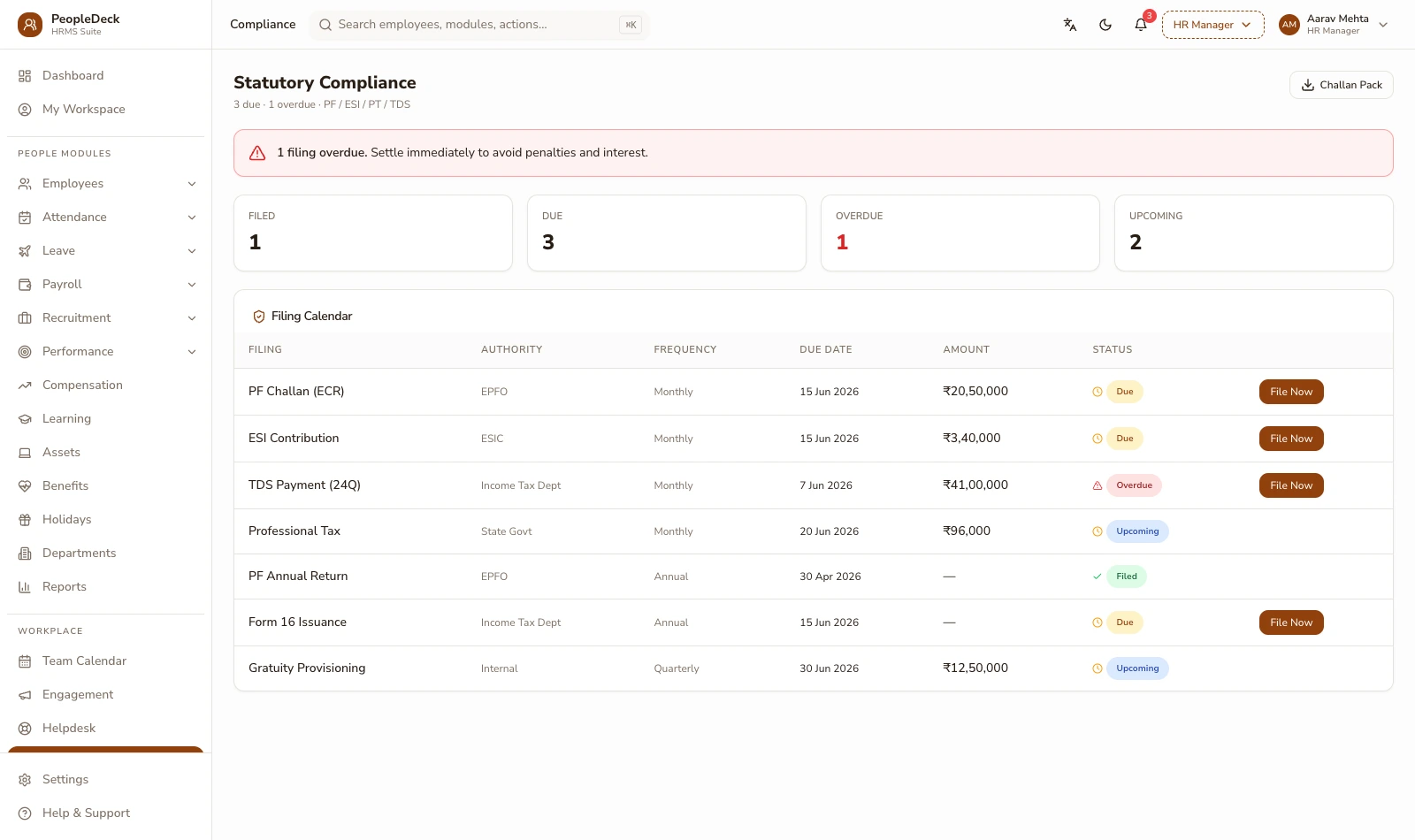
What does HR software for banks and NBFCs do?
It runs attendance, leave and payroll for banks and NBFCs — applying PF, ESI and TDS to every payslip and generating upload-ready return files, while handling what makes this industry different: branch networks and audit trails. PeopleDeck prices this per employee, per month.
Branch networks and audit trails
An NBFC's payroll spans a branch network where attendance, incentives and transfers happen far from HQ, and every rupee has to survive an audit. Records matter as much as the run.
An NBFC's payroll is a branch network wearing one balance sheet. Attendance happens in two hundred places the HQ never visits; incentives compute on disbursement and collection numbers that live in the loan system; transfers move people between branches (and states) mid-month; and above all of it stands the audit posture: RBI supervision, statutory audit, internal audit, each expecting every rupee of employee cost to carry its trail. The sector's specific traps are payroll-shaped: PT that changes when an employee transfers from Chennai to Gurugram, incentive clawbacks when collections sour, and the maker-checker discipline every other system in the company already follows but the payroll spreadsheet never did. PeopleDeck runs branch-network payroll with the controls the rest of the institution takes for granted: role-scoped access, approval workflows, effect-dated changes, and an audit trail that treats payroll like the regulated cost it is.
How PeopleDeck runs it
- ✓ Branch-wise attendance and transfers across the network
- ✓ Variable and incentive pay with a full audit trail on every change
- ✓ PF, ESI, professional tax and TDS applied to every payslip — upload-ready return files, never filed on your behalf
- ✓ Self-service payslips, Form 16 data and leave balances for every employee
A month in NBFC payroll
-
1
Branches capture, HQ consolidates
Each branch's attendance closes under its manager with exceptions resolved locally; HQ sees the network's close status live. Nobody emails attendance sheets up the hierarchy, and no branch's laxity hides until payday.
-
2
Incentives enter as governed data
Disbursement and collection incentives import from business data through approval — maker enters, checker approves, the run computes under the published scheme. Clawback rules net soured incentives against current months, cited to source.
-
3
Transfers re-map treatment automatically
A transfer order moves an employee's branch, cost centre and (when states change) PT treatment, all from the effect date. The Chennai-to-Gurugram move that used to leak wrong PT for three months becomes one dated record.
-
4
The run closes under audit discipline
Salaries, incentives and allowances compute with PF, ESI where applicable, state-correct PT and TDS; approvals are logged maker-checker style; and the outputs — registers, contribution files, cost by branch and vertical — export in the shapes internal audit and RBI inspection teams ask for.
A worked example
A branch sales officer on ₹28,000 gross earns a ₹6,200 disbursement incentive under the quarter's scheme — entered from business data, checker-approved, itemised on the payslip with its scheme reference. Mid-month he transfers from the Coimbatore branch to Bengaluru: the run splits his cost between branches to the day and switches PT from Tamil Nadu's half-yearly regime to Karnataka's monthly slab from the effect date. Six months later, ₹2,100 of that incentive claws back when the underlying loans slip past the scheme's performance window — netted against the current month, citing the original entries. When internal audit samples his record, every number resolves: scheme, approver, transfer order, PT basis. The sample takes minutes, which is the entire point.
The network view is where management lives: employee cost per branch against its book size, incentive spend against disbursement by region, and the cost of the collections vertical as recovery season peaks. Because every figure carries its trail, the numbers move straight into board decks and RBI data calls without a reconciliation layer in between.
Figures are illustrative, for mechanism only; your structures and rates will differ.
Key terms in NBFC payroll
Maker-checker payroll
Inputs entered by one role and approved by another, with both logged. Standard in every banking system, and the control auditors increasingly expect payroll to share.
Incentive clawback
Recovery of performance pay when the underlying business sours, netted with source citations. Governed clawbacks protect the institution; ungoverned ones generate disputes and audit findings.
Transfer-linked PT treatment
Professional tax follows the work state, so transfers change deduction regimes from the effect date. Networks that span states leak here chronically without systemic treatment.
Is PeopleDeck the right fit?
Built for you if
- ✓ Your branches span multiple states and PT regimes
- ✓ Incentives compute from disbursement and collection data
- ✓ Transfers move people between branches monthly
- ✓ Internal audit and RBI supervision touch employee cost
- ✓ Maker-checker discipline is expected of every system you run
Not the fit if
- ✕ You want loan-origination or collection software. This consumes business outcomes as pay inputs, nothing more
- ✕ You need treasury-grade payment execution inside the tool; it prepares bank files; execution stays in your payment systems
Mechanism deep-dives: the payroll engine · attendance & leave · statutory compliance
Switching without a bad payday
NBFCs switch region by region after a head-office pilot, because the risk posture demands it. The pilot encodes structures, schemes and PT mappings, then runs a full cycle in parallel with the incumbent process while internal audit observes, an involvement worth inviting, since their sign-off carries the rollout. The parallel cycle's findings run to type: PT wrong for transferred staff, incentives paid off spreadsheet versions of schemes rather than approved ones, and clawbacks tracked in a collections manager's personal file.
Regions migrate on the pilot's template, each inheriting corrected mappings, and the network typically completes inside two quarters. What the institution gains is not speed first but governance: payroll joins the set of systems that pass audit by construction, and the annual inspection's employee-cost section becomes an export rather than an exercise. The discipline to hold: schemes and structures change only through the same maker-checker gate as everything else: the moment a special case bypasses it, the trail develops the gap an auditor will eventually find.
Not your industry?
Running a school or college? Staff payroll belongs inside your ERP: SchoolDeck staff payroll or CampusAlly payroll.
Related industries
Frequently asked questions
What does HR software for banks and NBFCs include?
Attendance and rosters, leave, onboarding to full-and-final, and payroll with PF, ESI and TDS applied to every payslip, plus branch networks and audit trails handled natively. Employees get self-service payslips.
Is every payroll change logged?
Yes, every edit to pay, attendance or structure carries who, when and what, so internal and statutory audits read straight from the system.
How is PeopleDeck priced?
Per employee per month, in rupees. You pay for the headcount you run, no module bundles, no per-site fees.
Does PeopleDeck file PF and ESI returns?
No; it applies PF, ESI, professional tax and TDS and generates upload-ready ECR and return files. Filing stays with you or your consultant.
How granular is the audit trail?
Every input, approval and computation carries who, when and on what basis — queryable per employee, per run, per branch. An auditor's sample resolves to source records without HR assembling anything.
Can access be scoped by branch and role?
Yes — branch managers see their branch, regional heads their region, HR and finance their functions; salary visibility is role-gated, and the scoping itself is part of the audit posture.
How are field-staff attendance and outstation duty handled?
Collection and sales staff mark duty with location capture per your policy; outstation duty records as such: attendance stays truthful for a workforce that rarely sits in the branch.
What about gratuity and leave provisioning for the auditors?
Accruals compute from live tenure and balances, reportable by branch and vertical: the provision numbers your statutory auditors test, generated from the same records that pay people.
Can it prepare data for RBI or statutory data calls?
Employee cost, headcount and contribution data export per period in structured form, branch- and entity-tagged, so data calls draw from the payroll system of record instead of a hand-built consolidation.
Payroll for banks and NBFCs, without the spreadsheets.
Per employee, per month: attendance to upload-ready returns.
Start free