


Enterprise HCM, or the essentials?
Darwinbox is built for enterprise scale, and priced, implemented and configured like it. If your team is fifty or five hundred rather than five thousand, the honest question is whether you need an HCM platform or the HR-payroll essentials done well.
Different weight classes, honestly stated
Darwinbox is a genuine enterprise HCM: a broad, configurable platform serving large organisations with implementation programmes to match, and it competes credibly with global suites at that altitude. PeopleDeck is not that, and does not pretend to be. It is the essentials layer: attendance, leave, onboarding to FnF, statutory-applied payroll, self-service — self-served and priced per employee, for businesses whose HR team is one person or a small few. The comparison is not better-versus-worse; it is fit: an enterprise platform under-used is expensive shelf-ware, and an essentials product over-stretched is a ceiling.
How to run this evaluation
Count two things: the modules you will genuinely operate in year one, and the people who will administer the system. If the answers are 'the payroll-anchored core' and 'one HR generalist', an essentials platform fits and a free parallel month proves it. If you run matrixed orgs, global entities and a COE-grade HR function, evaluate enterprise HCM seriously (including Darwinbox) and verify scope and implementation expectations with their team.
The side-by-side, honestly
Concrete claims below are about PeopleDeck only. For the other column, we state category facts and what to verify. Products change, so check current details on their own pages before you decide.
| Dimension | PeopleDeck | Darwinbox; verify on their pages |
|---|---|---|
| Product shape | One platform for payroll, attendance, leave, onboarding to FnF, records and self-service, bought self-serve by any business | Enterprise HCM platform, broad module surface — built and implemented for large organisations |
| Payroll & statutory | PF, ESI, PT and TDS applied on every payslip; upload-ready ECR and return files generated. Filing stays with you | Payroll offered within the platform; verify India-statutory depth and file formats for your registrations |
| Pricing model | Per employee, per month, in ₹. Whole platform included, rate shown transparently at sign-up, start free | Enterprise sales-led commercial model; request and verify current terms; no claim made here |
| Attendance & leave | Rosters, rotating shifts, biometric, web and mobile punches; attendance feeds payroll directly | Configurable enterprise time modules; verify configuration effort at your team size |
| Onboarding to exit | Joining checklists to a computed full-and-final statement with every line's working shown | Full lifecycle suite; verify what your team would actually operate in year one |
| Self-service | Payslips, balances, declarations, claims and Form 16 data in every employee's hands | Mature ESS and mobile; verify rollout and admin overhead at your scale |
| Getting started | Self-serve sign-up; import employees, run a parallel month, go live when it reconciles | Implementation programme; confirm timeline, effort and partner involvement with their team |
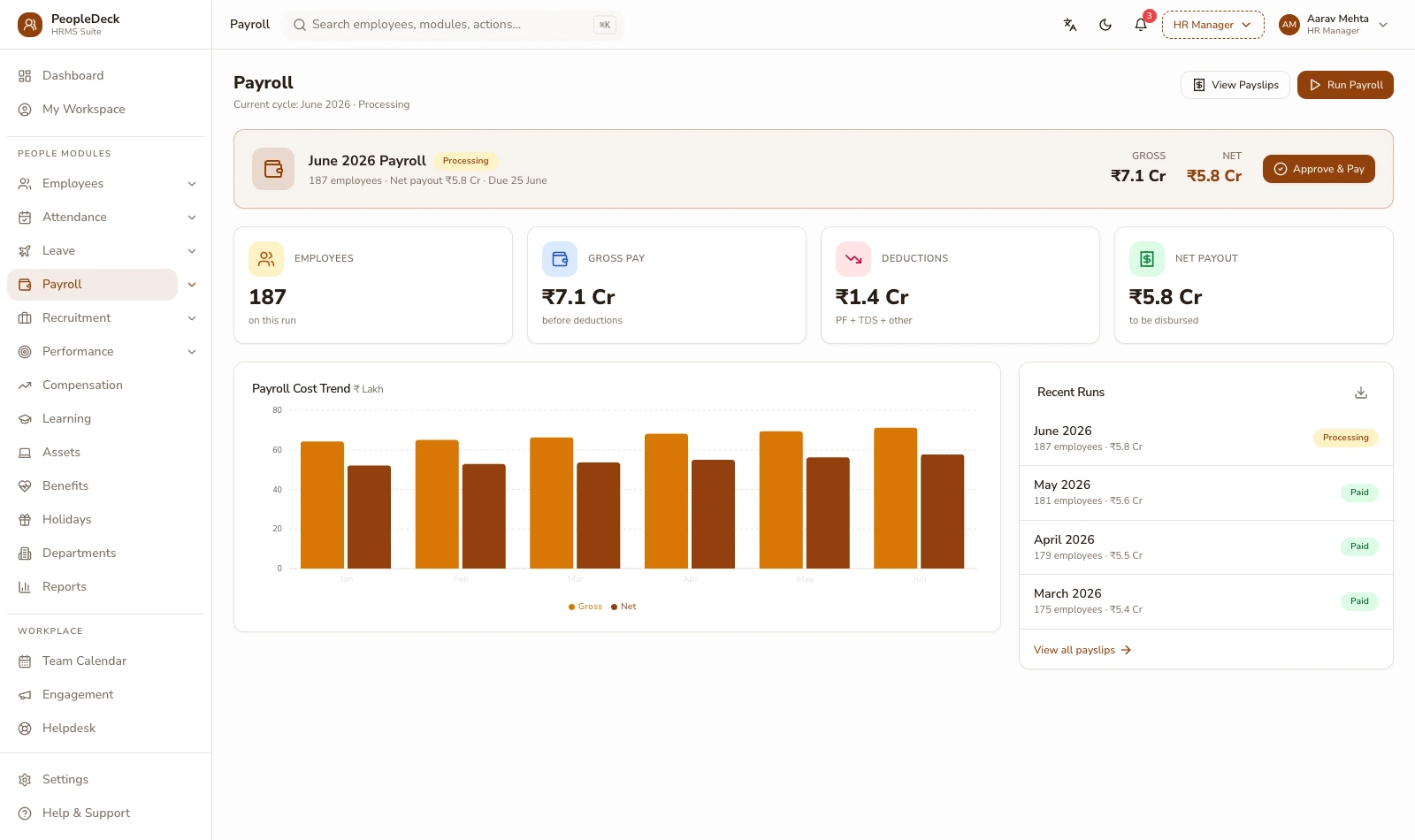
What switchers say they were actually looking for
-
1
Time-to-first-payroll
At SME scale the decisive metric is how fast the system pays people correctly. Self-serve setup plus a parallel month means weeks, run by your own HR person, no implementation programme, no partner dependency.
-
2
Administration that fits one person
Enterprise platforms assume an HR operations function to feed them. PeopleDeck assumes the opposite: one generalist, defaults that are already right for Indian statute, and configuration measured in afternoons.
-
3
Paying for what you run
Per-employee pricing with everything included keeps the bill proportional to the workforce, not to a module list. Whatever you evaluate, model total cost of ownership including implementation and administration time, not licence alone.
PeopleDeck in depth: the payroll engine · statutory compliance · per-employee pricing
Migrating without a bad payday
Moving down from an enterprise platform (or skipping one) is mostly subtraction: export the employee master and structures, import via validated sheets, encode the policies you actually use, and let the features you never operated stay behind without ceremony.
Run the parallel month against your current payroll source, reconcile, and go live on a month boundary. Teams that migrate this direction usually report the same surprise: the process shrank to fit the team, and payroll accuracy did not move because accuracy was never the enterprise feature.
The boundary that decides it
PeopleDeck is a standalone HRMS any business signs up for, priced per employee, per month, with PF, ESI, professional tax and TDS applied to every payslip and upload-ready return files generated, never filed behind your back. If you are an education institution comparing ERP-bundled payroll instead, that is a different product shape: see SchoolDeck staff payroll for schools or CampusAlly payroll for colleges, licensed per institution.
Frequently asked questions
Is PeopleDeck trying to compete with Darwinbox?
Not at enterprise altitude — Darwinbox is built for organisational complexity PeopleDeck deliberately does not model. The competition is for growing teams deciding whether they need that altitude yet; many do not.
When would you genuinely need enterprise HCM?
Multi-entity global payroll, matrixed approval hierarchies, a dedicated HR-ops function, deep talent-suite requirements — at that shape, evaluate enterprise platforms seriously. The essentials category is the wrong answer there.
Can PeopleDeck scale as we grow?
Per-employee pricing and the same engine carry from ten to hundreds of employees — multi-location, multi-state PT, shift complexity included. What it will not grow into is enterprise HCM breadth; that honesty is on the label.
What does implementation actually look like here?
Import, configure policies, one parallel month; run by your own team. If a vendor quotes an implementation programme for a fifty-person payroll, that is a signal about fit, theirs or ours.
What should we verify with Darwinbox?
Current scope, India-payroll depth, implementation expectations and commercial terms, with their team, for your size. Enterprise platforms evolve fast; only their current material counts.
The essentials, done properly.
Run a parallel month on your own data — the reconciliation decides, not the brochure.
Start free