


Evaluating a Keka alternative?
A structured way to compare: what PeopleDeck does concretely, what to verify on Keka's current pages, and how a switch actually runs, so the decision comes from a parallel month, not a brochure.
Where both platforms stand
Keka is an established Indian HRMS suite with a broad module set spanning HR, payroll and performance, and a large installed base; if you are evaluating it, you are evaluating a serious product. PeopleDeck's proposition is narrower on purpose: the HR and payroll essentials every business runs: attendance, leave, onboarding to full-and-final, statutory-applied payroll, self-service, priced per employee with nothing gated behind plans. The honest comparison is between a suite you configure to your processes and a platform whose scope is by design the payroll-anchored core.
How to run this evaluation
Ignore both vendors' adjectives, including ours. List the ten things your payroll month actually contains: shift patterns, arrears, contractor evidence, state PT spread, exit volume, and test both products against that list on your own data. PeopleDeck's sign-up is free precisely so this test costs nothing but an afternoon; for Keka, ask their team to demonstrate your list live and verify module boundaries and plan inclusions on their current pages, since packaging changes.
The side-by-side, honestly
Concrete claims below are about PeopleDeck only. For the other column, we state category facts and what to verify. Products change, so check current details on their own pages before you decide.
| Dimension | PeopleDeck | Keka; verify on their pages |
|---|---|---|
| Product shape | One platform for payroll, attendance, leave, onboarding to FnF, records and self-service, bought self-serve by any business | Broad HRMS suite: HR, payroll, PMS and more; confirm which modules your quote includes |
| Payroll & statutory | PF, ESI, PT and TDS applied on every payslip; upload-ready ECR and return files generated. Filing stays with you | Indian payroll is core to their offer; verify current statutory coverage and file formats for your registrations |
| Pricing model | Per employee, per month, in ₹. Whole platform included, rate shown transparently at sign-up, start free | Check their current published model and what sits in which plan, no claim made here |
| Attendance & leave | Rosters, rotating shifts, biometric, web and mobile punches; attendance feeds payroll directly | Attendance modules offered; verify device support and policy fit for your shifts |
| Onboarding to exit | Joining checklists to a computed full-and-final statement with every line's working shown | Onboarding and exit flows offered; verify FnF computation depth against your cases |
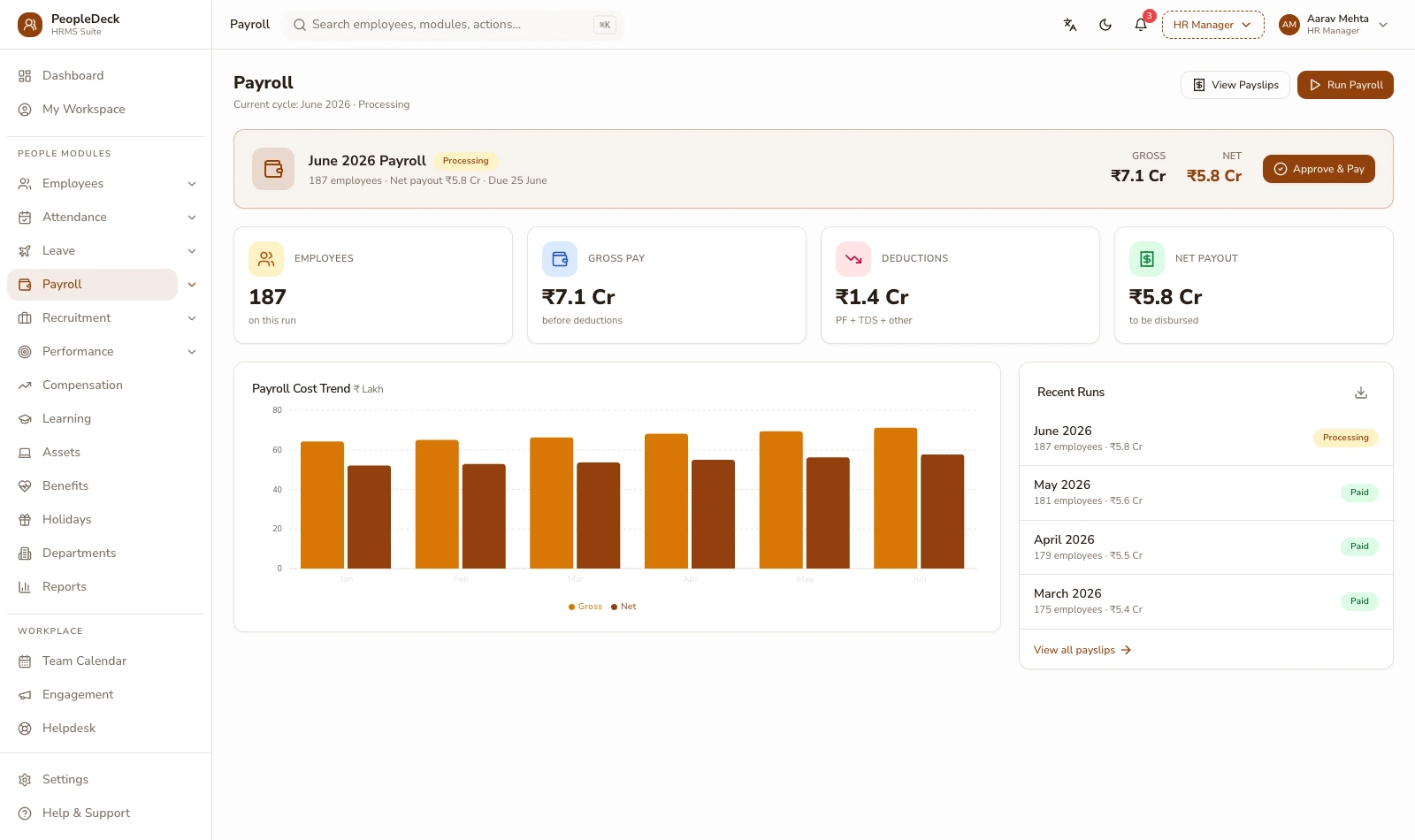
| Self-service | Payslips, balances, declarations, claims and Form 16 data in every employee's hands | ESS and mobile apps offered; verify against what your employees will actually use |
| Getting started | Self-serve sign-up; import employees, run a parallel month, go live when it reconciles | Typically a sales-led onboarding; confirm timelines and implementation scope with their team |
What switchers say they were actually looking for
-
1
Pricing they can predict
Teams comparing suites most often cite bill predictability: one per-employee rate with everything included is arithmetic anyone can do at a board meeting. Whatever platform you choose, insist on modelling your bill at twice your headcount before you sign.
-
2
Statutory transparency over configurability
A configurable suite is powerful; it also means your payroll correctness depends on your configuration. PeopleDeck's bet is that most businesses want the statutory layer to be the product's job: applied by default, shown on every payslip, files generated from the approved run.
-
3
A test that costs nothing
The strongest evaluation is a parallel month. PeopleDeck's free start exists so you can run one against whatever you use today (including a Keka trial) and let the reconciliation arbitrate.
PeopleDeck in depth: the payroll engine · statutory compliance · per-employee pricing
Migrating without a bad payday
Import your employee master and structures (spreadsheet exports are fine), encode your leave and shift policies, and run one full month in parallel with your current system — payslip against payslip. Discrepancies are either a rule to fix once or an error you were already living with; both are worth knowing before you commit to anything.
History matters too: prior payslips and contribution records import as reference so gratuity tenure, leave balances and TDS projections carry over. Go live on a month boundary, and keep your old exports archived, a good migration leaves you more auditable, not less.
The boundary that decides it
PeopleDeck is a standalone HRMS any business signs up for, priced per employee, per month, with PF, ESI, professional tax and TDS applied to every payslip and upload-ready return files generated, never filed behind your back. If you are an education institution comparing ERP-bundled payroll instead, that is a different product shape: see SchoolDeck staff payroll for schools or CampusAlly payroll for colleges, licensed per institution.
Frequently asked questions
Is PeopleDeck a full replacement for Keka?
For the HR-and-payroll core: attendance, leave, onboarding to FnF, statutory-applied payroll, self-service — yes, that is exactly what it does. For modules beyond that core (deep PMS, engagement tooling), evaluate whether you use them enough to anchor the decision; many teams discover the payroll core is the decision.
Can we migrate mid-financial-year?
Yes — opening balances carry TDS projections, leave and gratuity tenure, and prior months stay in your archived records. A month boundary is the clean cut; a quarter boundary is even cleaner for TDS.
Do you import data from Keka?
Standard exports (employee master, salary structures, balances) import via structured sheets with validation, so bad rows surface before anything computes. Your data is yours everywhere; export rights on PeopleDeck are absolute too.
Why doesn't this page list Keka's prices or plans?
Because we would either get them wrong or get them stale, and a comparison you cannot trust on one row is untrustworthy on all of them. Verify their current packaging with them; hold us to the same standard.
What does PeopleDeck deliberately not do?
It never files returns on your behalf; it applies statutory lines and generates upload-ready files you sign off. And it renders no verdicts on people: no auto-decided raises, no attrition scores. Arithmetic is the product; judgment stays yours.
Compare on your own payroll, not our copy.
Run a parallel month on your own data — the reconciliation decides, not the brochure.
Start free