


Looking beyond Zoho People?
Zoho People anchors HR inside the wider Zoho ecosystem; PeopleDeck anchors HR around Indian payroll. This page lays out that structural difference honestly, and what to verify before you choose either.
Two different centres of gravity
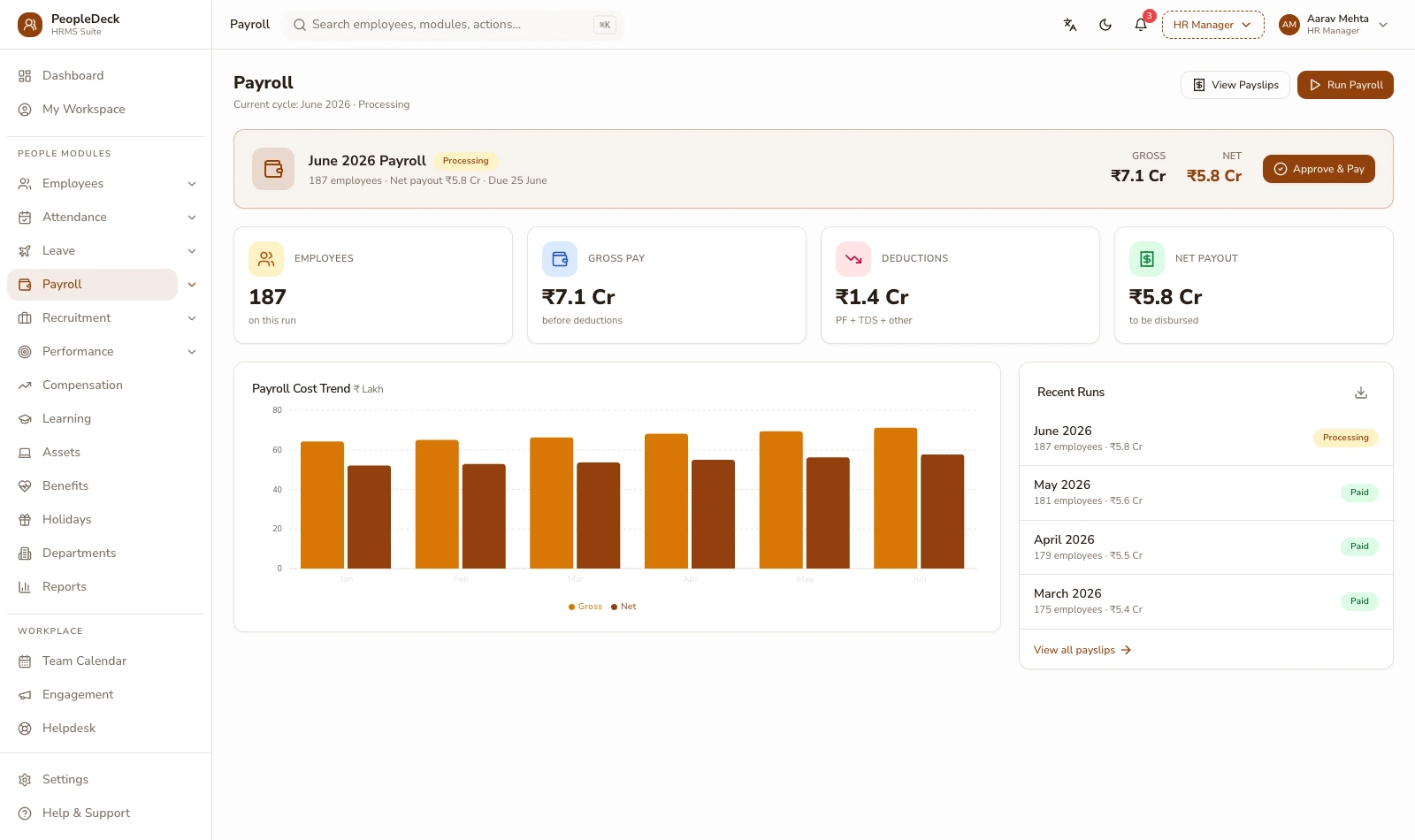
Zoho People is the HR module of one of India's most successful software ecosystems: attendance, leave and HR process tooling that fits naturally if your business already runs on Zoho apps. Payroll, in the Zoho world, lives in Zoho Payroll, a separate product in their suite; verify how the two combine for your case on their current pages. PeopleDeck inverts that architecture: payroll with PF, ESI, PT and TDS applied is the native core, and attendance, leave, onboarding and self-service are built around feeding it: one product, one bill, no join between HR and pay.
How to run this evaluation
Decide first where your pain lives. If it is HR workflow (approvals, records, processes) evaluate both as workflow tools. If it is the payroll month: statutory correctness, arrears, FnF, files for the consultant; then test the payroll path end to end: structure to payslip to ECR file, on your own data. PeopleDeck's free start makes that test an afternoon; for the Zoho pairing, confirm on their pages which products your scenario needs and trial the combination as one flow.
The side-by-side, honestly
Concrete claims below are about PeopleDeck only. For the other column, we state category facts and what to verify. Products change, so check current details on their own pages before you decide.
| Dimension | PeopleDeck | Zoho People; verify on their pages |
|---|---|---|
| Product shape | One platform for payroll, attendance, leave, onboarding to FnF, records and self-service, bought self-serve by any business | HR module within the Zoho ecosystem; Indian payroll is a separate Zoho product; verify the pairing your case needs |
| Payroll & statutory | PF, ESI, PT and TDS applied on every payslip; upload-ready ECR and return files generated. Filing stays with you | Via Zoho Payroll (separate product); verify statutory coverage, file formats and how the two products hand off |
| Pricing model | Per employee, per month, in ₹. Whole platform included, rate shown transparently at sign-up, start free | Check their current published pricing for the product combination you would actually run |
| Attendance & leave | Rosters, rotating shifts, biometric, web and mobile punches; attendance feeds payroll directly | Established attendance and leave tooling; verify device support and shift depth for your patterns |
| Onboarding to exit | Joining checklists to a computed full-and-final statement with every line's working shown | HR workflows offered; verify where FnF computation happens in a two-product setup |
| Self-service | Payslips, balances, declarations, claims and Form 16 data in every employee's hands | ESS within the Zoho apps; verify the employee experience across the products you'd combine |
| Getting started | Self-serve sign-up; import employees, run a parallel month, go live when it reconciles | Self-serve trials available; verify configuration effort for your policies across products |
What switchers say they were actually looking for
-
1
One product where two would do
The commonest reason teams land here: they want the HR-to-payslip path to be one system with one record, rather than an integration they own. If your payroll month is simple, two well-integrated products can serve; as it grows edge cases, the join is where errors live.
-
2
India-statute as the core competence
PeopleDeck's entire product is organised around the Indian payroll month — contribution-period ESI, state-wise PT, arrears with workings, FnF on exit. Ecosystem suites serve many countries and many jobs; a single-purpose engine can afford to be opinionated about one.
-
3
Ecosystem independence
Zoho rewards being all-in on Zoho — genuinely. Teams not otherwise in that ecosystem often prefer an HRMS that assumes nothing about the rest of their stack.
PeopleDeck in depth: the payroll engine · statutory compliance · per-employee pricing
Migrating without a bad payday
Export your employee records and structures from Zoho People (their export tooling is good; your data is yours), import via validated sheets, and encode leave and attendance policies. Run one parallel month: PeopleDeck's payslips and files against whatever your current payroll path produces.
If payroll currently runs elsewhere (a consultant, a spreadsheet, Zoho Payroll) reconcile against that source specifically, because that is the record that matters. Go live on a month boundary with balances and TDS projections carried as opening records.
The boundary that decides it
PeopleDeck is a standalone HRMS any business signs up for, priced per employee, per month, with PF, ESI, professional tax and TDS applied to every payslip and upload-ready return files generated, never filed behind your back. If you are an education institution comparing ERP-bundled payroll instead, that is a different product shape: see SchoolDeck staff payroll for schools or CampusAlly payroll for colleges, licensed per institution.
Frequently asked questions
Is PeopleDeck part of an ecosystem like Zoho's?
It is part of the Databus product suite, but it assumes nothing about your other tools — exports are standard formats your accounting and banking already consume. The bet is on depth in one job, not breadth across many.
We use other Zoho products. Does switching HR break anything?
Your other Zoho apps continue unaffected — Zoho People's data exports cleanly and PeopleDeck imports it. What changes is that HR-to-payroll stops being an integration and becomes one record.
Does PeopleDeck really include payroll natively?
Yes: payroll is the core, not a module or a separate SKU: structures, runs, statutory application, files, FnF, all in the same product and the same per-employee price.
What should we verify on Zoho's side before deciding?
Which products your scenario needs (People, Payroll, or both), current India-statutory coverage, and how the handoff between them works for your edge cases — mid-month exits, arrears, multi-state PT. Their pages and trials are the authoritative source.
What does PeopleDeck by design not do?
File returns (it generates upload-ready files; you sign off), make people-decisions (facts, not verdicts), or global payroll (Indian statute only — stated plainly rather than discovered late).
One system from punch to payslip.
Run a parallel month on your own data — the reconciliation decides, not the brochure.
Start free