


Keka vs Zoho People — and a third option
Two strong products, two different shapes: a purpose-built Indian HRMS suite versus the HR module of a software ecosystem. This page compares them factually, and adds the per-employee alternative to both.
The real difference between the two
Keka is a purpose-built Indian HRMS: HR, payroll and performance in one suite, sold and configured as such. Zoho People is the HR module of the Zoho ecosystem, at its best when your business already lives in Zoho apps, with Indian payroll handled by Zoho Payroll as a separate product in the suite. Verify both on their current pages — packaging moves. The choice between them is really a choice of centre: a dedicated HR suite versus an ecosystem you commit to more broadly.
Where PeopleDeck enters
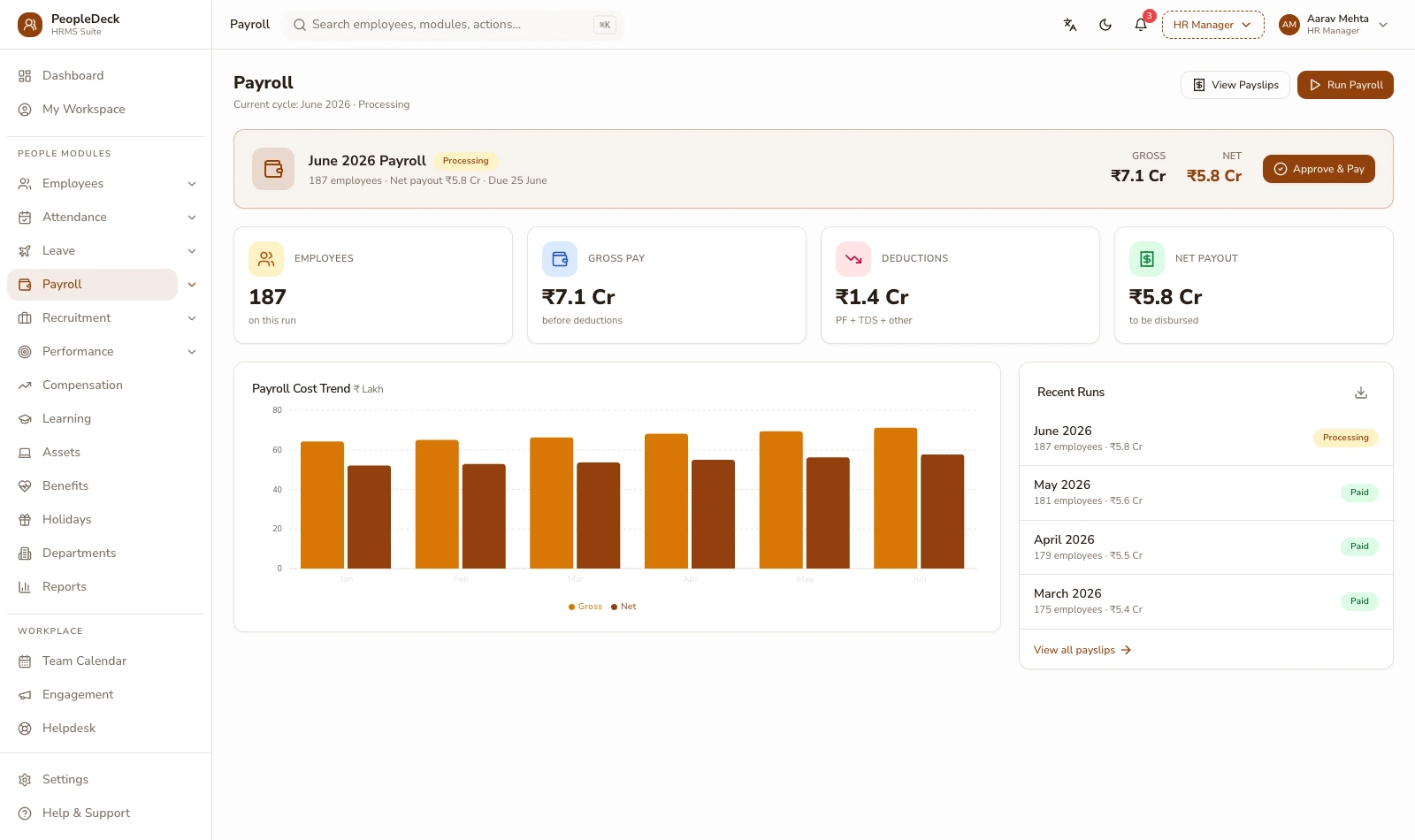
PeopleDeck is the third shape: neither a broad suite nor an ecosystem module, but a payroll-spined essentials platform: attendance, leave, onboarding to FnF, statutory-applied payroll, self-service, priced per employee with everything included and started self-serve. If your evaluation keeps circling back to the payroll month and the bill's predictability, that shape may fit better than either of the two you came to compare.
Three shapes side by side
Concrete claims below are about PeopleDeck only. For the other platforms, we state category facts and what to verify. Products change, so check current details on their own pages before you decide.
| Dimension | Keka; verify current | Zoho People; verify current | PeopleDeck |
|---|---|---|---|
| Product shape | Purpose-built Indian HRMS suite: HR, payroll, PMS together; verify plan packaging | HR module of the Zoho ecosystem; Indian payroll via Zoho Payroll, a separate suite product; verify pairing | One platform for payroll, attendance, leave, onboarding to FnF, records and self-service, bought self-serve by any business |
| Payroll & statutory | Native payroll within the suite; verify current statutory coverage for your registrations | Via Zoho Payroll; verify coverage and the People↔Payroll handoff for your cases | PF, ESI, PT and TDS applied on every payslip; upload-ready ECR and return files generated. Filing stays with you |
| Pricing model | Plan-based; check current published packaging | Per-product pricing across the combination you run; check current pages | Per employee, per month, in ₹. Whole platform included, rate shown transparently at sign-up, start free |
| Attendance & leave | Suite modules (verify shift depth and devices | Established tooling) verify depth and how it reaches payroll | Rosters, rotating shifts, biometric, web and mobile punches; attendance feeds payroll directly |
| Self-service | Suite ESS and mobile (verify scope | Zoho apps experience) verify across the product pairing | Payslips, balances, declarations, claims and Form 16 data in every employee's hands |
| Getting started | Sales-led onboarding (confirm timeline | Self-serve trials) verify configuration effort across products | Self-serve sign-up; import employees, run a parallel month, go live when it reconciles |
What switchers say they were actually looking for
-
1
Decide the shape before the vendor
Suite, ecosystem module, or payroll-spined essentials — pick the shape your team can operate, then compare vendors within it. Cross-shape feature comparisons mislead by construction.
-
2
Test all three on one real month
Run identical data through trials of whichever two or three survive your shortlist: the arrears case, the exit, your states' PT. The payslips and files arbitrate better than any comparison page, including this one.
-
3
Model the bill at 2× headcount
Every model — suite plans, ecosystem product combinations, per-employee — should be priced at double your current size before you sign. Growth is the test pricing models fail quietly.
PeopleDeck in depth: the payroll engine · statutory compliance · per-employee pricing
Migrating without a bad payday
Whichever direction you choose, migration mechanics are similar: employee master and structures export from all three ecosystems in standard formats, balances and year-to-date figures carry as opening records, and one parallel month validates the switch.
PeopleDeck's specific path: validated imports, policy encoding, parallel run, month-boundary go-live — self-served, free to test, with export rights absolute if the answer turns out to be one of the other two.
The boundary that decides it
PeopleDeck is a standalone HRMS any business signs up for, priced per employee, per month, with PF, ESI, professional tax and TDS applied to every payslip and upload-ready return files generated, never filed behind your back. If you are an education institution comparing ERP-bundled payroll instead, that is a different product shape: see SchoolDeck staff payroll for schools or CampusAlly payroll for colleges, licensed per institution.
Frequently asked questions
Which is better, Keka or Zoho People?
Wrong question, honestly; they are different shapes. Keka is a dedicated HRMS suite; Zoho People is an ecosystem HR module that pairs with Zoho Payroll for pay. Decide whether you want a suite, an ecosystem, or a payroll-spined essentials product, then compare within the shape.
Is PeopleDeck really an alternative to both?
For the HR-payroll core, yes, that core is its entire product. For deep PMS (Keka's strength) or ecosystem breadth (Zoho's), it deliberately is not. The honest pitch is fit, not superiority.
Can we trial all three cheaply?
Yes, all three offer self-serve starts or trials. Feed them identical data for one month; verify current trial terms on each vendor's pages.
What should we verify on Keka's and Zoho's pages?
Current packaging and plan inclusions, payroll's place in each (native module versus separate product), statutory file coverage, and India-specific depth for your states and cases.
What does PeopleDeck not do that these two might?
Deep performance suites, ecosystem app integration, global payroll. Its bet is depth on the Indian payroll month, per-employee; if that is not your centre of gravity, one of the other shapes fits better.
Three shapes. One parallel month decides.
Run a parallel month on your own data — the reconciliation decides, not the brochure.
Start free