


Hiring, tracked: end to end
PeopleDeck's ATS keeps a hire moving: openings posted with their own pipelines, applications collected in one place, candidates advanced through stages you define, interviews scheduled with panel notes on the application, and offers rolled out that flow straight into onboarding on acceptance. Ranking helps a human build a shortlist; it never auto-rejects anyone. From requisition to accepted offer, every application keeps its history: sources, notes, decisions and outcomes.
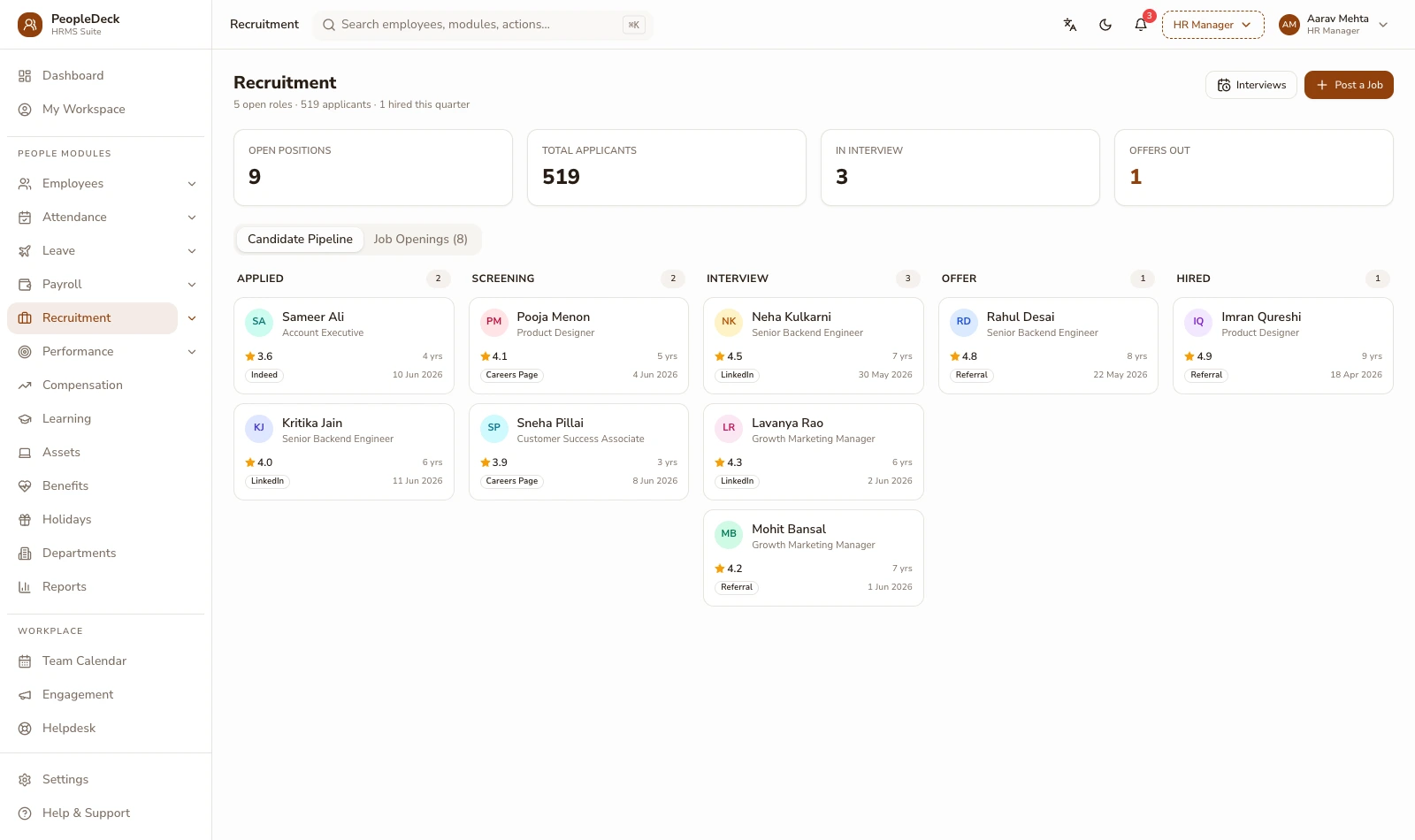
How it works
-
1
Open a role with its own pipeline
Each opening carries a description, its hiring team and a pipeline suited to the role, a sales hire might run screen → interview → offer; a plant supervisor might add a practical assessment; a senior role might add panel rounds. Stages are per opening, so process fits the role instead of the role bending to one process.
-
2
Collect every application into one record
Applications land in the ATS with CV, source and screening answers attached, whether they came from a careers link, a referral or a hand-collected CV typed in by the team. Duplicate detection keeps one candidate one record, and the record accumulates every interaction from first screen to final decision.
-
3
Advance candidates on decisions, not memory
Moving a candidate between stages is a recorded action with an owner. Screens, interview feedback and panel notes attach to the application, so the next interviewer reads context in one place, and a candidate never goes silent simply because their state lived in someone's inbox.
-
4
Schedule interviews without the email tennis
Interview slots, panels and locations (or links) are scheduled from the application; candidates and panellists are notified; feedback forms open against the interview. The panel's notes join the record where the hiring decision will actually be made.
-
5
Offer, accept, onboard: one handoff
An offer rolled out from the ATS carries the structure and grade the hire was made on. On acceptance, the candidate hands off to the onboarding flow automatically: joining checklist opened, data recruitment collected carried over, nothing asked twice. Declines and dropouts are recorded outcomes too, so the pipeline's history stays honest.
-
6
Measure the pipeline you actually ran
Because every stage change is a recorded decision, pipeline metrics describe reality: where candidates stall, which sources produce hires that stay, how long each stage genuinely takes. No fabricated benchmarks; your funnel, measured from your own decisions, which is the only version of recruiting analytics worth acting on.
A requisition, start to finish
Illustrative: a Coimbatore engineering unit opens a maintenance-supervisor role with a four-stage pipeline including a practical. Thirty-one applications arrive from a careers link and two staffing referrals; screening advances nine; the practical passes four; panel notes on each application carry the reasoning. One offer rolls out at the grade's structure, is accepted in three days, and the candidate lands in onboarding with documents already half-collected from the application. The two runners-up are closed with recorded reasons, retrievable the next time a similar role opens. Six months later, the same pipeline data shows referrals converting at twice the rate of the job board, so the next opening leads with referrals.
A shortlist aid, never an auto-reject
Filters and ranking exist to help a human work a large pipeline (order by relevance, filter by must-haves) but no candidate is scored out or rejected by the system, ever. Rejection is a person's action, recorded with the application. This is the recruitment expression of the same rule that governs performance: the software organises facts for human judgement; it does not manufacture verdicts about people. And no invented 'time-to-hire drops by X%' claims: the honest promise is a pipeline where nothing gets lost.
The same discipline protects the employer's brand: candidates judged by named humans, informed at each stage, and closed with recorded reasons describe a company worth joining, and the record of how you hire is, over time, part of why people accept.
Key terms, plainly
ATS
Applicant Tracking System: the pipeline-and-record system that keeps every application, interaction and decision for a role in one accountable place.
Pipeline stage
A step in a role's hiring flow (screen, interview, assessment, offer) advanced by recorded human decisions with owners.
Requisition
The internal request that opens a role: description, grade, hiring team and pipeline, the container all applications for that role live in.
Offer rollout
The recorded issue of an offer at a grade and structure: the artefact that, on acceptance, seeds onboarding without re-entry.
What you get
- ✓ Per-opening pipelines with stages that fit the role
- ✓ One record per candidate: CV, source, screens, interviews, notes, outcome
- ✓ Interview scheduling with panel feedback on the application
- ✓ Ranking and filters as a human shortlist aid, no auto-rejection
- ✓ Accepted offers hand off to onboarding with data carried over
| Event | What happens to the record |
|---|---|
| Application received | Candidate record created, deduplicated |
| Interview held | Panel feedback attaches to the application |
| Offer accepted | Hands off to onboarding; checklist opens pre-filled |
| Not selected | Closed with a recorded, human reason, searchable later |
Works with: Onboarding & offboarding · Employee database
From inbox hiring to pipeline hiring
Hiring by inbox fails silently: CVs arrive addressed to whoever posted the role, interviews live in personal calendars, and candidates go quiet because their state exists nowhere. Moving to a pipeline is mostly a habit change, every CV, from any source, becomes an application; every advance is a recorded decision. The compounding value arrives with history: six months in, 'we interviewed someone great for this last year' becomes a search instead of a rumour, and your pipeline metrics describe reality because the pipeline is where hiring actually happened. Start with your single most-painful opening: the habit spreads from one well-run pipeline. Time-to-offer becomes measurable per role and per stage, and the bottleneck the data names is usually not the one the hiring meetings blamed.
Pipeline setup checklist
- 1.Define stages per opening type: office, plant, senior
- 2.Route the careers page and referrals into the ATS
- 3.Set interview feedback forms per stage
- 4.Agree who advances and who rejects; decisions carry names
- 5.Wire offer grades to salary structures
- 6.Confirm the accepted-offer handoff into onboarding
Is this the right fit?
Built for you if
- ✓ Hiring runs through inboxes and candidates go silent mid-process
- ✓ Interview feedback exists only in the panel's memory
- ✓ Offers get made at salaries nobody mapped to structures
Not the fit if
- ✕ You want job-board syndication contracts: the ATS receives applications; board contracts are yours
- ✕ You want AI to screen out candidates; ranking assists a human, and rejection is always a person's act
Related features
Running a school or college? Staff payroll belongs inside your ERP: SchoolDeck staff payroll or CampusAlly payroll.
Frequently asked questions
Can we customise hiring stages?
Yes — pipelines are defined per opening, so a plant role and a sales role can run entirely different stages under the same system.
Does it auto-reject candidates?
No — ranking and filters help a human shortlist; every rejection is a person's recorded action. The system never scores anyone out.
How do referrals enter the pipeline?
As applications with their source recorded — referrals, careers page and hand-entered CVs all become the same kind of accountable record.
What does the panel see before an interview?
The full application: CV, screening answers and every previous round's feedback — context in one place instead of a forwarded thread.
What carries over to onboarding?
Everything reusable: identity details, documents already collected, the offer's grade and structure: the joining checklist opens pre-filled.
Can we reopen past candidates for a new role?
Yes — closed applications remain searchable with their history and reasons, so last year's runner-up is this year's first call.
How is PeopleDeck priced?
Per employee per month, in rupees: the ATS is part of the product, not a per-recruiter licence.
Can hiring managers see only their own openings?
Yes — visibility is role-based per requisition, so a manager sees their pipeline and HR sees the whole board.
Do candidates get status updates?
Stage changes can notify candidates automatically: the silence that damages employer brand is usually just missing state, which the pipeline provides.