


HR software for NGOs and trusts
Project and grant-wise cost allocation, PF and ESI applied, and clean records for donor and statutory audits, all in one place.
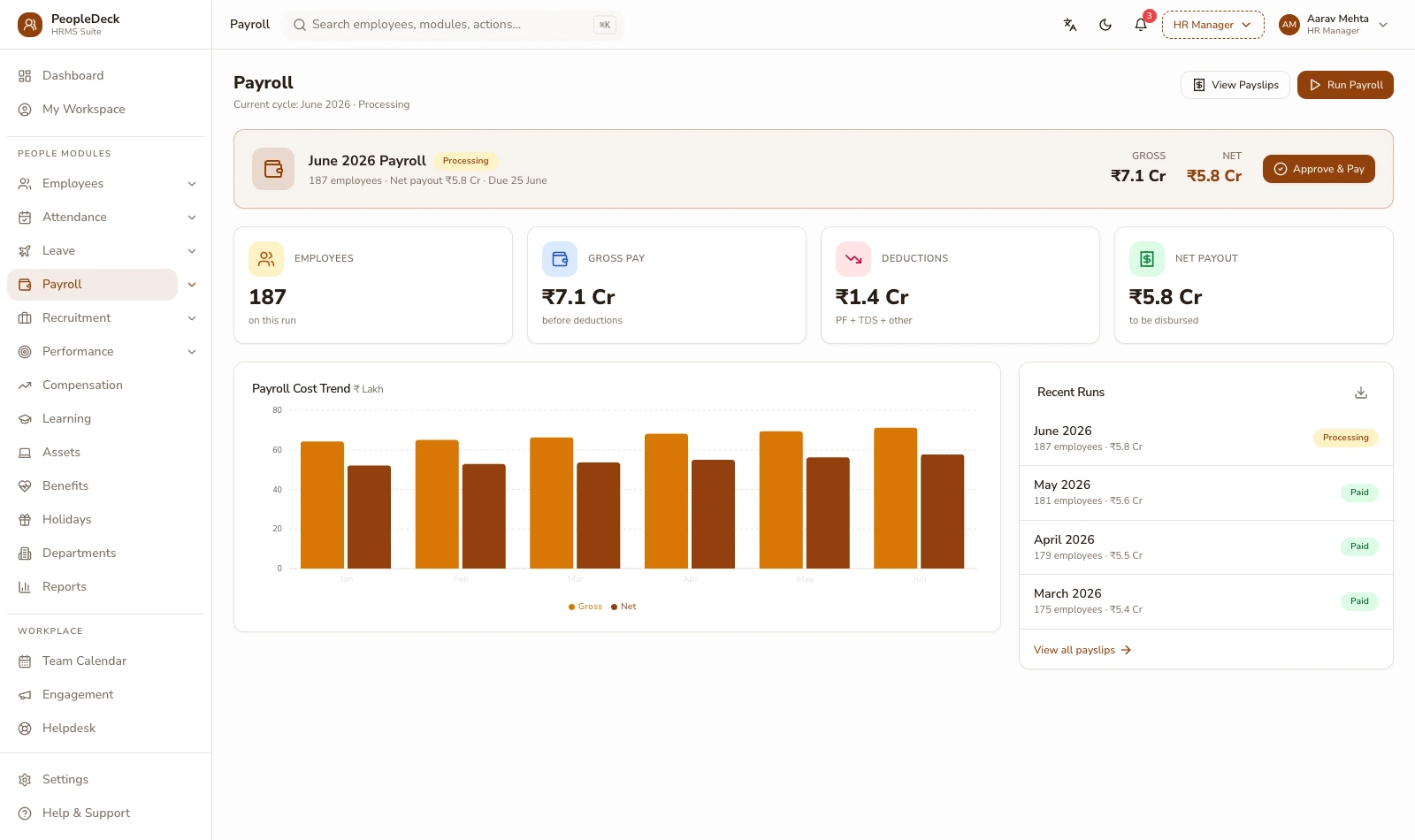
What does HR software for NGOs and trusts do?
It runs attendance, leave and payroll for NGOs and trusts — applying PF, ESI and TDS to every payslip and generating upload-ready return files, while handling what makes this industry different: grants, projects and donor audits. PeopleDeck prices this per employee, per month.
Grants, projects and donor audits
NGO salaries are paid from grants, and every donor wants to see their money reach their project. Payroll has to allocate each salary across projects and survive two audits: statutory and donor.
NGO payroll answers to two masters. The statutory master is the same one every employer faces — PF, ESI, PT, TDS, applied correctly on every payslip. The donor master is unique to the sector: every salary is paid from somebody's grant, most staff work across projects, and each funder's audit wants to see their money reaching their budget lines and nothing else. The failure mode is familiar to every programme director: payroll runs as one undifferentiated monthly cost, and at reporting time a finance officer reverse-engineers allocations in a spreadsheet — approximately, differently each quarter, and indefensibly under a sharp audit. PeopleDeck makes the allocation structural: each staff member's cost splits across projects by defined percentages or timesheets, the split computes with the run, and both audits (statutory and donor) read from the same records. Restricted funds stay restricted because the system, not the spreadsheet, enforces the boundary. The sector's quiet truth is that funders increasingly rate organisations on exactly this: whether people-costs are allocated by system or by spreadsheet is now a due-diligence question, and the answer shapes which grants an organisation can credibly hold.
How PeopleDeck runs it
- ✓ Project and grant-wise salary cost allocation
- ✓ Records structured for donor audits alongside statutory ones
- ✓ PF, ESI, professional tax and TDS applied to every payslip — upload-ready return files, never filed on your behalf
- ✓ Self-service payslips, Form 16 data and leave balances for every employee
A month in NGO payroll
-
1
Allocations declared, not reconstructed
Each staff member carries a project allocation: the field coordinator 60/40 across two grants, the accountant on core funds. Allocations are effect-dated, so a project ending mid-year re-maps its people from the closure date.
-
2
Attendance and leave run as normal
Field and office staff punch or mark attendance; leave follows your policy. Nothing about the donor layer complicates the daily employee experience: the allocation works underneath.
-
3
The run computes and splits at once
Salaries compute with all statutory lines; simultaneously each gross-plus-employer-cost splits across projects per allocation. Project-wise salary cost is a by-product of payday, not a quarterly reconstruction.
-
4
Two audits, one export each
The statutory trail (ECR, contribution references, TDS workings) exports per establishment. The donor trail (per-project salary cost with the allocation basis) exports per grant, in the shape budget-versus-actual reports consume.
A worked example
A programme officer on ₹42,000 gross is allocated 70% to a livelihoods grant and 30% to core funds. The run computes her salary with PF on basic and TDS per declaration; the cost report shows ₹29,400 plus proportional employer contributions against the grant and the balance against core. When the funder's mid-term audit samples salaries, the export shows her allocation, its effect date, the board-approved basis, and the payslip trail — fifteen minutes of evidence. Across the organisation, the quarter's project-wise salary actuals land in the budget-variance report without the finance officer building a single allocation spreadsheet, and the year-end statutory audit reads the same records from the other side.
The organisational view is what changes board meetings: people-cost by project, core-versus-restricted balance, and the funding cliff visible months out because when a grant that carries 40% of salaries ends in September, the allocation map shows exactly who is exposed. Leadership plans the bridge in April instead of discovering the cliff in August.
Figures are illustrative, for mechanism only; your structures and rates will differ.
Key terms in NGO payroll
Salary allocation
The percentage or timesheet-based split of a staff member's cost across projects. Made structural and effect-dated, it is the difference between donor reporting and donor archaeology.
Restricted funds
Grant money legally confined to its project. Payroll touches this monthly, every misallocated salary is a restricted-fund breach, which is why the split belongs in the system, not in hindsight.
Employer-cost loading
Project costing must carry gross plus employer PF, ESI and gratuity accrual: the true cost donors fund. Reporting bare gross understates and eventually embarrasses.
Is PeopleDeck the right fit?
Built for you if
- ✓ Staff salaries are funded from multiple grants
- ✓ Donor audits sample your salary allocations
- ✓ Project closures and launches re-map people mid-year
- ✓ A finance officer currently builds allocation spreadsheets quarterly
- ✓ You need both statutory and donor trails from one system
Not the fit if
- ✕ You want grant accounting or fund-ledger software. This feeds it project-wise cost; the ledger lives in your accounting system
- ✕ Your team is entirely volunteers with stipends outside employment: payroll needs an employment relationship to compute
Mechanism deep-dives: the payroll engine · attendance & leave · statutory compliance
Switching without a bad payday
NGOs switch at a financial-year or grant-cycle boundary when possible. The sequence: staff master with structures, then the allocation map, which is where the real work lives, because most organisations discover their allocations were never written down, only remembered. Getting programme leads to declare and the board to note the allocation basis is governance work the software merely records; then one payroll cycle runs in parallel while the finance officer's spreadsheet and the system argue it out.
The parallel month's finding is almost always the same: the spreadsheet allocations drifted from any defensible basis years ago, and the correction is itself audit-relevant. From go-live, quarterly donor reporting drops from days to an export, and audit season stops being feared. The discipline to hold: every allocation change goes through effect-dated approval: the day allocations start moving informally again is the day the archaeology returns. Funders notice the difference within a reporting cycle: allocation questions that once took a week of spreadsheet archaeology now close with a same-day export.
Not your industry?
Running a school or college? Staff payroll belongs inside your ERP: SchoolDeck staff payroll or CampusAlly payroll.
Related industries
Frequently asked questions
What does HR software for NGOs and trusts include?
Attendance and rosters, leave, onboarding to full-and-final, and payroll with PF, ESI and TDS applied to every payslip, plus grants, projects and donor audits handled natively. Employees get self-service payslips.
Can one salary split across two grants?
Yes, an employee's cost can be allocated across projects by percentage, so grant utilisation reports match payroll to the rupee.
How is PeopleDeck priced?
Per employee per month, in rupees. You pay for the headcount you run, no module bundles, no per-site fees.
Does PeopleDeck file PF and ESI returns?
No; it applies PF, ESI, professional tax and TDS and generates upload-ready ECR and return files. Filing stays with you or your consultant.
Can allocations be based on timesheets instead of fixed percentages?
Yes — where funders require effort reporting, timesheet-based splits compute the month's actual allocation, and the timesheet itself stays attached as the audit basis.
How are gratuity and leave liabilities shown to donors?
Accruals report with the same project loading as salaries, so a grant's true people-cost includes its share of what accrues: the treatment sophisticated funders now ask for explicitly.
What happens when a grant ends mid-year?
Allocations re-map by effect date: staff moving to other projects carry their history, and the closed grant's final salary cost is complete to the closure date, exactly what the closeout report needs.
Does it handle consultants paid from grants?
Consultants on professional fees process outside salary with the correct TDS treatment, and their cost can still tag to projects — separated from employment, visible to the grant.
Can donors see the allocation evidence directly?
You export it — per-grant salary cost with allocation basis and payslip trail. Most organisations attach it to scheduled reports; some grant auditors scoped read-access during audits, which is your call, not a default.
Payroll for NGOs and trusts, without the spreadsheets.
Per employee, per month: attendance to upload-ready returns.
Start free