


Comparing Pocket HRMS?
Pocket HRMS pitches mobile-first HR with payroll for Indian SMEs. PeopleDeck contests the same buyer with a different emphasis: the payroll month as the product's spine, self-served and per-employee.
Two SME products, two emphases
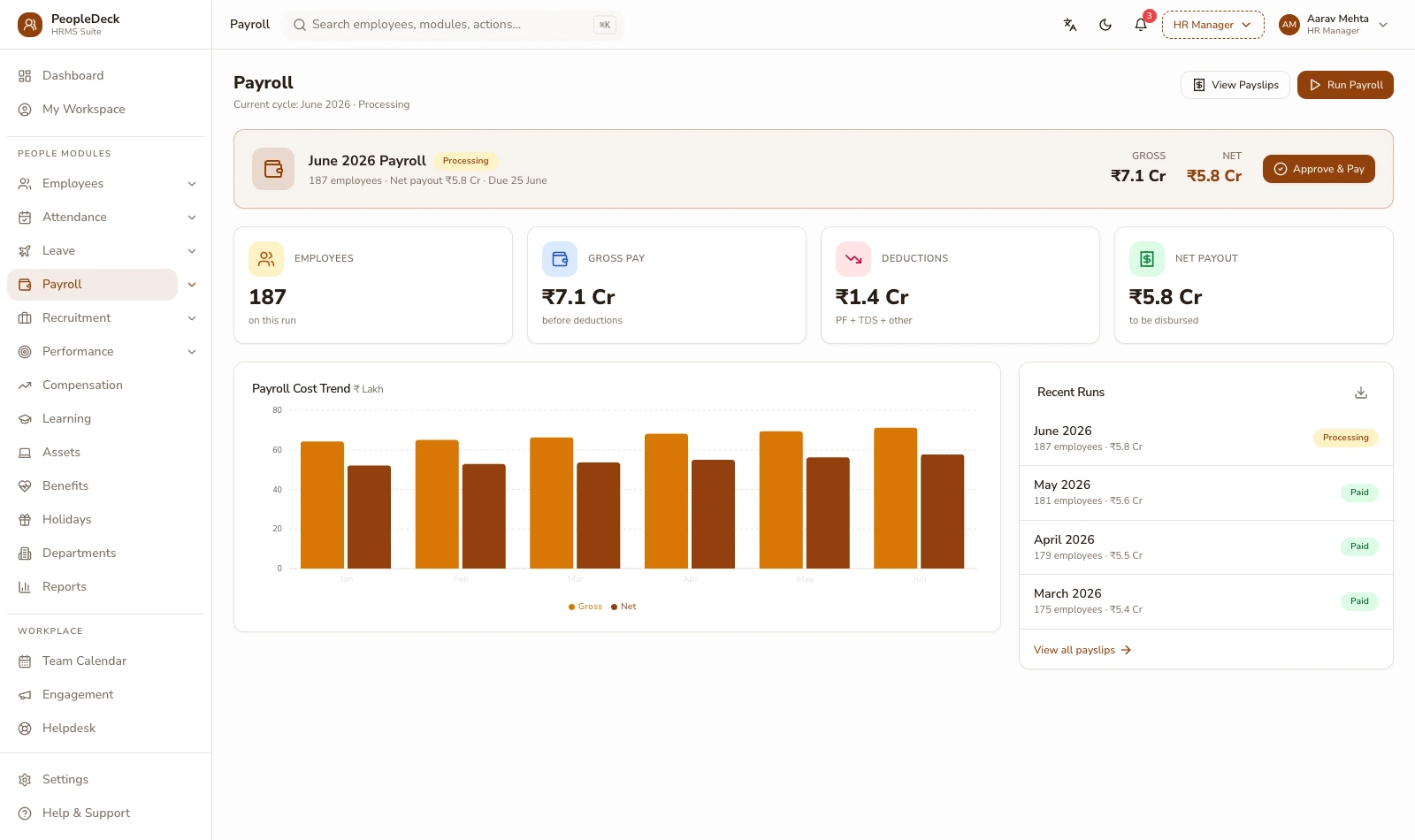
Pocket HRMS is an established Indian HR platform with payroll, attendance and an emphasis on mobile experience and AI-flavoured tooling; verify its current module map on their pages. PeopleDeck's emphasis is the payroll-anchored core done deeply: statutory application with workings shown, attendance and leave engineered as payroll inputs, FnF computed on exit, and one per-employee rate covering all of it. Both serve the same size of business; the choice is which centre of gravity matches your pain.
How to run this evaluation
Take your three ugliest recent payroll moments: the disputed payslip, the late ECR, the exit that dragged, and replay them on both products. Mobile polish matters for adoption; month-end correctness matters for everything else. PeopleDeck's free start covers the replay on our side; ask Pocket HRMS to demonstrate the same cases live and verify inclusions on their current material.
The side-by-side, honestly
Concrete claims below are about PeopleDeck only. For the other column, we state category facts and what to verify. Products change, so check current details on their own pages before you decide.
| Dimension | PeopleDeck | Pocket HRMS; verify on their pages |
|---|---|---|
| Product shape | One platform for payroll, attendance, leave, onboarding to FnF, records and self-service, bought self-serve by any business | Indian SME HR platform with payroll and mobile emphasis; verify current module map |
| Payroll & statutory | PF, ESI, PT and TDS applied on every payslip; upload-ready ECR and return files generated. Filing stays with you | Payroll offered; verify statutory depth, file formats and workings visibility |
| Pricing model | Per employee, per month, in ₹. Whole platform included, rate shown transparently at sign-up, start free | Check their current published plans, no claim made here |
| Attendance & leave | Rosters, rotating shifts, biometric, web and mobile punches; attendance feeds payroll directly | Attendance with mobile capture; verify shift and policy depth for your patterns |
| Onboarding to exit | Joining checklists to a computed full-and-final statement with every line's working shown | Lifecycle features offered; verify FnF computation against your cases |
| Self-service | Payslips, balances, declarations, claims and Form 16 data in every employee's hands | Mobile-first ESS is their emphasis; verify payslip-level detail |
| Getting started | Self-serve sign-up; import employees, run a parallel month, go live when it reconciles | Verify onboarding path and timeline with their team |
What switchers say they were actually looking for
-
1
Depth where the risk is
Payroll is where HR software's errors cost money and standing. A product whose statutory engine is the spine (not one module among many) concentrates its depth where your risk concentrates.
-
2
Explainable payslips
Workings printed on every payslip end the payday-question queue and shorten every dispute. Whichever product you pick, make explainability a test case, not an assumption.
-
3
One rate, no matrix
Per-employee pricing with everything included turns procurement into arithmetic. Comparing against any tiered model, map your needed features to tiers before comparing numbers.
PeopleDeck in depth: the payroll engine · statutory compliance · per-employee pricing
Migrating without a bad payday
Standard SME migration: export masters and balances, import via validated sheets, encode policies, carry year-to-date statutory figures. Plan an afternoon for data and one cycle for the parallel run.
Reconcile the parallel month payslip by payslip, including one exit and one arrears case if you have them, and go live on a month boundary. Keep the old system's exports archived for audit continuity.
The boundary that decides it
PeopleDeck is a standalone HRMS any business signs up for, priced per employee, per month, with PF, ESI, professional tax and TDS applied to every payslip and upload-ready return files generated, never filed behind your back. If you are an education institution comparing ERP-bundled payroll instead, that is a different product shape: see SchoolDeck staff payroll for schools or CampusAlly payroll for colleges, licensed per institution.
Frequently asked questions
What genuinely differs between SME HRMS products?
Less than the brochures suggest at feature-list level; a lot at the level of depth, explainability and model. That is why this page pushes you to replay your hardest cases rather than count checkmarks.
Is mobile self-service weaker on PeopleDeck?
Employees get payslips, balances, declarations, claims and Form 16 data on their phones: the workforce-facing core. Judge both apps by what your employees will actually do monthly, not by feature count.
How does pricing comparison work against tiers?
Map the features your month needs to their current tiers, price that tier at your headcount, and set it against one per-employee rate with everything included. The exercise takes ten minutes and usually settles the commercial question.
Can you import our existing HR data?
Yes — validated structured imports for masters, structures and balances, with rejects surfaced before anything computes. Export rights on our side are absolute, in both directions of the decision.
What should we verify on their side?
Current module inclusions per plan, statutory file coverage, payslip workings visibility, and implementation expectations, from their current pages and team.
Judge it on your worst month, not the demo.
Run a parallel month on your own data — the reconciliation decides, not the brochure.
Start free