


Considering a sumHR alternative?
sumHR serves small and mid-size Indian teams with cloud HR and payroll. PeopleDeck plays in the same bracket. This page gives you the honest side-by-side and the switch path.
Same bracket, different spine
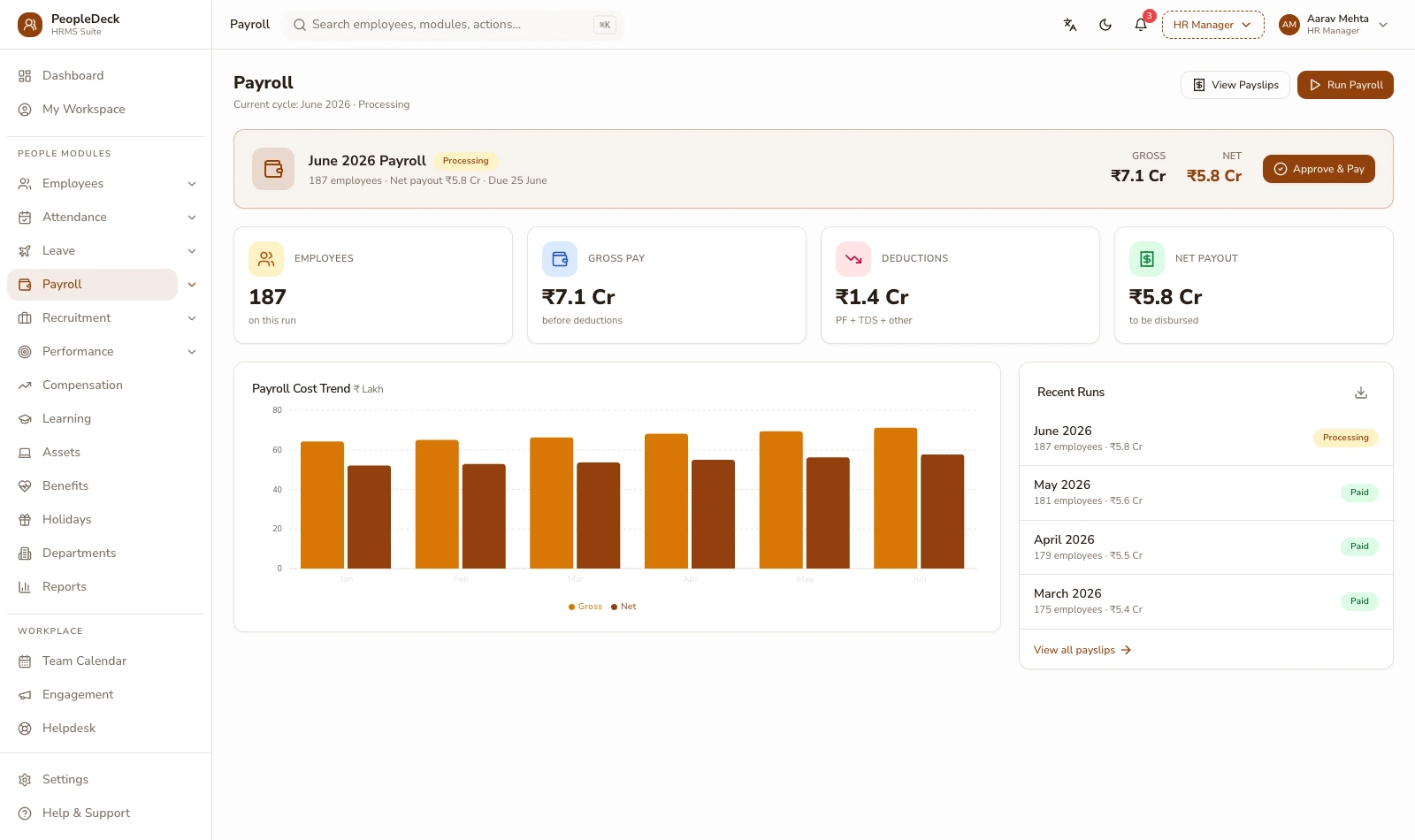
sumHR is a cloud HR platform for Indian SMEs — HR records, attendance, leave and payroll in a modern package; verify its current scope and plans on their pages. PeopleDeck's distinction in the same bracket is where the depth sits: the statutory payroll engine is the spine: applied rates with workings printed, contribution-period ESI, state-wise PT, computed FnF, with attendance, leave and onboarding engineered as its inputs, and one per-employee rate covering the lot.
How to run this evaluation
SME products in the same bracket look alike in demos; they separate on real months. Take your last quarter's three hardest payroll events and replay them on both products (free on our side, live-demonstrated on theirs) and compare payslips, workings and generated statutory files, not feature grids. The product that explains its arithmetic is the one that survives your first dispute.
One more test worth running
Ask each vendor to show you a mistake being corrected: a wrong attendance day discovered after approval, a payslip that needs a documented adjustment. Products reveal their character in the correction path — whether history stays intact, whether the fix carries an owner and a reason, and whether the employee's next payslip explains what changed. A clean correction path is what audit-readiness feels like day to day, and it is rarely on any feature grid.
The side-by-side, honestly
Concrete claims below are about PeopleDeck only. For the other column, we state category facts and what to verify. Products change, so check current details on their own pages before you decide.
| Dimension | PeopleDeck | sumHR; verify on their pages |
|---|---|---|
| Product shape | One platform for payroll, attendance, leave, onboarding to FnF, records and self-service, bought self-serve by any business | Cloud HR and payroll for Indian SMEs; verify current scope and plan boundaries |
| Payroll & statutory | PF, ESI, PT and TDS applied on every payslip; upload-ready ECR and return files generated. Filing stays with you | Payroll offered; verify statutory depth, workings visibility and file generation |
| Pricing model | Per employee, per month, in ₹. Whole platform included, rate shown transparently at sign-up, start free | Check their current published plans, no claim made here |
| Attendance & leave | Rosters, rotating shifts, biometric, web and mobile punches; attendance feeds payroll directly | Attendance and leave tooling; verify shift depth for your patterns |
| Onboarding to exit | Joining checklists to a computed full-and-final statement with every line's working shown | Lifecycle features offered; verify FnF computation depth |
| Self-service | Payslips, balances, declarations, claims and Form 16 data in every employee's hands | ESS offered; verify payslip detail and declaration flows |
| Getting started | Self-serve sign-up; import employees, run a parallel month, go live when it reconciles | Self-serve or guided; verify timeline for your setup |
What switchers say they were actually looking for
-
1
Statute as spine, not module
When the payroll engine is the organising principle, edge cases get engineering attention, and edge cases are where SME payroll actually hurts.
-
2
Payslips that answer questions
The working printed on every payslip is the cheapest HR automation there is: the payday question queue answers itself.
-
3
Pricing without a decoder
Per employee, everything included. Ten minutes with both vendors' pricing pages at your headcount settles the commercial half of this decision.
PeopleDeck in depth: the payroll engine · statutory compliance · per-employee pricing
Migrating without a bad payday
Cloud-to-cloud migration in this bracket is quick: export masters, structures and balances, import via validated sheets, encode policies, carry year-to-date figures as opening records.
One parallel month, payslip-level reconciliation, month-boundary go-live. Keep both trials honest by feeding them identical inputs: the reconciliation is the entire argument.
The boundary that decides it
PeopleDeck is a standalone HRMS any business signs up for, priced per employee, per month, with PF, ESI, professional tax and TDS applied to every payslip and upload-ready return files generated, never filed behind your back. If you are an education institution comparing ERP-bundled payroll instead, that is a different product shape: see SchoolDeck staff payroll for schools or CampusAlly payroll for colleges, licensed per institution.
Frequently asked questions
How is PeopleDeck genuinely different from sumHR?
On the axis that matters at month-end: statutory depth and explainability as the product's spine, and a per-employee model with nothing gated. On breadth-of-HR-tooling, evaluate both against what you will actually operate.
Is switching between SME cloud products risky?
It is the lowest-risk migration class there is — clean exports, validated imports, one parallel cycle. The bigger risk is staying on a product your month has outgrown.
What about our attendance devices?
Biometric, web and mobile capture are native; device data reaches the run directly. Verify your specific hardware against both products' current support.
Do both products handle multi-state teams?
Test it — state-wise PT (including half-yearly TN, Kerala's local bodies, and the no-levy states) is exactly the sort of depth that separates same-bracket products. PeopleDeck maps treatment per recorded work state.
What should we verify on sumHR's side?
Current plan boundaries, statutory file coverage, payslip workings and device support, from their current pages, since SME products iterate quickly.
Same bracket. Deeper spine.
Run a parallel month on your own data — the reconciliation decides, not the brochure.
Start free